
Behind-the-Scenes at the Oppenheimer Fireside Chat
To mark the release of the Oppenheimer interviews in early April, AIP hosted a fireside chat with Kai Bird and Oppenheimer’s grandchildren, Dorothy Oppenheimer Vanderford and Charles Oppenheimer. MIT professor of science history and physics David Kaiser moderated. A recording of the panel discussion is available on AIP’s YouTube channel. Ahead of this exciting conversation, event guests enjoyed a reception that included a specially curated exhibit of materials relating to Oppenheimer’s life and legacy from the Niels Bohr Library & Archives.

AIP CEO, Michael Moloney, welcomes audience to the Fireside Chat event.

Special NBLA display of Oppenheimer materials.

NBLA archivist, Allison Buser, discusses displayed materials with event guests.

David Kaiser, Charles Oppenheimer, Kai Bird, and Dorothy Oppenheimer Vanderford (from left to right) listening to an audio excerpt from the Oppenheimer interviews.

David Kaiser leads dynamic panel conversation with Charles Oppenheimer, Kai Bird, and Dorothy Oppenheimer Vanderford (from left to right).

At the event reception: (left to right) University of Maryland Vice president and Chief Research Officer Patrick O’Shea, AIP Senior Director of Development Allison Corbett, NBLA Luce Foundation Intern Zoe Adams, Luce Foundation Board Co-Chair Debra S. Knopman, and Georgetown University Professor Thomas McNaugher.

Chatting at the reception: (left to right) historian of science Melinda Baldwin, UMD’s Patrick O’Shea, and AIP Chief Research Officer Trevor Owens.
Objects on display came from a wide array of NBLA’s collections, including the general books collection, personal papers of individuals, AIP’s institutional records, the records of AIP Member Societies, and, of course, the Oral Histories collection. Oppenheimer’s presence across this spectrum of collections demonstrates his deep influence on mid-century scientific community and American society’s relationship with science more generally.
“Reflections on the Resonances of Physics History”

Page one of “Reflections on the Resonances of History.”
Miscellaneous Physics Collection. MP 2013-1163. AIP Niels Bohr Library & Archives.
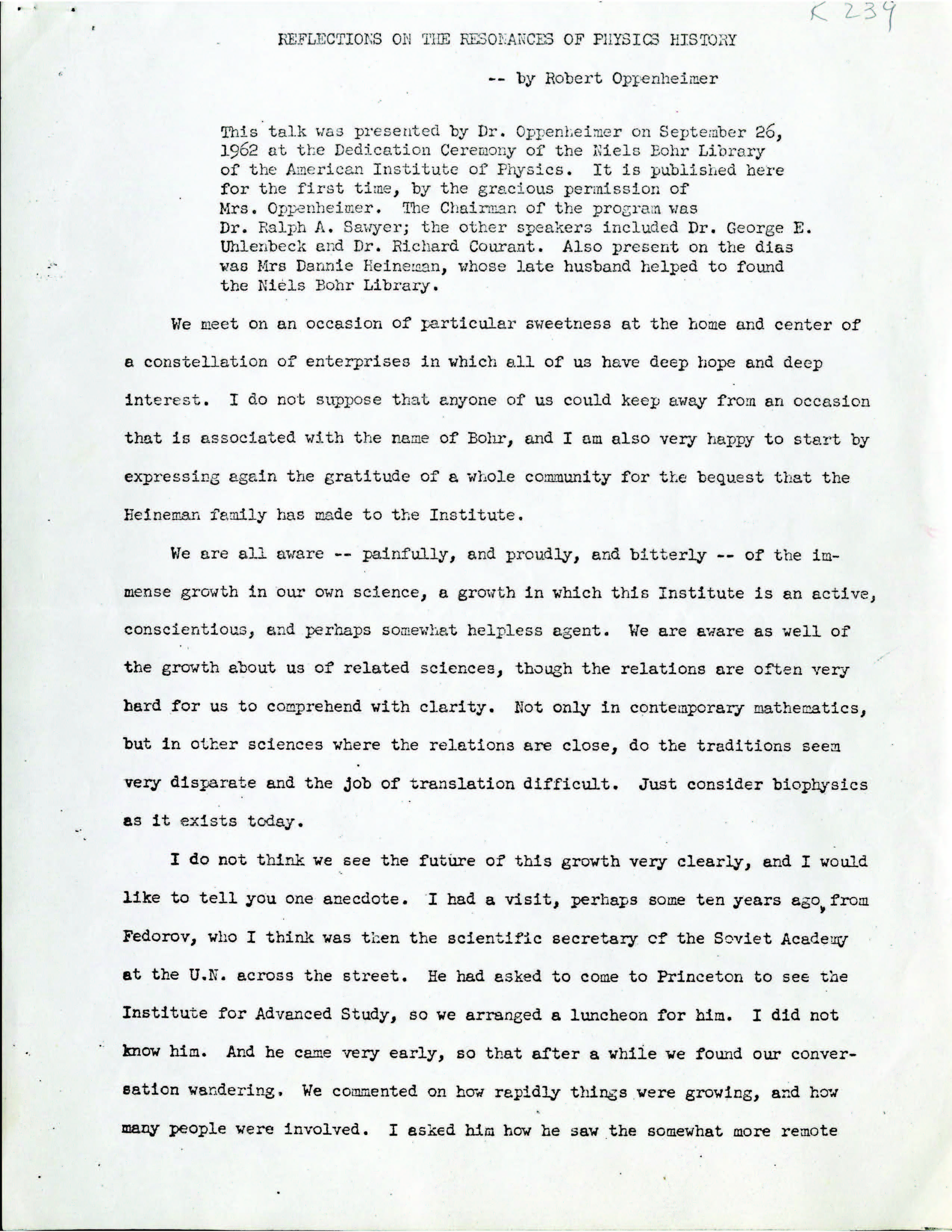
Transcript of a talk presented by Robert Oppenheimer at the dedication of the Niels Bohr Library at the American Institute of Physics on September 26, 1962. Oppenheimer reflects on the emergence of the history of science as a specialized subfield in historiographical practice and the importance that organizing knowledge of that history to supporting scientific enterprise more broadly. Listen to the dedication audio on our repository.
Miscellaneous Physics Collection. MP 2013-1163. AIP Niels Bohr Library & Archives.
American Prometheus: The Triumph and Tragedy of J. Robert Oppenheimer by Kai Bird & Martin J. Sherwin

Author Kai Bird signed NBLA’s copy of “American Prometheus” during the Fireside Chat. The inscription reads: “For appreciation of all the good work performed by the folks at AIP!”
Elizabeth Wood/AIP
This Pulitzer Prize winning biography relied on the 1963 interview as a source of information on Oppenheimer’s early life, education, and participation in the exciting development of quantum physics in Europe. It later served as a basis for the 2023 blockbuster film Oppenheimer.
1st edition. Gift of author, 2005. General Collection. L8 OPP BIR. AIP Niels Bohr Library & Archives.
Interview Transcript: Frank Oppenheimer, 1973

Portrait of Frank Oppenheimer, undated.
AIP Emilio Segrè Visual Archives, Physics Today Collection. Catalog ID: Oppenheimer Frank A1.
Transcript of recorded interview conducted by Charles Weiner in two sessions on February 9 and May 21, 1973. The oral history was conducted as part of AIP’s History program. In response to the interviewer, Frank Oppenheimer describes notable experiences from his own personal life, his political and scientific work, and his efforts to promote science education. He discusses the influences of his parents, his brother (J. Robert Oppenheimer), and physics teacher as well as his impressions, contacts with scientists, and experiences at various academic institutions where he worked.
Interview of Frank Oppenheimer by Thomas S. Kuhn, November 18 & 20 1963. AIP Niels Bohr Library & Archives.
First Cover of Physics Today: Oppenheimer as a Symbol of the Scientific Times

The first cover of Physics Today featured Oppenheimer’s signature porkpie hat, 1948.
Lawrence Berkeley National Laboratory, courtesy of AIP Emilio Segrè Visual Archives, Physics Today Collection. Catalog ID: Oppenheimer J Robert H6.
According to Ryan Dahn and Andrew Grant in their 2023 Physics Today article celebrating PT‘s 50th anniversary, “Henry Barton, the director of the American Institute of Physics from 1931 to 1957, stated that it depicted the tension between civilian life and atomic work that characterized postwar US physics. Whatever the intended message, the image of ‘Oppenheimer’s famous porkpie hat placed jauntily amid cyclotron piping,’ as historian of science David Kaiser put it, certainly made an impression in May 1948 when it appeared on the cover of a new magazine called Physics Today. Oppenheimer’s name comes up twice in that issue, the first of many mentions over the next 75 years. According to Barton, Oppenheimer approved the cover” (Dahn & Grant, Physics Today, “Oppenheimer in the PT archives” 2023).
AIP Physics Today Division Collection on the 50th Anniversary of Physics Today, 1998. IH 2007-783. AIP Niels Bohr Library & Archives.
Press Release Announcing First PT Issue & Cover Image

First page of the press release announcing the publication of Physics Today, with Oppenheimer’s famous porkpie hat as the cover image.
AIP Physics Today Division records, 1948-1971. AR 206. AIP Niels Bohr Library & Archives.
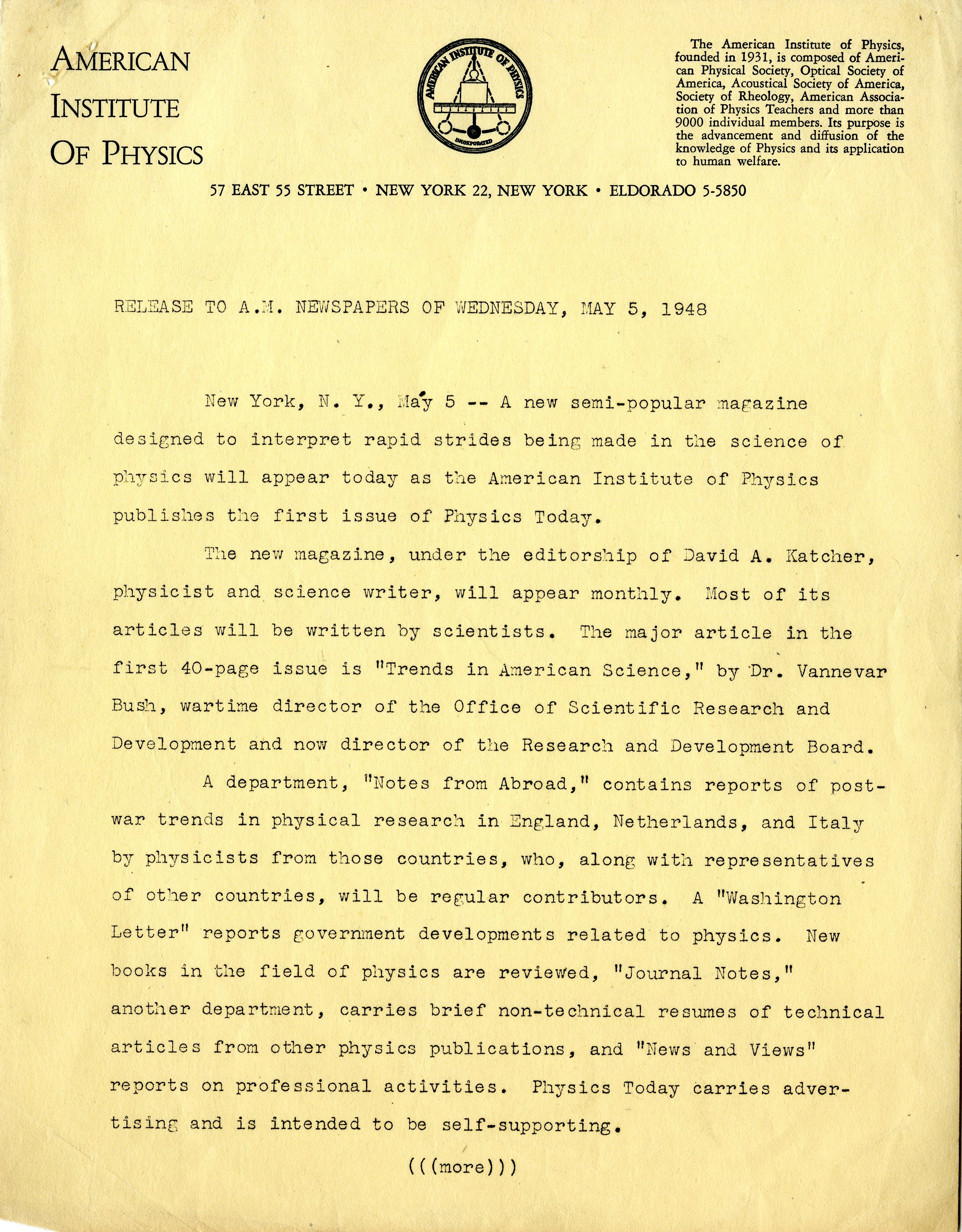
AIP Physics Today Division records, 1948-1971. AR 206. AIP Niels Bohr Library & Archives.
PT Press Release (.pdf, 2 mb)“Physics Tonight”

J. Robert Oppenheimer speaks at an American Physical Society (APS) press conference, January 27, 1966.
Photograph by Mitchell Valentine, courtesy of AIP Emilio Segrè Visual Archives
An address presented before the American Institute of Physics as part of the AIP’s 25th Anniversary Session on the general topic “Anticipations,” held February 2, 1956, in New York City. In this address, Oppenheimer “urged physicists to try to communicate more of the ‘substance’ of their work to the ‘man of art or letters or affairs.’ On a more poignant note, it also lamented the ‘sorrows’ and ‘evils’ of the US national security system, which Oppenheimer himself had suffered under” (Dahn & Grant, Physics Today, “Oppenheimer in the PT archives” 2023).
Listen to the “Physics Tonight” audio on our repository.
Oppenheimer Security Clearance Hearing, 1954
While serving as Chairman of the General Advisory Committee on the postwar Atomic Energy Commission, Oppenheimer’s emphatic opposition to continued development of atomic weapons and desire for international mediation of atomic research put him in conflict with many government and military figures. Amid deepening Cold War politics, Oppenheimer’s loyalty to the United States was challenged, with AEC adversaries pointing to his prewar associations with Communist organizations. In 1954, a board was assembled to determine whether to strip Oppenheimer of his security clearance or allow him to continue as a prominent scientific voice in public policy.
Aware of the implications the outcome held in determining the future relationship between scientists and the government, American scientists and scientific organizations closely monitored the AEC hearing. The AEC’s ultimate decision, issued on May 27, 1954, to revoke Oppenheimer’s clearance brought widespread outcry from the scientific community, who understood government as diminishing the value and influence of scientific expertise in public policy, and placing application of scientific research firmly in the hands of non-expert, government actors.
Draft Statements from APS for Either Outcome from the AEC

Statements drafted by APS to address either outcome of the Oppenheimer security clearance trial.
J. H. Van Vleck Papers, 1853-1981. AR 351. AIP Niels Bohr Library & Archives.
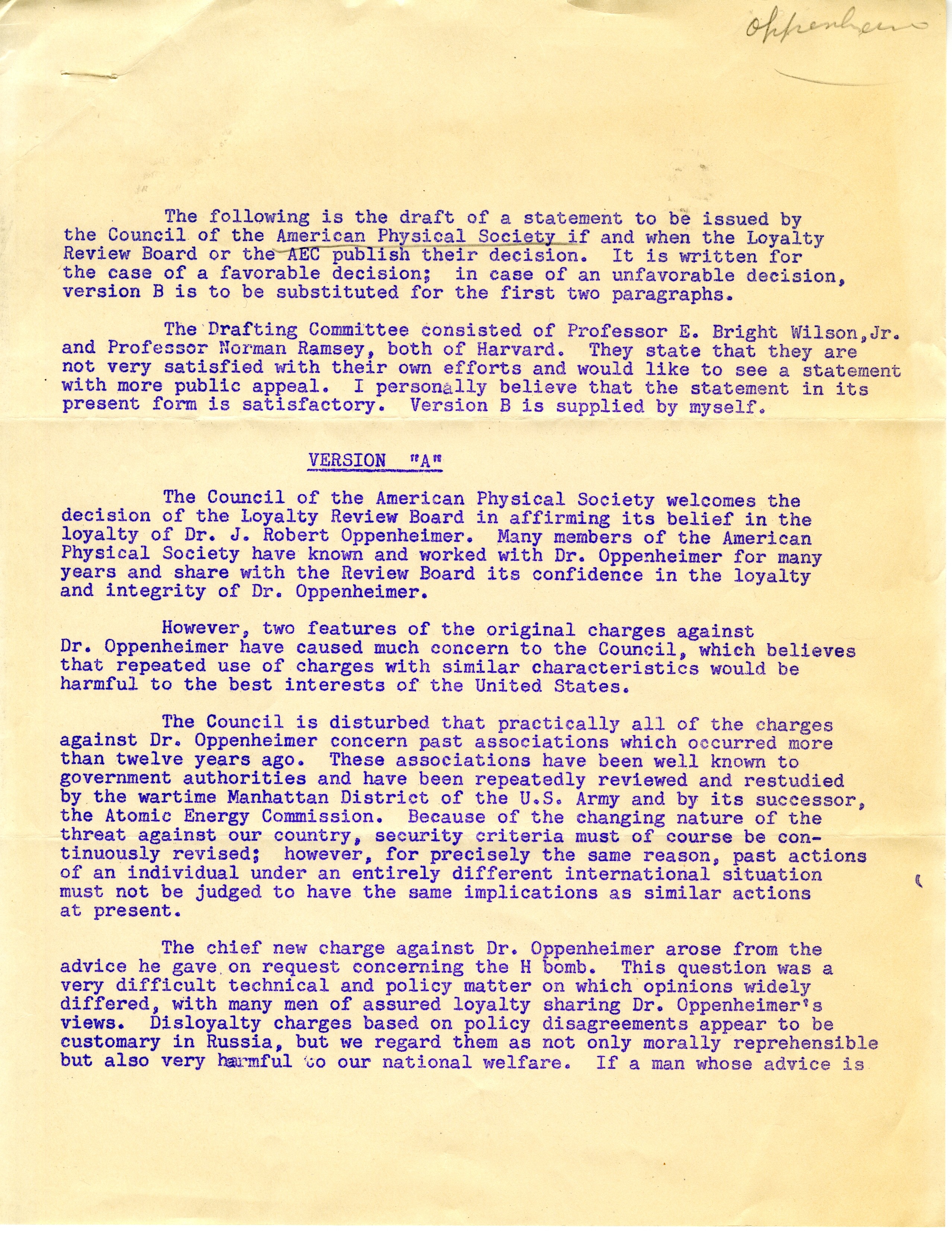
In preparation for the board’s decision, the Council of the American Physical Society prepared two statements: Version A for the dismissal of the charges and Version B if Oppenheimer’s clearance was revoked.
J. H. Van Vleck Papers, 1853-1981. AR 351. AIP Niels Bohr Library & Archives.
APS Draft Statements (.pdf, 1 mb)Deliberating on Publishing a Statement in Physics Today

Letter from Physics Today editor Robert R. Davis deliberating PT’s coverage of the Oppenheimer security clearance proceedings.
AIP Physics Today Division Records, 1948-1971. AR 206. AIP Niels Bohr Library & Archives.
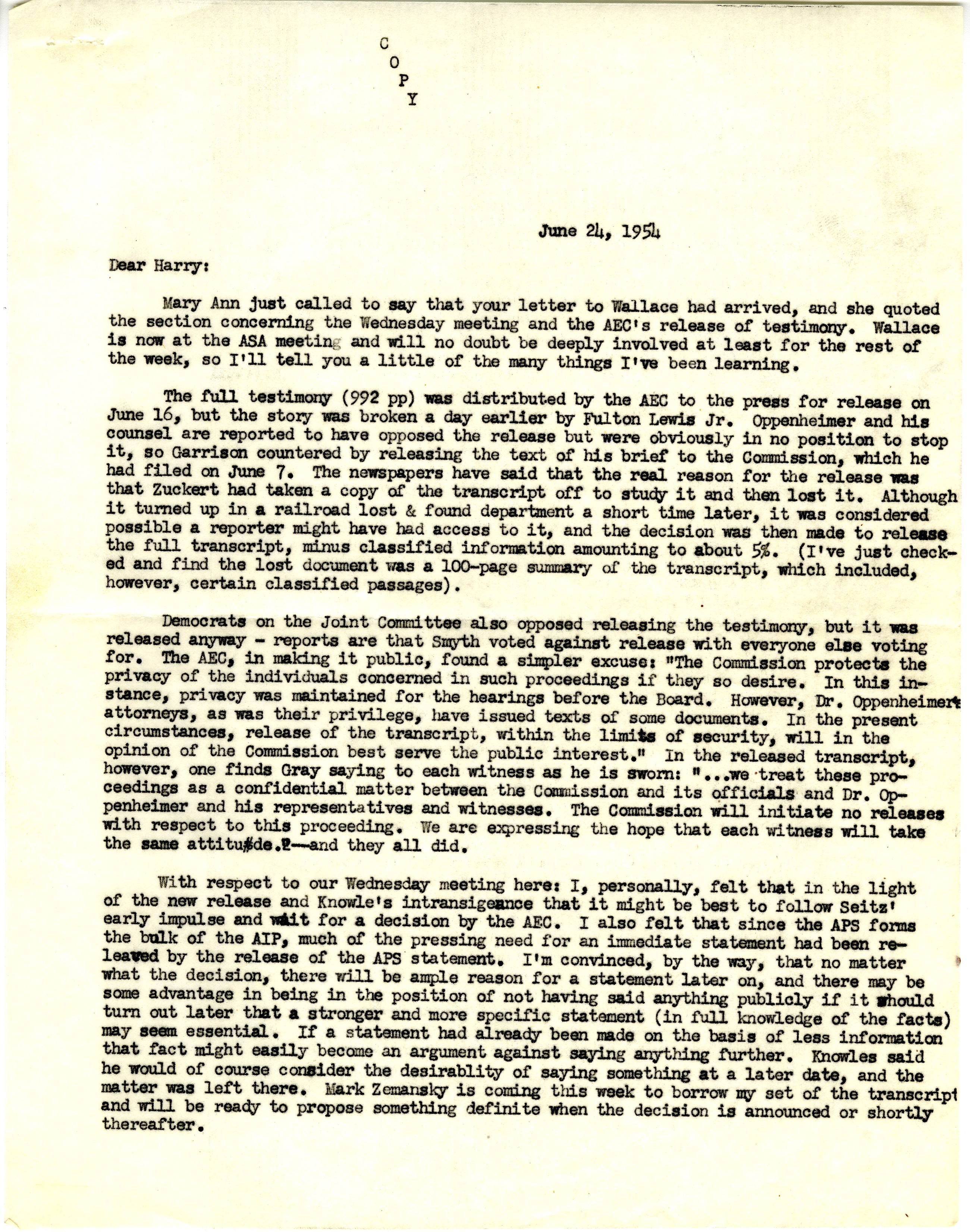
In this letter written on June 24, 1954, Physics Today editor Robert R. Davis carefully considered the magazine’s approach to publishing an official stance on the AEC’s decision. While unofficially aligning with APS’s statement released in the immediate aftermath, Davis acknowledges that AIP must be highly circumspect in its language as not to alienate potential government allies that might help mitigate the damage caused to science’s role in public policy.
Learn more about PT’s coverage of the hearing in Dahn & Grant, Physics Today, “Oppenheimer in the PT archives” 2023.
Physics Today Division records, 1948-1971. AR 206. AIP Niels Bohr Library & Archives.
PT Deliberations (.pdf, 1 mb)Notes from Berkeley: Oppenheimer Lecture Notes

Cover of the notebook used by a student in J. Robert Oppenheimer’s quantum mechanics course.
Elizabeth Wood/AIP

The notes are written in a prose, narrative form, with equations and drawings woven in.
Elizabeth Wood/AIP

The notes are written in a prose, narrative form, with equations and drawings woven in.
Elizabeth Wood/AIP
Student notes on Oppenheimer’s quantum mechanics course taught during his prewar professorship at the University of California, Berkeley (likely the notes of Shuichi Kusaka).
Edward Gerjuoy Collection of Lecture Notes, 1939-2005. AR 2018-2585. AIP Niels Bohr Library & Archives.
Notes from Göttingen: Max Born Lecture Notes

First page of Born’s lecture notes from his atomic mechanics course on given at Göttingen during the 1927/28 academic year.
Elizabeth Wood/AIP
Notes by Max Born,1926/27. Born became Oppenheimer’s doctoral advisor when the latter matriculated in 1926 at the University of Göttingen, a center of development in early quantum physics. Oppenheimer obtained his Doctor of Philosophy the following year and alongside Born, published the Born–Oppenheimer (BO) approximation.
Max Born Lecture Notebooks Collection, 1905-1937. AR 1999-6. AIP Niels Bohr Library & Archives.
Telegram From Oppenheimer Inviting Van Vleck to Manhattan Project

Telegram from J. Robert Oppenheimer to J. H. Van Vleck inviting him to join the Manhattan Project.
J. H. Van Vleck Papers, 1853-1981. AR 351. AIP Niels Bohr Library & Archives.
Spurred by “urgent development” Oppenheimer telegraphed this invitation to join the Manhattan Project to John Hasbrouck Van Vleck, now considered the “Father of Modern Magnetism,” whose work in establishing the quantum mechanical theory of magnetism would later co-earn a Nobel Prize. Van Vleck accepted Oppenheimer’s invitation to join a group of theoretical and experimental scientists in the summer of 1942 convened to study the theoretical feasibility of a fission bomb and develop the principles which would establish its design.
J. H. Van Vleck Papers, 1853-1981. AR 351. AIP Niels Bohr Library & Archives.