
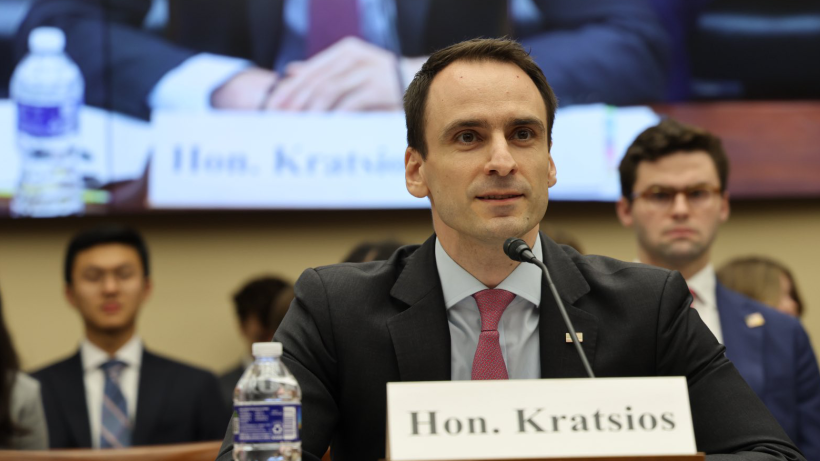
OSTP Director Michael Kratsios testifies at a House Science Committee hearing on July 22.
House Science Committee
White House science vision puts individuals before institutions
The US research enterprise has become too centered on established research institutions rather than individual researchers, according to a report issued by the White House Office of Science and Technology Policy last week.
The report, titled Science: A Golden Age, authored by OSTP Director Michael Kratsios, seeks to update Vannevar Bush’s landmark 1945 report Science: The Endless Frontier for the modern era. Kratsios’ report argues that today’s scientific landscape is shaped by AI, global competition, and large private-sector investment and therefore requires a fundamental redesign of how the federal government funds research.
Key recommendations in the report include prioritizing individual scientists over “a narrow set of legacy institutions,” with greater support for startups, independent research organizations, nonprofits, industry, and the National Science Foundation’s recently launched X-Labs. It also highlights NSF’s Graduate Research Fellowship Program as a success story that should be expanded, though that program has not been unaffected by the tumult affecting NSF grants and programs over the past year. The report argues that traditional peer review tends to disadvantage bold ideas from individual researchers and recommends more experimental approaches to funding research, including “golden tickets” that would let technical reviewers at individual agencies recommend “unconventional proposals that may not pass consensus-driven review panels” — a model that is being piloted at NSF’s Technology, Innovation and Partnerships Directorate. The report also issues a new call to “rein in indirect cost recovery that supports administrative bloat, redirecting that money to real scientific infrastructure.”
Alongside the report, Kratsios and White House Office of Management and Budget Director Russ Vought jointly published a memorandum on the Trump administration’s R&D budget priorities for fiscal year 2028. The memo instructs science agencies to incorporate the administration’s priorities into their forthcoming budget requests, and develop implementation plans within 90 days for a series of “R&D priority practices.” These priorities include: developing new research funding mechanisms, identifying and supporting top tech talent through early career and STEM-learning opportunities, boosting the “science of science-funding” to evaluate which programs have the greatest impact, and collaborating with industry to drive greater private investment in R&D.
Genesis Mission expands, announces first research awards
The White House and the Department of Energy announced last week the first research awards for the Genesis Mission and an expansion of the initiative to span 20 federal agencies. During the Genesis Mission Summit last Wednesday, DOE Under Secretary for Science Darío Gil announced several sources of funding for the mission, including over $250 million from DOE’s budget for the research awards and over $800 million in contributions from participants of the Genesis Mission Consortium, a hub for public-private collaboration. These might include in-kind contributions: for instance, Google announced it would commit $40 million in AI tokens and cloud credits in support of Genesis.
Science heads at the National Institutes of Health, the National Science Foundation, the Department of Defense, and NASA discussed the applications of the Genesis Mission at their agencies. DOD announced that it is “on track” to commit over $200 million in fiscal year 2026 funds and over $1.3 billion in fiscal year 2027 funds to the initiative, while NASA Administrator Jared Isaacman said he estimates NASA will contribute over $100 million over the next few years.
The 278 projects include 342 participating institutions, including 16 of DOE’s 17 national labs, 142 universities, 157 companies, and 13 nonprofit organizations. The largest award, focused on AI and nuclear energy, will provide $60 million over three years, which is about one-fifth of the total funding announced for the 278 projects. Gil said more awards will be announced in the fall, possibly in early- to mid-September. He also announced that the Genesis Mission Consortium is now open to universities.
Budget deadlines loom as Congress leaves town
Congress is running out of time to pass spending legislation without triggering a government shutdown or resorting to stopgap measures. The fiscal year ends Sept. 30, and both the House and Senate will have long recesses between then and now. The House left last week and will not return until Aug. 31, while the Senate leaves on Aug. 7 and will not return until Sept. 14.
Although little public progress has been made on next year’s spending bills over the past few weeks, several science-related bills advanced in Congress last week. The Senate Commerce Committee unanimously passed the Hurricane Hunter Aircraft Recapitalization Act, which recommends $2.5 billion over four years to fund NOAA’s Hurricane Hunters program and would support up to nine new survey aircraft.
The House passed the National Defense Authorization Act of 2027 on a party-line vote of 216-212. The bill includes an amendment that would prevent certain foreign nationals from entering non-public areas of any Department of Energy national lab. The NDAA still needs to move through the Senate, where further changes may occur.
Also last week, the House Science, Space, and Technology Committee advanced a batch of bills with bipartisan support, including:
- The Geo POWER Act would create a milestone-based demonstration program for new geothermal energy projects.
- The SCALE Biology Act would establish a biometrology program at NIST.
- The USA Act encourages NIST to develop international AI and other emerging technology standards with private sector involvement.
- The National Earthquake Hazards Reduction Program Reauthorization Act aims to improve research relating to earthquakes along with warning systems and hazard mapping.
Also on our radar
- District Judge Richard Mark Gergel ruled last month that DOGE cuts to EPA grants were illegal, and last week ordered the agency to administer them through Sept. 30, 2026.
- Chris Fall, director of the Center for AI Standards and Innovation, resigned only three months after being appointed. NIST Director Arvind Raman will serve as acting director until a replacement is appointed.
- The US and Saudi Arabia signed a civil nuclear cooperation agreement last week, but the fate of the deal was almost immediately thrown into question by President Trump’s post-signing demand that Saudi Arabia join the Abraham Accords and his declaration that the deal does not allow the enriching of uranium.
- Reps. Marcy Kaptur (D-OH) and Zoe Lofgren (D-CA) sent a letter to Energy Secretary Chris Wright questioning why the former head of DOE’s Office of Clean Energy Demonstrations remained on paid administrative leave nine months after she was removed from her position.
- The Office of Naval Research released its Science & Technology Strategy for 2026 last week. This is the first such report released since Rachel Riley, a former business consultant who worked with DOGE, became chief of naval research, a position traditionally held by an active duty admiral.
- The Department of Commerce announced a new certification program last week that aims to authorize commercial space activities that are not clearly covered by existing agencies and regulations.
- DOD added two Chinese universities to its Section 1286 list, an index of foreign research universities and institutions that the Pentagon says pose a threat to US research and security.


All events are Eastern Time unless otherwise noted. Listings do not imply endorsement. Events beyond this week are listed on our website.
Monday, July 27
National Academies: Securing the digital world: Innovation by the numbers
1:00 - 2:00 pm
Tuesday, July 28
ASBTDC: Innovation to impact: How SBIR/STTR funding can transform your research
12:00 - 1:30 pm CT
ANS: What does the science say? A discussion on radiation studies and living near nuclear plants
4:00 - 5:00 pm
Wednesday, July 29
Senate: Hearing to examine the testimony of Anthony Fauci
8:30 am, Homeland Security and Governmental Affairs Committee
NASA: Media briefing on Nancy Grace Roman Space Telescope
2:00 pm
Thursday, July 30
Senate: Hearings to examine intelligent networks, focusing on powering artificial intelligence and transforming communications
10:00 am, Commerce, Science, and Transportation Committee
Friday, July 31
No events.
Monday, August 3
No events.
Deadlines indicated in parentheses. Newly added opportunities are marked with a diamond.
AIP Science Policy Fellowships
AIP is opening applications for year-long science policy fellowships to support Congress and the State Department. Fellows will provide scientific guidance to directly shape legislative and policymaking processes. Congressional fellows will serve as staff in congressional offices or committees, while State Department fellows will focus on foreign policy issues. Fellowships are open to members of AIP Member Societies. Applications open Aug. 1.
Job Openings
◆APS: Head of scientific programs
(ongoing)
◆UCS: Science policy advisor, Climate and Energy
(ongoing)
AIP: Director of social science research
(ongoing)
FIA: Fall intern
(ongoing)
ACS: Congressional fellowship
(ongoing)
NOAA: Director, Acquisition and Grants Office
(July 27)
◆DOE: Grants management specialist
(July 27)
NOAA: Deputy chief financial officer
(July 28)
DOE: Chief operating officer, Office of Nuclear Energy
(July 29)
NASA: Director, Planetary Science Division
(July 30)
◆NIST: Operations and financial manager
(Aug. 3)
◆AAAS: Senior editor
(Aug. 10)
◆AIP: Science policy fellowship, State Department
(Oct. 1)
◆AIP: Science policy fellowship, Congress
(Dec. 1)
Solicitations
Physics Today: Reader information survey
(ongoing)
◆NIST: Request for letters of interest for the Neutron-Based Materials Characterization Consortium
(ongoing)
NIST: Request for nominations for members to serve on NIST federal advisory committees
(ongoing)
NASA: RFI on astronaut candidate selection qualifications
(July 30)
NIST: Request for letters of interest to join the NIST AI Consortium
(July 31)
OPM: RFC on employee accountability proposed rule
(Aug. 3)
NIH: RFI on capping the number of simultaneous research project grants per principal investigator
(Aug. 3)
NSF: RFC on Do Not Pay matching program for identifying and preventing improper payments
(Aug. 12)
FAR Council: RFI on “Revolutionary Federal Acquisition Regulation Overhaul Parts 1, 2, 4, 33, 40, and 53”
(Aug. 24)
NSF: RFC on NSF Guidance on Financial Assistance
(Aug. 24)
National Academies: RFI on Earth Science and Applications from Space 2028-2037 decadal survey
(Aug. 24)
Know of an opportunity for scientists to engage in science policy? Email us at fyi@aip.org.
Do you have a story to tell about how science policy is impacting you?
AIP’s research team is gathering first-hand accounts from scientists, engineers, students, and staff whose careers have been affected by policy and funding changes over the past year. Volunteers can submit their stories via this online form. Participants’ stories will be added to the Niels Bohr Library & Archives digital repository as searchable, citable records — with options for anonymity and a five-year embargo period. Read more about the initiative here.
News and views currently in circulation. Links do not imply endorsement.
White House
Inside Higher Ed: Trump administration can’t cite changed priorities to terminate grants
Bulletin of the Atomic Scientists: American Nero: Why Trump is trying to burn down the National Academy of Sciences
(perspective by Benjamin Santer)
E&E News: Trump threatens National Academies with debarment. Here’s what it is
NPR: Trump cuts target federal advisory boards. What does it mean for agencies like NASA?
Power: AI is usually cast as a grid burden. The Genesis Mission is betting it’s a grid tool
HPCwire: Genesis Mission Summit 2026: Big ambitions and a familiar blind spot
Congress
Senate Appropriations Democrats: Energy secretary’s own lawyers flatly contradict his repeated denials that politics played any role in mass termination of projects
Politico: Obernolte-Trahan artificial intelligence bill introduced in House
Politico: House AI ‘kill switch’ bill unveiled as OpenAI hack raises alarms
Sen. Patty Murray (D-WA): Senator Murray outlines how Trump administration has undercut VA research, vows to reject budget cuts
Roll Call: Appropriators ponder alternatives to annual shutdown threats
E&E News: House lawmakers launch bipartisan weather caucus
Science, Society, and the Economy
ITIF: Robert Atkinson’s testimony to the Senate Commerce Committee on “Measuring what matters: Science, standards, and strategic competition”
Brookings: New awards signal the expansion of the place-based federal investment era
The Wire China: China’s new technology trap
(perspective by Anja Manuel)
Science: Dispatches from the front lines of science
(book review)
New York Times: ‘OnlyMarms’: Marmots are on OnlyFans to raise money for research
Education and Workforce
Chronicle of Higher Education: Why scientists hate Trump’s new plan to revamp research funding
Science: University science in the US needs a coherent plan
(perspective by Holden Thorp)
Chronicle of Higher Education: The long shadow of Columbia’s deal with Trump
Inside Higher Ed: AAUP denounces politician, donor ‘extortion’ of universities
Chronicle of Higher Education: CU Boulder’s $60-million pivot
Chronicle of Higher Education: The Education Dept. ends disparate-impact liability. Some say it’s hypocritical
AAU: Study shows early-career scientists in the US are rethinking their future in academia
The Atlantic: Where did all the computer-science professors go?
Research Management
Science: NIH is again terminating grants that the Trump administration dislikes
Scholarly Kitchen: Why research expectations have outpaced the systems that enabled them
(perspective by Lisa Colledge)
Science: A geologist learns AI
(perspective by Isaac Pope)
Nature: Could small-team science be dying out?
Nature: The science of foresight: How to future-proof your research
(perspective by Bertalan Meskó et al.)
Financial Times: Concerns rise as volume of research soars and quality drops
CERN Courier: arXiv’s one-strike rule on AI
Nature: How to use AI to make a graphical abstract in minutes
(perspective by Ananya Thakur)
Labs and Facilities
Washington Business Journal: NASA narrows headquarters search to DC after exploring regional options
Spaceflight Now: Critical NASA Deep Space ground station in Spain evacuated due to wildfires
The Guardian: Jodrell Bank Observatory facing closure after major funder cuts support
HPCwire: PNNL to lead 16 DOE Genesis Mission projects, join 26 more AI research efforts
American Nuclear Society: Nuclear is prominent in Genesis Mission projects
DOE: NNSA selects Amentum for AI data center and energy project at Savannah River site
Defense One: Spies are targeting US AI labs, experts warn Congress
The Information: Anthropic investor in talks to fund new lab run by two Stanford AI professors
Computing and Communications
The Conversation: Legally or not, the US government is controlling global access to the world’s most powerful AI
(perspective by João Marinotti)
The Conversation: What is open-source AI? A software engineering researcher explains
Bloomberg: China’s Moonshot to release breakthrough AI model for download
Politico: Inside the White House debate over what to do about Chinese AI
Wired: This is Donald Trump’s AI brain trust
Wired: Silicon Valley is completely divided over Chinese AI
Bloomberg: China vows response to US sanctions threat against AI firms
New York Times: The US is still winning the AI race. Trump could blow it
(editorial)
The Information: OpenAI president endorses Musk’s proposal for industry meetings on AI safety
Emerging Technology Observatory: Exploring state AI governance in AGORA #2: AI regulatory sandboxes
Space
Space Policy Online: Department of Commerce takes step towards mission authorization
Breaking Defense: FCC approves satellite spectrum license streamlining
MIT Technology Review: Shape-shifting mirrors on NASA’s new space telescope could unveil Jupiters like our own
Space Florida: Space Florida, UK government establish first partnership under new Florida international fund
The Guardian: 50 years after Viking landed on Mars, did Nasa overlook evidence of life?
GAO: NASA: Assessments of Major Projects
AAU: University-led NASA missions produce high impact, cost-effective science
NASA: New NASA Earth missions gear up to start science flights
Politico: NASA’s nuclear Mars mission to cost over $2 billion
Nature: Here’s what’s next for the Artemis II astronauts
Weather, Climate, and Environment
The Guardian: Space datacenters proposed by Musk and Bezos ‘catastrophic’ for planet, experts warn
The Conversation: The National Climate Assessment is broken – appointing Matthew Wielicki to lead it won’t help
(perspective by Joe Árvai)
E&E News: Trump ally floats Republican pitch for sun-blocking technologies
E&E News: Dismissed EPA science advisers reconvene under nonprofits
Energy
E&E News: House passes bipartisan geothermal research bill
Power: Quantum computing is emerging as a tool for tomorrow’s electrical grids
(perspective by Tom Shindelman)
Politico: Fusion is ready. Is Trump’s Washington?
Financial Times: The US needs a new Manhattan Project for fusion energy
(perspective by Carlos Paz-Soldan)
Fusion Industry Association: FIA outlines EU financing pathway for fusion
E&E News: Nonprofits go to court to recoup canceled solar grants
E&E News: Heinrich calls for probe of wind project reviews
Inside Climate News: To block renewable energy projects, Texas Republicans have weaponized conservation concerns
GAO: Managing critical isotopes: DOE could better assess market needs and respond to risks
Defense
Breaking Defense: House passes 2027 NDAA while measure remains stalled in the Senate
The Guardian: ‘Most people don’t know we’ve set up a doomsday system’: physicist Laura Grego on satellites, nuclear weapons and the battle for our skies
(interview)
CSET: Remarks at the Global Nobel Laureates Assembly on Artificial Intelligence and Nuclear War
(perspective by Emelia Probasco)
The Conversation: More testosterone won’t make a better soldier or a tougher man – aggression and strength drive T levels, not the other way around
(perspective by Adam Stanaland)
The Guardian: AI can fuel biological weapons. We must harness its power for defense
(perspective by Annie Jacobsen)
Biomedical
Stat: Federal health quality research grants worth $109 million ended early
CNN: Vote on CDC nominee clinched with change to CDC’s website on vaccines and autism
The Guardian: CDC cuts leave US less prepared for disease outbreaks, former officials warn
Nature: How does Make America Healthy Again hold up against scientific scrutiny?
New York Times: FDA panel supports lifting restrictions on four peptides, despite scientists’ objections
Undark Magazine: How tragedy changed the FDA
(interview with Mikkael Sekeres)
Stat: HHS to convene experts on standards for clinical AI
Stat: Hospitals’ AI may be drifting. Who’s watching?
(perspective by Peter Pronovost et al.)
MIT Technology Review: How AI helps scientists design the next generation of medicines
Financial Times: Investors bet on AI drug discovery despite approval gap
International Affairs
Science|Business: SNSF joins international coalition to rebuild Ukraine’s research ecosystem
Science|Business: EU universities build policy expertise to meet growing role in funding
Science|Business: Industry rejects move to cash contributions for EU Joint Undertakings
Financial Times: Axing UK science department risks slower policymaking, say tech leaders
Research Policy: When stars hold power: The impact of returnee deans on academic publications in Chinese universities
(report)
Science: Death of girl in Chinese gene-editing trial was never made public
Bloomberg: Israel’s AI czar seeks chip fab, new data centers to keep edge
University World News: Tripling of Australia visa charge could deter international students


