Margaret Burbidge in 1974.
AIP Emilio Segrè Visual Archives, Blustine Collection, Gift of Martin Blustine.
Note: The AIP History Weekly Edition is on a summer break and will resume publication of original content on September 4. A longer version of this article by AIP Society of Physics Students summer intern Amelie Heying was first published on August 4 on the AIP Niels Bohr Library & Archives Ex Libris Universum blog.
On a morning in January 1978, in Austin, Texas, American Astronomical Society President Margaret Burbidge took the stage at the society’s 151st meeting. Following her state-of-the-society address and before turning the proceedings over to the AAS Pierce Prize lecture, she reported on actions the society’s council had just taken. Among these was that the society would not hold future meetings in states that had not ratified the Equal Rights Amendment.
“This was raised in a way that I never thought would create such a furor as it did,” Burbidge told historian David DeVorkin just six months later, during an oral history interview. She explained, “I knew that many societies were going on record as not meeting, and some had actually cancelled meetings in states that hadn’t ratified the ERA. Of course, we are a small society and it would be purely moral support, rather than a financial impact on a convention city.”
Burbidge had invited members to write to her with their views and had by then received a maelstrom of correspondence both supporting and opposing it. These letters were later preserved in AAS’s records at AIP’s Niels Bohr Library & Archives, which has allowed me to piece together a rough picture of what transpired.
AAS joins the ERA push
In 1921, a year after the Nineteenth Amendment guaranteed women’s suffrage, the National Women’s Party began campaigning for a constitutional amendment that would secure equal legal rights for all US citizens, regardless of sex. Between 1923 and 1972, various forms of the amendment were reintroduced to Congress, failing each time.
However, the tide began to turn with the rise of second-wave feminism during the 1960s and the lobbying efforts of the National Organization for Women (NOW). On March 22, 1972, after passing through the House the year prior, the Equal Rights Amendment was overwhelmingly adopted by the Senate and placed before the fifty state legislatures. It was given until 1979 to achieve the required ratification from thirty-eight states.
By January 1977, thirty-five states had ratified, but momentum had stalled in the face of mounting opposition from the conservative political movement. In February, NOW organized a boycott of states that had not yet ratified and was soon joined by the bipartisan ERAmerica coalition in encouraging organizations to only hold conventions in states that had ratified the ERA.

ERA button belonging to physicist and astronaut Sally Ride.
Smithsonian Institution, Gift of Tam O’Shaughnessy.
The AAS decision to join this movement came through a six-to-five vote in closed session. Letters reveal Burbidge and council member Jeremiah Ostriker as spirited advocates of the action. Ostriker contended that the ERA directly affected astronomy by creating an equal legal basis for many of the field’s members. Writing to Burbidge, council member Elske Smith described his speech during the meeting as an “impassioned statement.”
In a letter seemingly written during the Austin meeting, council members Frank Drake, Edward Ney, and Gart Westerhout condemned the action, asserting it was “contrary to the purpose and constitution of the Society to become involved in political issues not directly related to astronomy.” They asked that any record of the vote explicitly reflect that they voted against it. President-elect Ivan King likewise disapproved, later writing to Berkeley department chair John Gaustad that he regretted “not oppos[ing] that ill-considered move more effectively.”
In a letter to former AAS treasurer Frank Edmondson, AAS Secretary Laurence Frederick claimed that he hadn’t seen the action as political given that meetings were already “set up well beyond the ERA deadline and in pro ERA states.” To Frederick and many supporters of the resolution, the ERA action was less about punishing states that had not yet ratified the ERA so much as supporting measures already taken.
Opponents focus on action’s appropriateness
Opposition to the council’s decision from within the AAS membership was swift and powerful. Berkeley astrophysicist Carl Heiles was an especially outspoken opponent, immediately resigning from AAS in protest until the action could be submitted to the membership through a mail-in ballot. Gaustad backed Heiles’s actions and, writing as Berkeley’s department chair, signaled a pending mass resignation by department members.
However, in a second letter three months later, Gaustad backpedaled, clarifying that the department’s objection was to the council’s action on a political matter without consultation of the membership and not necessarily to the ERA action itself. It is unclear what happened at Berkeley, but attached to his second letter was a record of a departmental vote with a nearly unanimous set of signatures agreeing that “it is the legitimate business of the AAS to take a stand on the ERA.”
In other letters to AAS, Frank Bradshaw Wood and James Felten both emerge as fierce opponents. Felten would go on to make a public statement in 1979 deploring the boycott as indiscriminate and undemocratic. Wood, though originally attempting to preserve his relationship with Burbidge, became riled by the continued action of the council as time went on. In his last archived letter to Burbidge, he called the council a “politburo” and refused to pay further dues to AAS.
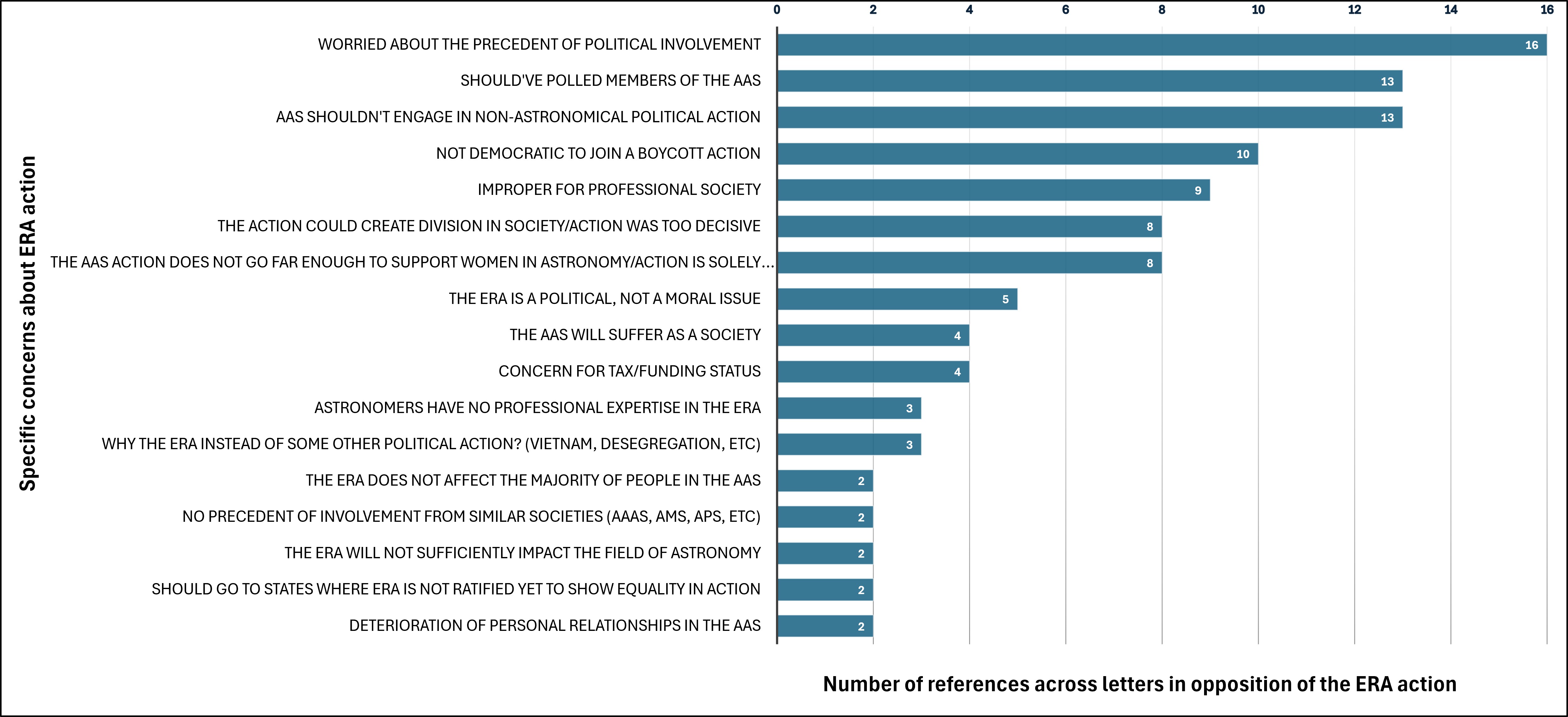
Analyzing the arguments of opponents such as Felten and Wood, I have categorized them in the following chart.

Chart categorizing reasons given for objecting to the AAS ERA action.
Amelie Heying.
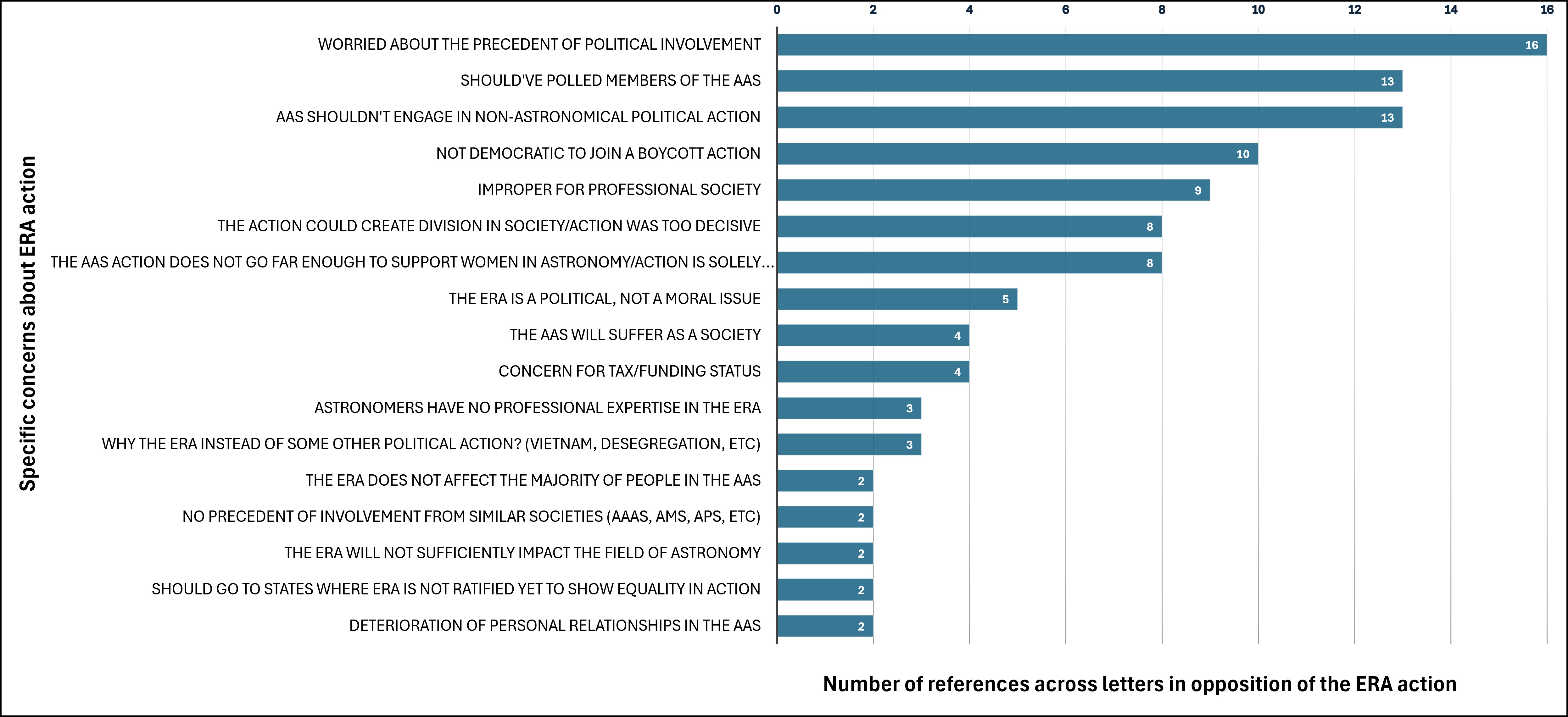
Many of the concerns about the council’s ERA action ostensibly had nothing to do with the ERA itself. This was in some contrast to letters sent to the all-male council of the American Physical Society when it pursued a similar action, with more emphasis placed on negative consequences of the ERA. Instead, AAS letter-writers focused more on the precedent of political involvement and what that could mean for the society’s future. Some drew a distinction between political activity that was and was not supposedly related to astronomy, while others did not.
A strong secondary concern was that the AAS council had taken a political position without polling the membership. Such polls had apparently preceded other major decisions during the period, such as the establishment of a Washington, DC office—notably, to increase AAS’s political lobbying power.
Supporters ambivalent about “political” label
Letters supporting the council’s ERA action tended to be much shorter in length, possibly because many writers already felt understood by the council and were not seeking to sway it. Many supportive notes were handwritten rather than typed. A long list of University of Washington faculty signatures was submitted in support of the vote. A shorter list of signatures of support came from the Lowell Observatory in Arizona, and an independent faculty letter arrived from Berkeley.
Letters from women astronomers all over the country expressed solidarity with the council’s actions. The vast majority of letters from women astronomers recognized that gender discrimination in the field was still common and often fierce.
Ann Boesgaard, then president of the Astronomical Society of the Pacific, encouraged Burbidge to maintain courage in the council action. Both were the first women presidents of their respective societies, and Boesgaard lamented it was difficult for hers to take a similar action, particularly due to the opposition at Berkeley. “I don’t consider the action to be political—rather it is a question of human rights and civil rights,” she wrote.
David Helfand, a research associate at Columbia University, elaborated on whether the issue was “political.” Pointing to the society’s lobbying activities, he opined that “AAS is not strictly an apolitical organization.” Moreover, he argued that the ERA was pertinent to AAS because it would “very directly affect the lives of the individuals who are members of the society in both professional and personal contexts.”
The fading of the ERA question
In the face of member opposition, some council members supportive of the action began re-evaluating the decision. After considerable “soul-searching,” Elske Smith wrote to Burbidge proposing that the action be rescinded at the next council meeting. She feared that the society would hesitate to elect another woman to the AAS presidency if they thought women scientists were more concerned with women’s affairs than astronomy. Ivan King, set to take over as president, likewise pushed to rescind.
As it unfolded, the issue continued to simmer over the course of 1978, including at the 152nd AAS meeting that summer in Madison, Wisconsin. With correspondence divided almost evenly between support for and opposition to the action, with a narrow majority favoring it, King ultimately appointed a committee to conduct a more formal poll, study the issue more deeply, and hold an open hearing at the 153rd meeting in Mexico City. It comprised supporter Vera Rubin, opponent Carl Heiles, and Arthur Hoag, who had not taken a position, and it was chaired by Arthur Code, a former AAS vice president who had also not taken a position.
By that time, though, with the ERA deadline passing, the issue began to fade from attention. By the time of the 155th meeting it had practically disappeared from AAS deliberations, and in 1984 the 163rd meeting was held in Las Vegas in Nevada, which had not ratified the amendment.
However, the debate was not for nothing. As the ERA issue focused attention on women’s place in the field, AAS established a standing Committee on the Status of Women in Astronomy in June 1979 that continues its work today.
—
Amelie Heying
AIP Society of Physics Students intern
history@aip.org
You can sign up to receive the Weekly Edition and other AIP newsletters by email here.
More from AIP