
Computing Venus: Opera Review

When you think about opera, perhaps some dramatic Puccini or long-winded Wagner comes to mind. (If you think you are unfamiliar with Wagner, check out Ride of the Valkyries .) However, opera is a living art form, and many new operas are composed and produced every year on a huge variety of topics. One such opera, Computing Venus , was published in 2024. With music composed by Timothy Takach and words by Caitlin Vincent, it focuses on astronomer Maria Mitchell’s teaching career at Vassar College, and in particular her experience with promoting the capabilities of her women students and her fight against the many who opposed the idea of women doing astronomy work. Vassar College produced the opera in January 2026, and there is a full recording on YouTube .
Apart from being a librarian at the AIP Niels Bohr Library & Archives, I am also a flutist, and I was delighted to be asked to play the flute part for the run of this opera at Anne Arundel Community College in Arnold, Maryland, this past September. The stars truly aligned in the planetary spheres of my interests! As every opera needs, I thought I’d provide my perspective as a history of science librarian and musician.


Whenever there is a dramatic retelling of a historical event or person, there is always a question of accuracy. In this case, I would say that the spirit of the story is accurate; while there are some divergences from the historical record, these divergences serve a purpose. For example, while the exact words that the characters sing may not be precisely what was said during the events of the 19th century, and there is occasional dramatic license taken, they do justice to the story they represent: Maria Mitchell’s teaching career. That said, there is one very notable exception, which I will explore later in this post.
Maria Mitchell

Maria Mitchell with her father, William Mitchell. William was a proponent of women’s education and tutored Maria in astronomy, mathematics, surveying, and navigation in her youth.
Photograph by Slee Bros., Vassar College Archives. Catalog ID: Mitchell Maria G1
First, a bit of background. Maria Mitchell (1818-1889) has long been one of my personal favorite historical figures. She is best known for her discovery of a comet, for which she was awarded a gold medal from the King of Denmark, and for being the “first professional woman astronomer ” in the US, but she was quite a multifaceted person outside of these landmark achievements. Her mother, Lydia Coleman, was a library worker, and her father, William Mitchell, was a teacher and an amateur astronomer. Maria ended up pursuing all of these professions over the course of her life. She was the first librarian of Nantucket Atheneum (which is still the public library of Nantucket), a position she held for 20 years from 1836 until 1856). She was an abolitionist and invited Frederick Douglass to speak at the Atheneum. At the same time, she worked both with her father’s and on her own scientific pursuits. She was a paid computer for the American Nautical Almanac, and in 1850, she became the first female member elected to the American Association for the Advancement of Science. In 1865, she was hired as the first Professor of Astronomy at the brand-new all-women’s Vassar College in Poughkeepsie, New York. She taught there until her health failed in 1888, and passed away in 1889.The Review
Computing Venus
Now, on to the opera. There are two major components of an opera: the music and the libretto. The music comprises the melodies, harmonies, rhythms, tone colors, orchestration (choice of instruments called for), and all other sonic aspects of the opera. The libretto is the story of the opera, including all of the lyrics. I will discuss both the music, by Timothy C. Takach, and the libretto, by Caitlin Vincent.
The opera starts with a prologue: it’s 1847, and Maria discovers the comet! This is the only part of the opera that takes place outside of Maria’s teaching career at Vassar College. It serves to tell the audience why this woman was so important and heavily anticipated as a professor. Musically, there’s a lovely yearning to Maria’s “Sweeping the sky” melodic entrance (check out the beginning of Vassar’s recording) , which we see repeated in the epilogue, making a nice bookend to the opera. Maria’s mother makes an appearance, coaxing her to come downstairs from their home’s rooftop telescope and get ready for her suitor, Isaac. I’m not sure if Isaac is real — I can’t find any evidence that he existed. I think the librettist wanted to point out the tension between societal expectations (getting married to a man) and Maria’s life, which does set up for a later twist. I wish Maria’s father had made an appearance, since he was alive at the time of the comet’s discovery and he was such an important figure in Maria’s life. Also, this part makes it seem like Maria’s mother wasn’t supportive of her astronomical pursuits, even though she was.
After the opening, there’s a big time skip to 1878, and the rest of the opera takes place during this year. I really enjoyed Scene One, in which Maria’s first students are getting ready to meet her for the first time. The bubbliness of both the libretto and the music do great service in conveying Maria Mitchell’s celebrity and the excitement over her appointment as a professor at Vassar College - check out “It’s our first day of astronomy !” To be nitpicky, the libretto says, “the first woman astronomer,” which doesn’t give consideration to the women, paid and unpaid, who have been observing the skies for centuries before Maria Mitchell. Caroline Herschel , for example, was an important figure in astronomy, made a living from it, and predated Maria Mitchell by a century. I guess “the first professional woman astronomer in the United States” doesn’t have quite the same ring, though.


As the opera progresses, we get to experience Maria Mitchell teaching and taking her students from New York to observe the solar eclipse in Denver, Colorado, which was especially notable because they were some of the only women present. I’m thrilled that this part of Maria’s career was included in the opera, and the countdown music to the total eclipse really escalates the excitement and tension of the moment. The topic of this eclipse is covered in great detail in the book American Eclipse: A Nation’s Epic Race to Catch the Shadow of the Moon and Win the Glory of the World by David Baron (2017), and features Maria Mitchell on the cover.

Edward Clark was a magnetic presence in the opera, portrayed by Will Kuethe.
Nicole Caracia Photography
Besides Maria Mitchell, one of the other prominent voice roles is Edward Clark, a real-life professor at Harvard Medical School who published the book Sex in Education, or a Fair Chance for the Girls, in 1873 (second edition available on Internet Archive ), one year before Maria started teaching at Vassar. Trigger warning: this book is extremely sexist and basically says that women should stay home, while men go out in the world. While I can’t find evidence that Edward Clark and Maria Mitchell had as close contact as the opera implies, I heartily approve of this choice to make Edward Clark the main villain and a representative figure of the backlash against women’s education that Maria encountered. His character also allows for some comic relief in the opera, which is a welcome palate cleanser for the otherwise serious and earnest subject matter of the story. There is some really excellent wordplay in his opening aria , and the prominent role of the bassoon contributes to a clown-like atmosphere. In the program notes, we learn that Maria Mitchell was an active proponent of women’s education, like her father; she cofounded the Association for the Advancement of Women and gave a series of speeches during her tenure. Towards the end of the opera, we see many of Maria’s students being forced by their parents to leave her classes and even higher education entirely, which did happen, sadly.

Maria, left, and Mary portrayed by Tania Rosa Bindhoff-Frieswyk, right. In the foreground, you can see the back of the conductor’s head, Dan Sitomer, flutist (yours truly), and oboist Jenny Campbell.
Nicole Caracia Photography

Real-life Maria Mitchell and several unidentified women (likely students) sitting on a staircase, probably at Vassar, with a telescope.
AIP Emilio Segrè Visual Archives. Catalog ID: Mitchell Maria E1
Finally, the big twist: there is a love storyline involving the character Mary, one of Maria’s students. This is probably the biggest bit of dramatic license that the libretto takes with Maria’s story. Maria Mitchell never married and there are no known romantic liaisons or interests that I could find any evidence of, and nothing to suggest that she might have been gay. Of course, we can’t know what we don’t know about Maria Mitchell, and her life certainly would have been much more difficult if she had been openly gay at this period in history. The idea of her being involved with a student also implies something about her character and the possibility of taking advantage of someone in a position of less power than herself. However, the libretto addresses this by giving Mary all of the more romantic lines and Maria the more ambiguous ones. Maria prioritizes Mary’s education above all else, and states, “there is no us,” and “I’m your shield Mary, I won’t let you be harmed.” The staging instructions in the score also indicate that there should never be any physical contact or anything to imply that Maria is taking advantage of the situation. Overall, this is an interesting choice by the librettist that I have mixed feelings about. I think it drives a point about society’s repression at the time, and it also provided the opportunity for my favorite flute part in the opera: Mary and Maria have a duet in tandem with an oboe and flute duet , which is lovely. However, the audience would have no idea that this love story isn’t real unless they did outside research, and I wish that this was better pointed out in the program notes.
Further reflections


This opera is very approachable. Clocking in at 1.5 hours with no intermission, this is a rather short opera, as far as operas go; it’s no epic Wagnerian Ring Cycle . However, I think this works in the opera’s favor, as the libretto is really focused on a specific period in Maria Mitchell’s life, which is well-explored without getting bogged down. The story is compact and has a satisfying through-line that feels complete by the end. The fact that you can enjoy the opera in one sitting, in the same time as it would take to watch a movie (or less), made it easier for me to ask my friends and family to watch me perform in it than if it had been a three-to-five-hour show.
Some people might be intimidated by the idea of listening to any opera, let alone a modern opera, which could potentially be very out-there, but fear not! The musical language of this opera is very approachable for an uninitiated audience. It is mostly tonal, with a few delicious spots of dissonance, which do well to serve the dramatic tension of the story. Many of the most well-known operas are in Italian, German, and French, so it’s worth noting that the opera is in English, making it even more accessible to a modern audience (no sub or supertitles needed!).
The orchestration is also a compact affair, much like the runtime. Rather than a full orchestra, the score calls for just two violins, a viola, a cello, a bass, a harp, a French horn, a flute, a clarinet, an oboe, and a bassoon. The light orchestration lends the music a warm sound without the strident or militaristic quality that one might associate with brass and percussion. It becomes more like chamber music, which is intimate and soloistic, since there is only one on a part, and I think this balances the singers well.

Edward Clark center, with chorus and orchestra, at AACC.
Nicole Caracia Photography
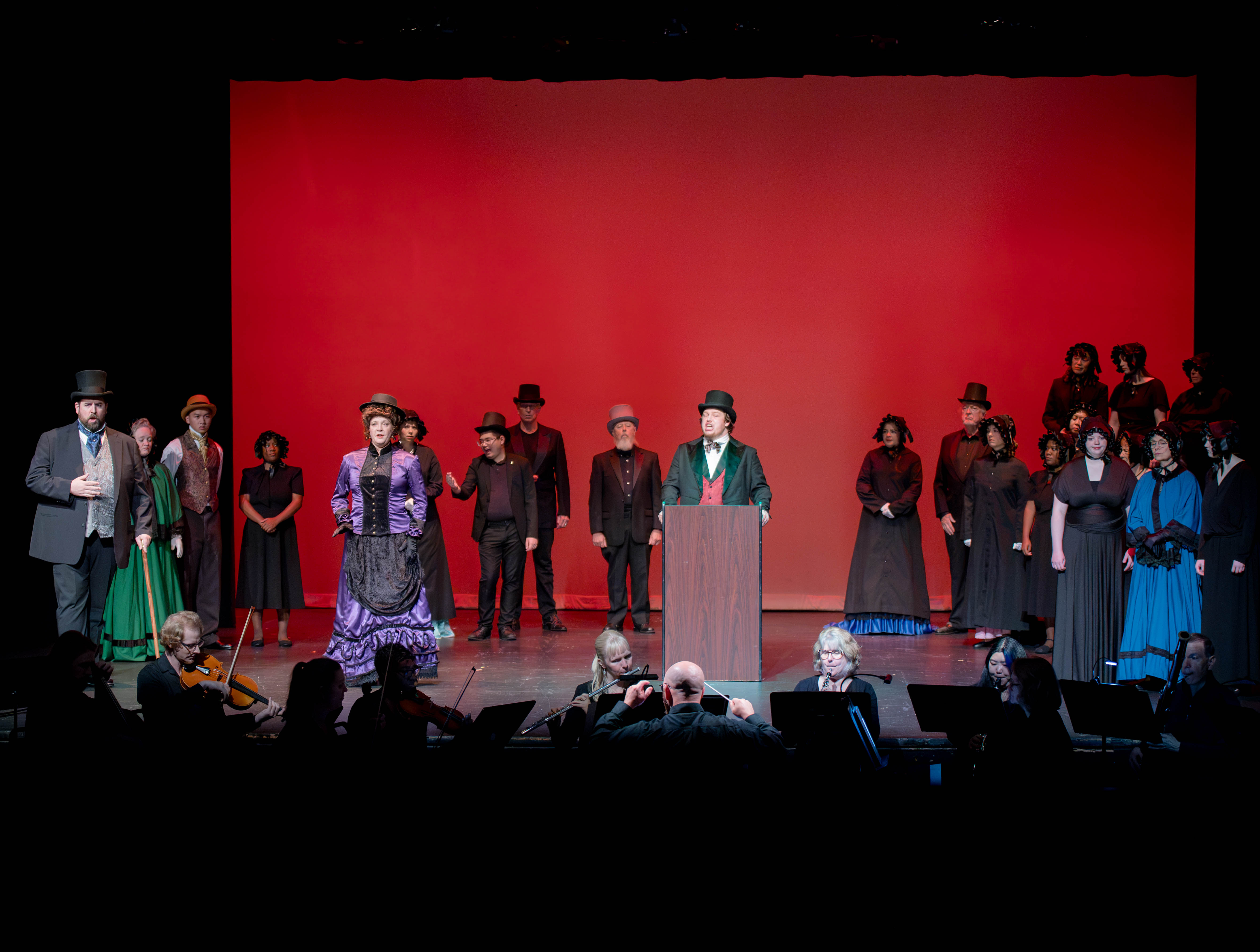
The smaller orchestra also allowed the production at AACC to use a demi-pit setup, rather than a full pit, which meant that the musicians were visible to the audience. We had to play more quietly than usual because of this. However, it was wonderful to feel like part of the action and I enjoyed watching the rehearsals, which I’m not usually able to do from a true pit. I think the audience also enjoyed the chance to see the orchestra.
Overall, the story and music of this opera are really lovely, and I’m so thrilled to have been part of it. Even with the dramatic license that the librettist takes, I think it’s still a great way to bring to public attention the story of this amazing figure in American history who most people don’t know at all.
As the libretto states, she changed the world, just by looking up !
References
Baron, David. “A Woman in Eclipse: Maria Mitchell and the Great Solar Expedition of 1878.” Undark, August 17, 2017. https://undark.org/2017/08/17/wilo-maria-mitchell-astronomer-eclipse/ .
Encyclopedia.com. “Mitchell, Maria (1818–1889).” Accessed October 30, 2026. https://www.encyclopedia.com/women/encyclopedias-almanacs-transcripts-and-maps/mitchell-maria-1818-1889 .
Hamilton, Melody. “‘Computing Venus’ Is a Reminder to Dream Together.” The Miscellany News, January 29, 2026. https://miscellanynews.org/2026/01/29/arts/computing-venus-is-a-reminder-to-dream-together/ .
Maria Mitchell Association. “About Maria Mitchell.” Accessed October 30, 2026. https://www.mariamitchell.org/about-maria-mitchell .
Town of Nantucket. “Walking in the Footsteps of Maria Mitchell: Maria Mitchell Walking Tour.” PDF. Accessed October 30, 2026. https://www.nantucket-ma.gov/DocumentCenter/View/23611/MM-WalkingTour .
Takach, Timothy C. “Computing Venus: An Opera in One Act Inspired by the Life of Maria Mitchell.” Accessed October 30, 2026. https://timothyctakach.com/computingvenus .


