
Policy analysis: Prospective changes to prevailing wage levels and impacts on international hiring


The US Department of Labor headquarters in Washington, DC.
DOL.
On September 19, 2025, President Trump issued a proclamation to restrict the entry of certain foreign workers to the US, with the declared aim of encouraging the hiring of US citizens and relieving downward pressure that hiring lower-paid foreign workers can place on pay. The centerpiece of the proclamation was an extraordinary $100,000 fee imposed on employers making new petitions for H-1B visas.
The same proclamation also instructed the Department of Labor (DOL) to initiate rulemaking to revise the “prevailing wage levels.” Prevailing wage levels establish what the minimum level of pay for certain foreign workers should be, and they vary based on occupation, experience level, and geographic location. They are calculated using formulas provided by DOL and are based on authoritative data sources that track pay across occupations. Potential employers of foreign workers are responsible for documenting that proposed pay meets or exceeds prevailing wage levels, and DOL is responsible for certifying the proposal conforms with that requirement. This certification is called a prevailing wage determination (PWD).
Once an employer has obtained a PWD, they may then petition to sponsor an H-1B visa for a temporary foreign worker or an EB-2 or EB-3 immigrant visa, also known as an employment-based green card. [1] H-1B visas and employment-based green cards are commonly used in science and engineering fields, both in industry and in nonprofit higher education institutions and research centers. Increasing prevailing wage levels could lead to increased pay in such occupations, but, as with the new fee on H-1B petitions, it could also dissuade employers from hiring foreign workers.
DOL is expected to publish a notice of proposed rulemaking modifying prevailing wage levels in early 2026 that will apply to both for-profit and nonprofit institutions. To get a sense of what to expect, one can look to an attempt by the first Trump administration to increase these levels, which resulted in an interim final rule released in October 2020 and a lightly revised final rule released in January 2021, six days before President Biden took office. [2]
How are prevailing wage levels structured?
The way that prevailing wage levels function in the US visa and immigration system can be opaque and confusing. Currently, there are four categories of levels, which relate the skill, experience, and responsibilities associated with a position to how that position’s pay is presumed to rank within the statistical distribution of that profession’s salary in a particular geographical location:
- Level I: Entry level (~17th percentile in each profession’s distribution of wages)
- Level II: Qualified (~34th percentile)
- Level III: Experienced (~50th percentile)
- Level IV: Fully competent (~67th percentile)
As an illustrative example, a PhD-level physicist could be classified in any of the four levels depending on the kind of position they occupy. According to a database maintained by DOL, the prevailing wage for a foreign-born level I PhD-level physicist working at a for-profit organization in the Washington, DC metro area is $110,864 per year. A foreign-born physicist working in a level IV position at a for-profit organization in DC must be paid at least $193,086. [3]
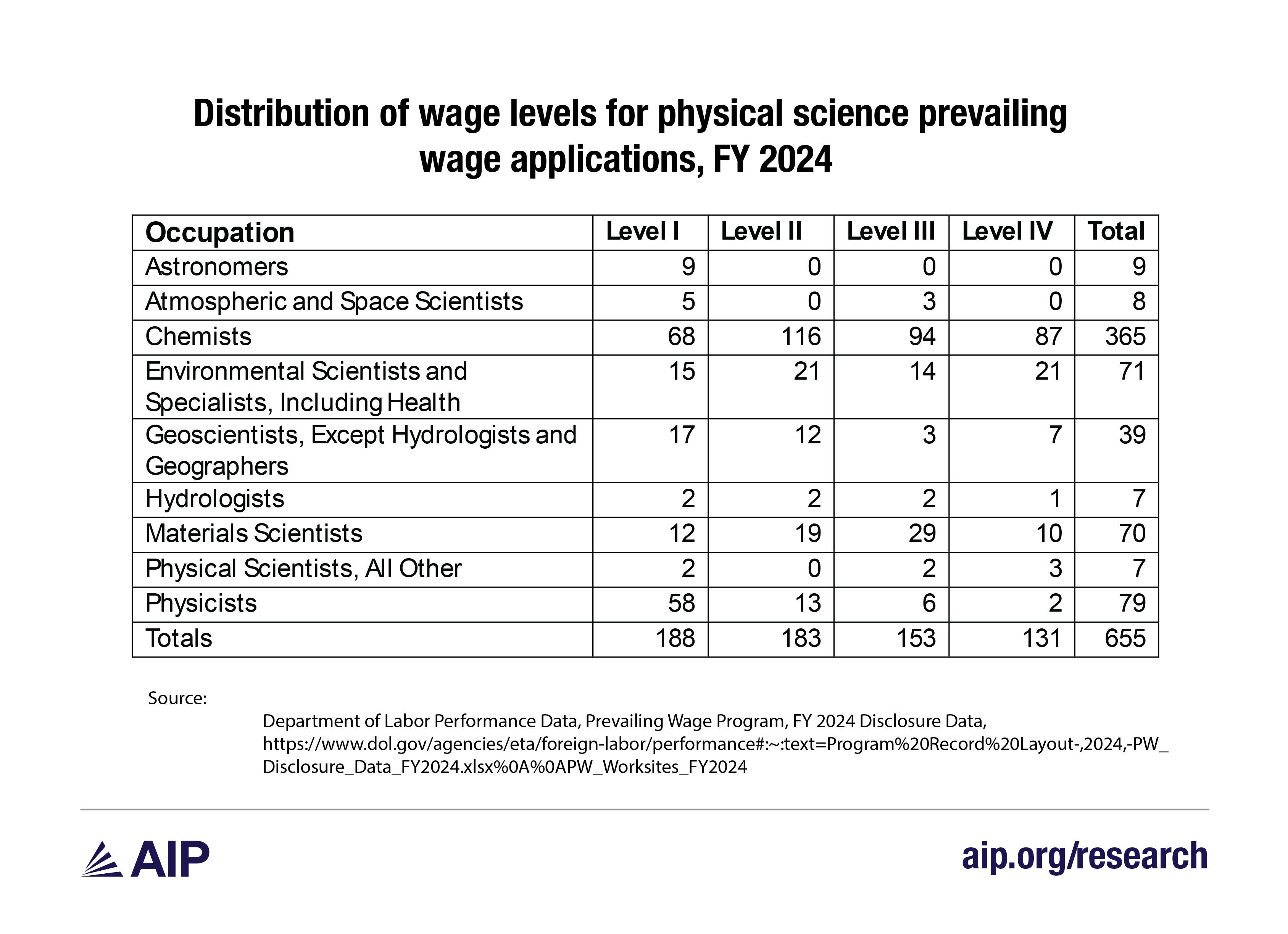
The table below shows the distribution of wage levels among all prevailing wage applications submitted to DOL in fiscal year (FY) 2024 for positions in physical sciences occupations.

A table containing the number of applications for prevailing wage determinations submitted by employers for positions in the physical sciences to DOL in FY 2024.

The first Trump administration’s 2020 interim final rule proposed using higher percentile benchmarks for each wage level, arguing that existing prevailing wage levels are distorted, in part because level I is calculated using the salaries of workers who would not qualify for an H-1B or employment-based green card, making all pay levels lower than they should be. The administration also stated that it found data to suggest that some firms pay well above prevailing wage levels, and, if those levels accurately captured the going rate for workers, this discrepancy would be less common.
The January 2021 final rule shifted the percentiles down slightly from the previously proposed ones, stating that “data provided by commenters indicate that [a lower level I] may in fact provide a more accurate representation of what US workers similarly employed to entry-level H-1B and [employment-based green card] workers are paid.” DOL also affirmed that, in the interim final rule, the “reasoning was weighted too heavily to certain occupations,” namely computer science fields.
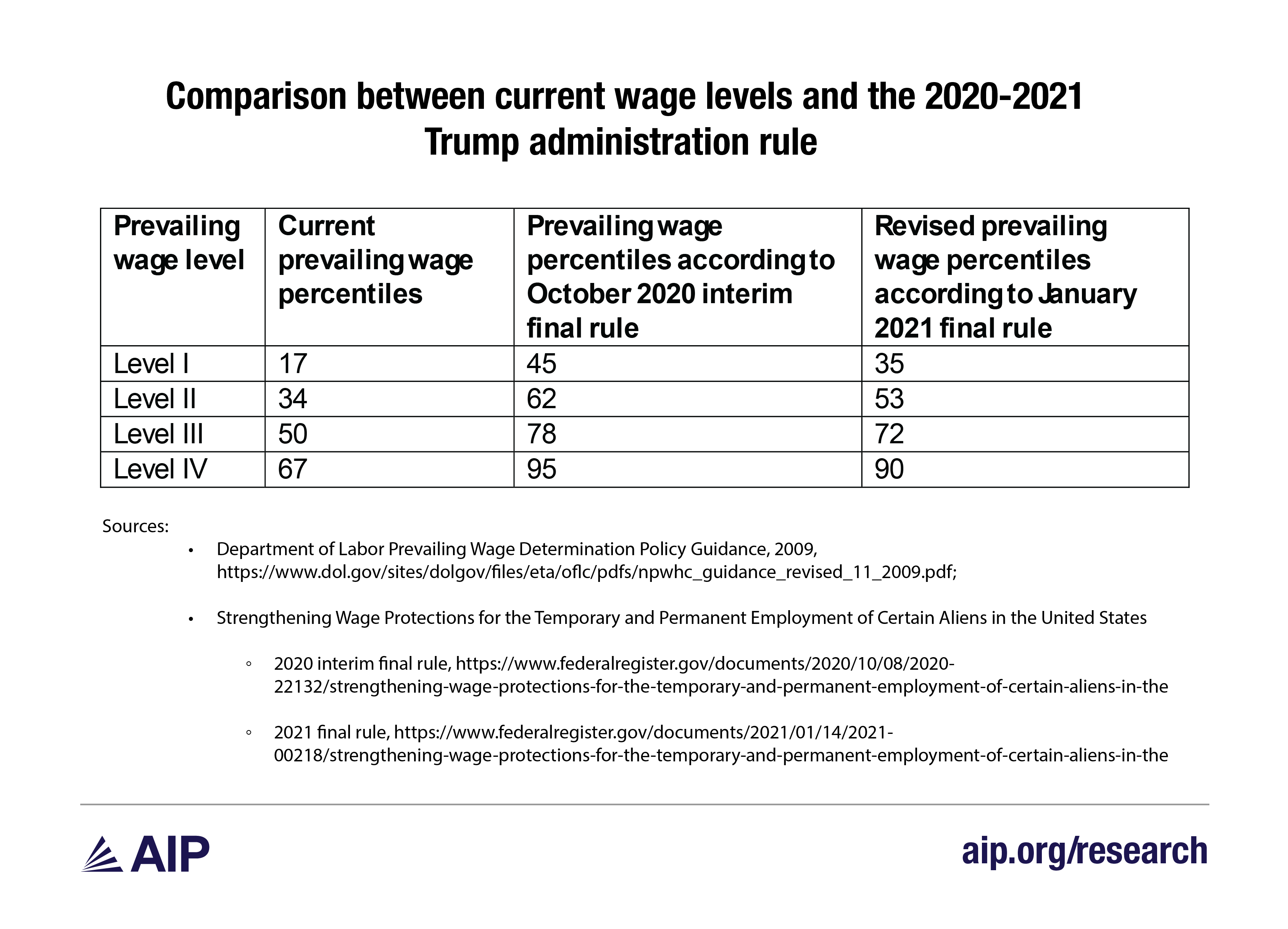
The table below shows the difference in prevailing wage level percentiles between the October 2020 interim final rule, the January 2021 final rule, and the system used today.

A table comparing the wage level percentiles that are currently used and those proposed by the first Trump administration in 2020 and 2021.

What would the impact be on the physical sciences community?
Estimating the potential impact of the forthcoming rule is tricky. While it is quite possible that the wage levels will be revised to percentiles similar to the 2021 rule, we will not know for sure what the new percentiles will be until the notice of proposed rulemaking is released. Additionally, occupational pay levels for percentiles other than the current benchmarks are difficult to obtain. However, we can make some comparisons based on the 2021 proposal, especially since the proposed percentile benchmarks were close to those currently used for the next wage level above it.
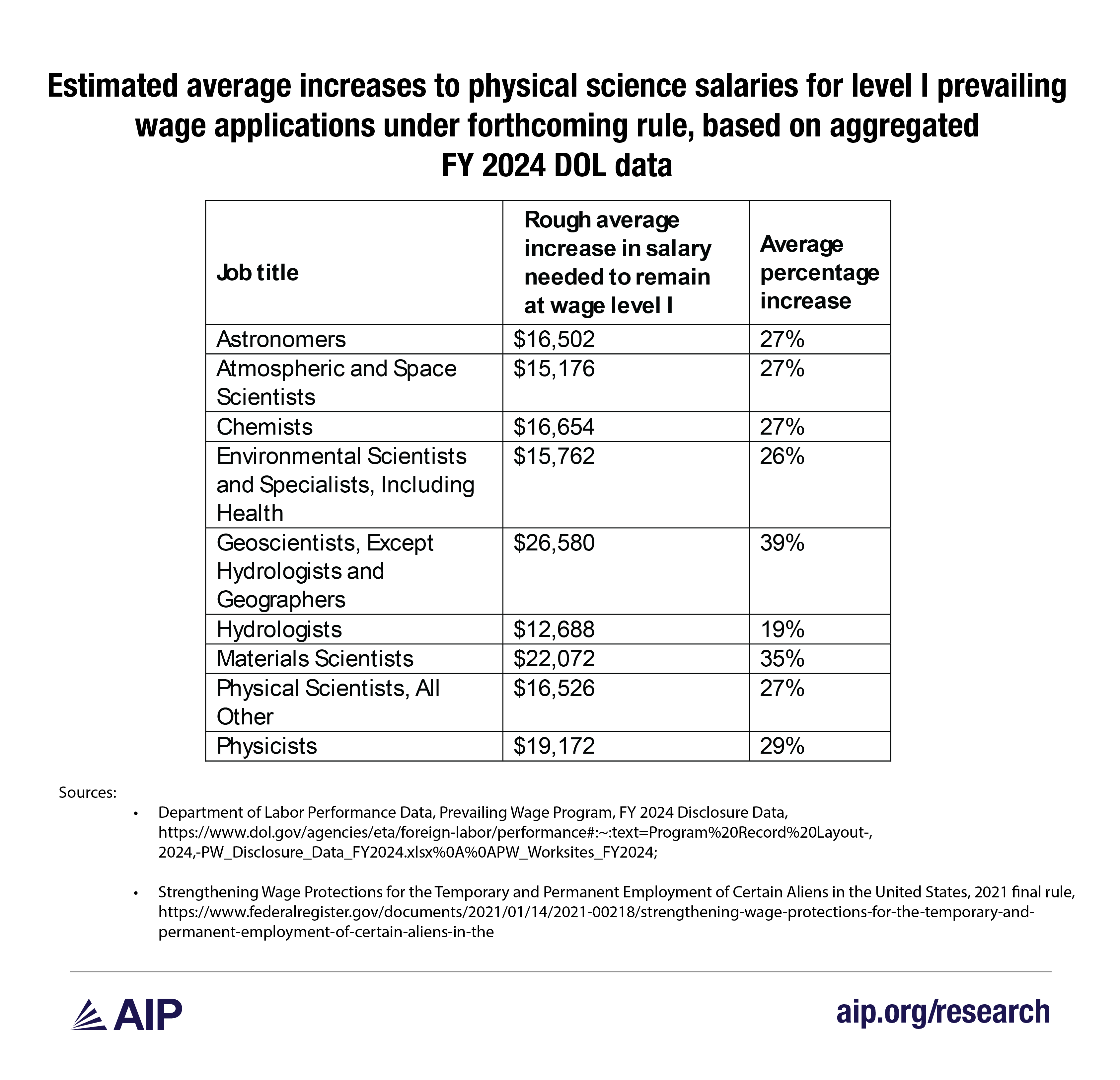
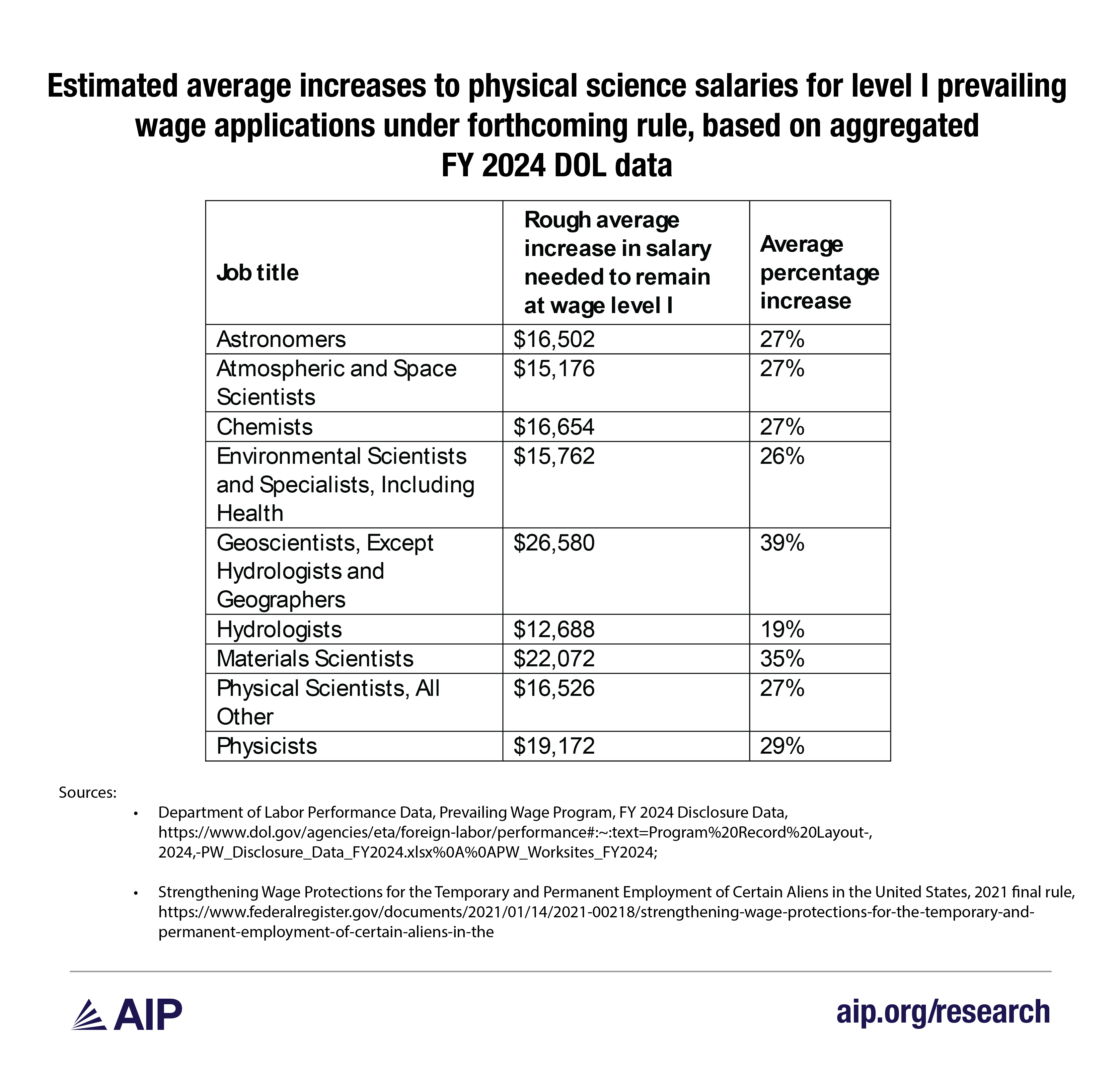
For example, the proposed 35th percentile for level I was close to the 34th percentile currently used for level II. In this example, wage applications for a level I employee would need to have a salary roughly in line with that for a current level II employee to avoid being rejected by DOL. An evaluation of the aggregated wages levels for all applications submitted in FY 2024 for physical sciences occupations shows that the salaries for the current level I positions would have to increase on average by around $18,600 to likely qualify under the forthcoming rule. Percentage-wise increases range from 19% for hydrologists to almost 40% for geoscientists.

A table showing the estimated increase in salary needed for a position to continue to qualify for wage level I, if the forthcoming rule is similar to the first Trump administration’s 2021 final rule.
Below, we provide a visualization for potential salary increases for foreign-born physicists. Each bar represents one application for a prevailing wage determination that was actually submitted to DOL in FY 2024. The blue section of each bar denotes the salary that the employer proposed to pay in FY 2024 to qualify for the current level I. The orange section denotes roughly how much more that employer would likely need to pay to continue to qualify for level I in the same geographical region under the forthcoming rule, if it will be like the 2021 rule. Many applications would have similar prevailing wages, because they are in either the same geographical region or a geographical region with a similar distribution of wages for that profession.

A visualization of how much more an employer would have needed to pay a foreign-born physicist to continue to qualify for wage level I, if the 2021 Trump administration rule went into effect. The forthcoming rule may have a similar impact on salaries.
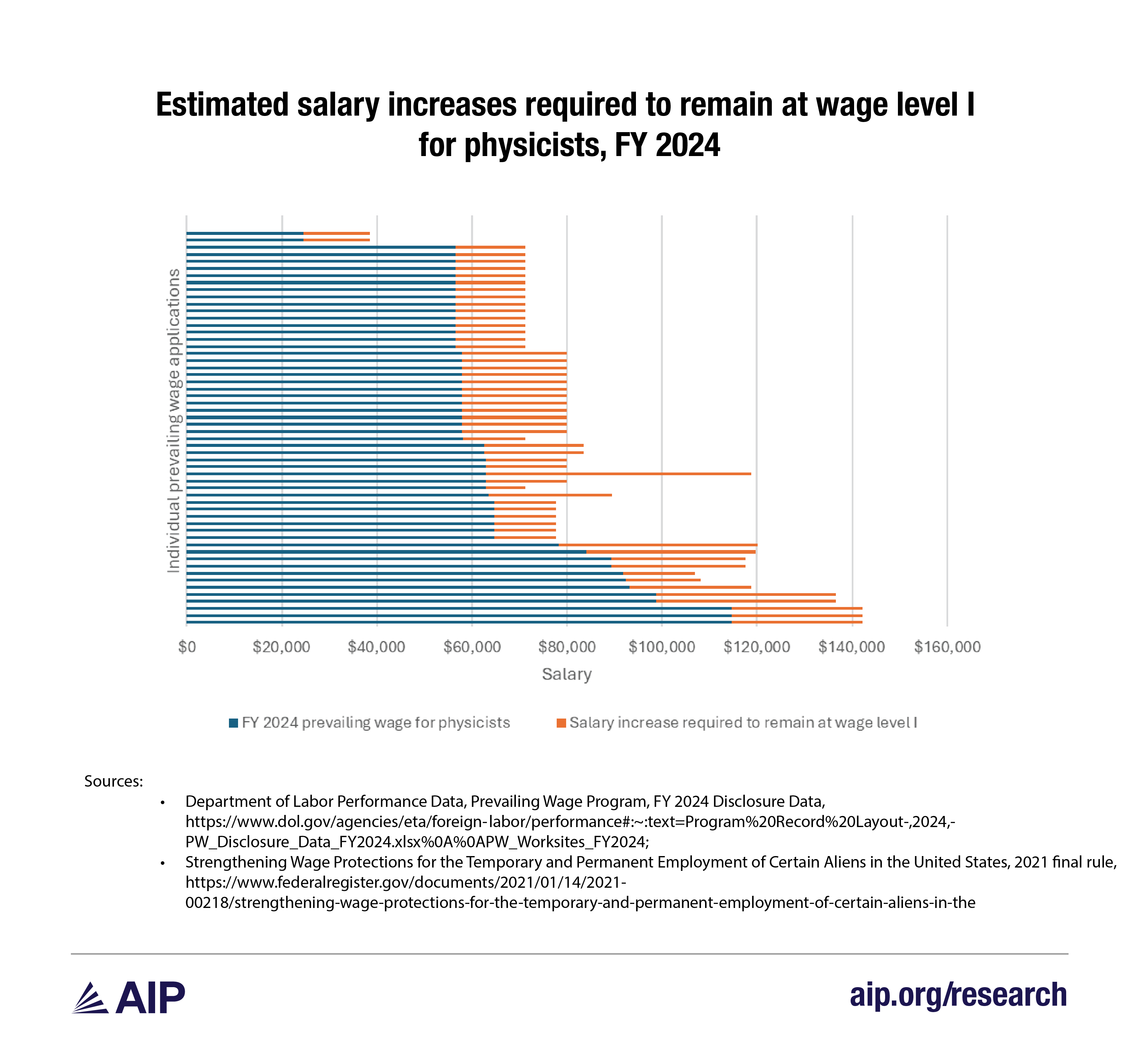

Note that these are only estimates. It remains to be seen how the forthcoming rule will actually impact the hiring of foreign-born workers in the physical sciences.
Notes
1. PWDs are also required to sponsor visas for E-3s (Australians working in occupations requiring at least a bachelor’s degree), H-2As (temporary agricultural workers), and H-2Bs (temporary non-agricultural workers). These visa categories are not covered in this article because they are less relevant for the physical sciences.
2. Before it went into effect, the US District Court for the Northern District of California vacated the rule and the Biden administration officially retracted it on December 13, 2021.
3. The database is updated annually with new wage data. The wages cited in this paragraph come from the July 2025 - June 2026 wage series.