
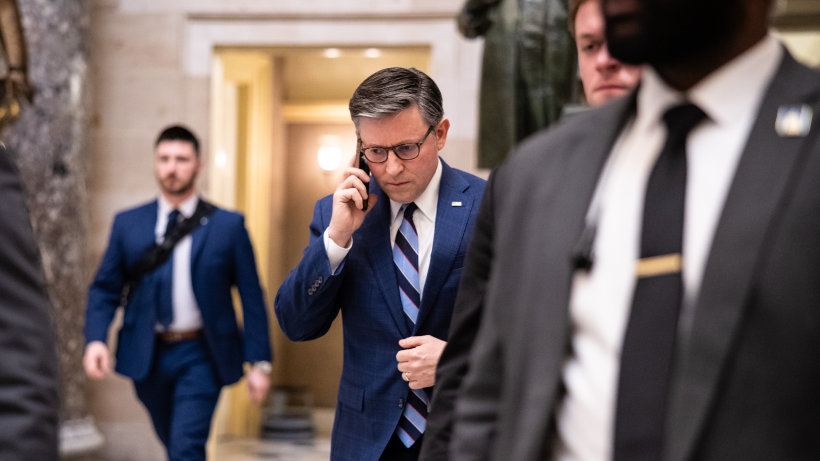
House Speaker Mike Johnson (R-LA) speaking on the phone.
Francis Chung / POLITICO via AP Images
Partial government shutdown impacts DOD, NIH
A partial government shutdown began over the weekend after Congress failed to meet the midnight Friday deadline to pass a revised funding package for some federal agencies. The lapse in funding means nonessential operations have temporarily ceased at the Department of Defense and the Department of Health and Human Services, which oversees the National Institutes of Health, among others.
Most science agencies, however, are unaffected by the shutdown as the Energy-Water, Commerce-Justice-Science, and Interior-Environment appropriations bills for fiscal year 2026 have already been signed into law. These bills cover NASA, NOAA, NIST, USGS, the National Science Foundation, and the Department of Energy’s Office of Science, among others.
Progress toward fully funding the government was disrupted last week after Senate Democrats refused to vote for a six-bill package that authorized funding for the Department of Homeland Security after two U.S. citizens were killed by federal agents in Minneapolis. The Senate compromise extends DHS funding for two weeks, but separates the DHS bill from the remaining five bills, allowing more time for negotiation over potential DHS reforms.
The House Rules Committee is due to consider the funding compromise that the Senate agreed to on Friday at 4:00 pm today. House Speaker Mike Johnson (R-LA) told Fox News on Sunday that he is optimistic the shutdown could end as soon as tomorrow, if the Rules Committee clears the spending package for a chamber-wide vote. Passage of the bill could still be hindered by House Democrats or dissenting members of the razor-thin Republican majority. Any revisions at this stage would force the bill to pass through the Senate again, possibly further delaying passage.
DOD merges Defense Science Board and Defense Innovation Board
The Department of Defense announced last week that it will merge the Defense Science Board and the Defense Innovation Board into a new Science, Technology and Innovation Board. According to the announcement, the new board replaces the functions of the DSB and the DIB. The STIB is not yet official, and no date has been set for its first meeting. The DSB was originally established in the 1950s, while the DIB was formed in 2016. The Trump administration has been steadily closing and merging federal advisory committees over the past year.
The inaugural chair of the combined board is Milan Nikolich, who served as the director of defense research and engineering for research and technology during the first Trump administration. The 18 board members listed on the STIB website include former Air Force Chief Scientist Victoria Coleman and other former DOD officials, as well as former Los Alamos National Lab Director Michael Anastasio and Johns Hopkins Applied Physics Lab Senior Fellow James Gosler. Alicia Jackson, the current director of the Advanced Research Projects Agency for Health (ARPA-H), is also on the board. Several board members previously served on the DSB.
DOE shares new details on reorganization
The Department of Energy announced that its new Office of Critical Minerals and Energy Innovation will have three sub-offices: the Office of Energy Technology; the Office of Critical Minerals, Materials, and Manufacturing; and the Office of Innovation, Affordability, and Consumer Choice. Audrey Robertson is leading the critical minerals and energy innovation office, and each sub-office will have a deputy assistant secretary. Robertson, who heads DOE’s Office of Energy Efficiency and Renewable Energy, told staff in November that the new office would include EERE and several other DOE offices under the old organization, E&E News reported. The department has not provided further details on the new offices for fusion and advanced computing, or the plan for the Office of Clean Energy Demonstrations.
House Dems investigate DOE nuclear safety changes
Democratic staff on the House Science Committee are seeking information on new directives at the Department of Energy that loosen nuclear safety regulations, including the As Low As Reasonably Achievable (ALARA) standard for radiation exposure. NPR reported last week that the new rules, created in the fall and winter of last year, were shared with nuclear companies but not made publicly available. In a statement to NPR, DOE said the changes “will increase innovation in the industry without jeopardizing safety,” and that “the ALARA standards have not changed.” The statement added that rules shared with companies were early copies and that DOE anticipates publicly posting the directives later this year. Energy Secretary Chris Wright reportedly issued a memo ending ALARA earlier this month.
In response to the NPR article, Democrats on the House Science Committee said they are “investigating” DOE’s changes. “Any changes to critical safety requirements must happen through a careful, transparent process guided by the best available science,” Adam Rosenberg, House Science Democratic staff director, said in a LinkedIn post. Some scientists and nuclear energy proponents have criticized ALARA in recent years and proposed various changes to the standard. A report from Idaho National Lab last summer recommended eliminating certain ALARA requirements as part of larger radiation safety reforms.
Also on our radar
- NWS Director Ken Graham said the agency is hiring again during a speech at the AMS annual meeting, but warned of a bumpy road ahead for the agency given budget constraints.
- The House Science Committee will consider the NASA Reauthorization Act on Wednesday. Congress has not passed NASA reauthorization legislation since 2022.
- The Senate Science Committee will consider the ORBITS Act to clean up dangerous orbital debris and the National Programmable Cloud Laboratories Network Act in a session on Tuesday.
- NIH Director Jayanta Bhattacharya will appear before the Senate HELP Committee on Tuesday to discuss modernizing the agency.
- Sens. Gary Peters (D-MI) and James Lankford (R-OK) have reintroduced the Streamlining Federal Grants Act, which aims to make it easier for under-resourced communities to access federal funding. The bill was first introduced in 2023.
- House CCP Committee Chair John Moolenaar (R-MI) wrote a letter to Secretary of Commerce Howard Lutnick with recommendations for how the agency can ensure U.S.-made chips are not used to advance China’s military. The letter criticizes U.S. tech company NVIDIA’s relationship with Chinese AI company DeepSeek.
- DOE’s Climate Working Group violated federal law because it failed to hold open meetings or include a balance of viewpoints, a federal judge ruled last week. However, the judge did not act on the plaintiff’s request to block DOE or EPA from relying upon the CWG’s report to inform agency actions.


All events are Eastern Time unless otherwise noted. Listings do not imply endorsement. Events beyond this week are listed on our website.
Monday, February 2
UN: Committee on Peaceful Uses of Outer Space Scientific and Technical Subcommittee meeting (continues through Feb. 13)
National Academies: U.S.-Africa Frontiers of Science, Engineering, and Medicine Symposium (continues through Wednesday)
Belfer Center: Beyond Left vs. Right: A clear path to American energy leadership
12:00 - 1:15 pm
National Academies: Future directions for NSF’s advanced cyberinfrastructure
2:30 - 3:30 pm
Tuesday, February 3
National Academies: A dialogue on the next decadal survey in Earth science and applications from space
9:00 am - 12:00 pm
Senate: Strategic competition in an unconstrained, post-New START Treaty environment
9:30 am, Armed Services Committee
Senate: Modernizing the National Institutes of Health: Faster discoveries, more cures
10:00 am, Health, Education, Labor, and Pensions Committee
Senate: Business meeting to consider legislation and the nomination of Steven Haines to be assistant secretary of commerce for industry and analysis
10:00 am, Commerce, Science, and Transportation Committee
Stimson: STARTing over? Russo-American arms control at a crossroads
10:00 - 11:15 am
House: Building an AI-ready America: Adopting AI at work
10:15 am, Education and Workforce Committee
CSIS: Securing critical mineral supply: A government–industry dialogue
1:00 - 7:30 pm
Bipartisan Policy Center: Permitting Summit 2026: Building America’s energy infrastructure
1:00 - 7:00 pm
New America: Exploring the American degree apprenticeship landscape
2:00 - 3:30 pm
Wednesday, February 4
House: Markup of the NASA Reauthorization Act of 2026
10:00 am, Science, Space, and Technology Committee
House: Europe’s threat to American speech and innovation: Part II
10:00 am, Judiciary Committee
Thursday, February 5
Institute for Science and Policy: Science at a crossroads: The intersection of politics and policy
8:00 am - 7:00 pm MST
Science|Business: Annual network conference
9:00 am - 5:30 pm CET
World Resources Institute: Exploring Climate Watch
10:00 - 11:00 am
Carnegie: Bluff or death? How to assess nuclear “threats”
1:30 - 2:30 pm
Carnegie: The future of nuclear proliferation
6:30 - 8:00 pm
Friday, February 6
No events.
Saturday, February 7
Science History Institute: Science and activism tour
2:00 pm
Sunday, February 8
AUTM: Annual meeting (continues through Wednesday)
Monday, February 9
NSSA: Defense & Intelligence Space Conference 2026 (continues through Wednesday)
National Academies: Review of the Small Business Innovation Research and Small Business Technology Transfer Programs at NASA
1:30 - 2:30 pm
Deadlines indicated in parentheses. Newly added opportunities are marked with a diamond.
Job Openings
◆National Academies: Managing editor
(ongoing)
◆House Science Committee: Communications staffer
(ongoing)
◆NSCEB: Emerging biotechnology policy and operations intern
(ongoing)
◆Aspen Institute: Melanie Diaz energy and environment intern
(ongoing)
APLU: Senior vice president for academic affairs
(ongoing)
APS: Chief marketing and communications officer
(ongoing)
WIRED: Senior editor, science
(ongoing)
Quanta Magazine: Video intern
(ongoing)
SEMI: Senior director of public policy and advocacy
(ongoing)
AIP: Director of science policy news
(ongoing)
AIP: Senior editor, Physics Today
(ongoing)
◆US Air Force: Chief scientist
(Feb. 3)
◆Aspen Institute: Science and technology policy fellowship
(Feb. 5)
US Air Force: Congressional liaison specialist
(Feb. 6)
◆Pew Research Center: Undergraduate intern, science and society
(Feb. 11)
OPCW: Senior science policy officer, AI, data sciences and knowledge management
(Feb. 18)
◆AAAS: Associate or senior editor
(Feb. 27)
◆Council on Foreign Relations: Technologist-in-residence fellowship
(Feb. 28)
Solicitations
AIP: Documenting career disruptions in the physical sciences
(ongoing)
AGU/AMS: Invitation for proposals for the US Climate Collection
(ongoing)
◆AAAS: Call for applications for the 2026 AAAS-TWAS Course on Science Diplomacy
(Feb. 4)
◆NSF: RFI on investing in U.S. workforce training to revitalize America’s energy dominance
(Feb. 13)
NOAA: RFC on space-based data collection system
(Feb. 20)
NASA: RFC on space technology priorities
(Feb. 20)
DOE: RFI on mobilizing talent for the Genesis Mission and developing an American workforce to advance AI for science and engineering
(March 4)
NIST: RFI on security considerations for AI agents
(March 9)
OSTP: RFI for the National Strategic Plan for Advanced Manufacturing
(March 30)
◆IEEE: Call for nominations and applications for IEEE leadership
(multiple deadlines)
Know of an opportunity for scientists to engage in science policy? Email us at fyi@aip.org.
News and views currently in circulation. Links do not imply endorsement.
White House
White House: Statement of support for the Senate appropriations deal
New York Times: US has officially withdrawn from the Paris climate accord
White House: America 250: Presidential message on the anniversary of the space shuttle Challenger disaster
Politico: Trump asks federal court to hit pause on abortion pill case, citing ongoing study
The National Interest: The complicated politics of Trump’s new AI executive order
(perspective by Vikram Venkatram et al.)
E&E News: Here’s what the Trump admin expects critical minerals deals to look like
Congress
Science: Congress set to cut defense science funding
Sen. Chris Van Hollen (D-MD): Van Hollen, colleagues urge Trump administration to reverse course on rollback of probationary federal employee protections
Export Compliance Daily: Senator hopes bill pauses ‘headlong rush’ to sell advanced US chips to China
E&E News: GOP bill would require Senate approval for climate deals
E&E News: Democrats say the next IRA will be about ‘speed’
E&E News: Congress eyes next steps on nuclear energy
Science, Society, and the Economy
New York Times: Doomsday Clock ticks closer than ever to apocalypse
AAU: We’re in a race with China - and starting to fall behind
(perspective by Barbara Snyder)
National Academies: Civic science media: Reimagining how we communicate science
CSIS: The future of the WHO – and how the United States can shape it
(perspective by Stephen Morrison and Paul Friedrichs)
GAO: Small business research programs: Additional actions needed to incorporate best practices for addressing foreign risks
(report)
Education and Workforce
Chronicle of Higher Education: Two states are pausing H-1B hiring at public universities. Here’s what that could mean.
Scholarly Kitchen: Politics and scholarly societies: 1200 partnerships with external organizations terminated at the University of Kentucky
(perspective by Robert Harington)
Science: US government has lost more than 10,000 STEM PhDs since Trump took office
Science: Trump slump? Attendance plummets at some science meetings, but others hold steady
Nature: Five ways to make the academic workplace happier and healthier this year
(perspective by Ferhan Sağın & Robert Harris)
Inside Higher Ed: New alliance aims to protect colleges and universities from government meddling
Wired: Google DeepMind staffers ask leaders to keep them ‘physically safe’ from ICE
Research Management
Scholarly Kitchen: Preliminary evidence linking open science to research integrity
(perspective by Tim Vines et al.)
Ars Technica: New OpenAI tool renews fears that “AI slop” will overwhelm scientific research
AAU: Litigation trends shaping higher education and research in 2025
Nature: Is this journal legitimate? This tool can help you decide
Nature: AI chatbots are infiltrating social-science surveys — and getting better at avoiding detection
Labs and Facilities
Physics World: The Future Circular Collider is unduly risky – CERN needs a ‘Plan B’
(perspective by Michael Riordan)
Science|Business: Viewpoint: the EU’s ‘CERN for AI’ is nothing of the sort
(perspective by Morten Irgens and Holger Hoos)
Los Alamos National Lab: 2025 economic impact on New Mexico
(report)
HPCwire: Argonne integrates Advanced Photon Source with DOE supercomputers
American Nuclear Society: ORNL, Kyoto Fusioneering to develop Tenn. fusion testing facility
HPCwire: Idaho National Laboratory deploys Teton supercomputer to expand multiphysics simulations
ANS: PPPL-led STELLAR-AI to advance fusion research
Computing and Communications
Power: AI’s power crunch: Six trends that will decide who wins the next decade
(perspective by Shaun Walsh)
CSIS: AI and grand strategy: The case for restraint
(report)
NASA: NASA launches its most powerful, efficient supercomputer
The Information: China approves first batch of NVIDIA H200 AI chip imports
Space
The Economist: For the first time in half a century, astronauts are going to the Moon
New York Times: How to view the Artemis II Moon launch
FedScoop: NASA has a new acting AI and data chief
SpaceNews: Budget remains tight for scaled-back GeoXO program
NASA: NASA science flights venture to improve severe winter weather warnings
SpaceNews: NASA seeks partners for Earth Science extended missions
NASA: NASA testing advances space nuclear propulsion capabilities
Weather, Climate, and Environment
SpaceNews: NOAA seeks more money and flexibility for commercial weather data program
New York Times: A shift for NOAA’s surveys: From science to mining
Roll Call: NOAA speeds up process to grant deep-sea mining permits
SpaceNews: NOAA solar observatory reaches Lagrange point 1
E&E News: Iowa considers criminalizing cloud seeding, geoengineering
E&E News: EPA cuts top executive jobs under Trump’s reorg
DOD News: Coast Guard cutter Polar Star marks 50 years of service, begins operation Deep Freeze
Washington Post: Trump’s biggest climate rollback stalls over fears it will lose in court
E&E News: GOP probes climate lawyers for ties to education group for judges
Energy
E&E News: What the spending ‘minibus’ means for DOE, Energy Star
E&E News: DOE doc reveals renewables office reorg
Battelle: Powering the future: A conversation with Andy Griffith on nuclear energy’s role in the world
E&E News: After 16 years, DOE resumes search for nuclear waste solution
NPR: The Trump administration has secretly rewritten nuclear safety rules
DOE Office of Science: Envisioning frontiers in AI and computing for biological research
(report)
Defense
DefenseScoop: New US defense strategy ‘barely mentions technology’
CSIS: What does the Trump administration’s new national defense strategy say about China?
Breaking Defense: Pentagon CTO picks six defense tech vets to lead Critical Technology Areas
GAO: Missile warning satellites: Space development agency should be more realistic and transparent about risks to capability delivery
(report)
Ars Technica: Trade wars muzzle allied talks on Trump’s Golden Dome missile shield
Reuters: Pentagon clashes with Anthropic over military AI use, sources say
Breaking Defense: Sweden weighs Franco-British nuclear weapons cooperation
Biomedical
Undark Magazine: How MAHA exploits the flaws of modern science
(perspective by Brandon Ogbunu)
Undark Magazine: At NIH, a power struggle over institute directorships deepens
Chemical & Engineering News: Google’s AlphaGenome predicts the function of a DNA sequence
Science and Public Policy: Managing the politics of health data during COVID-19: A comparative institutional analysis
(journal article by Cosmo Howard et al.)
Stat: Tenuous biomedical funding has put first-year Ph.D. students in a bind
Elizabeth Ginexi: What happens when science is asked to pretend this is normal
(perspective by Elizabeth Ginexi)
International Affairs
Chemical & Engineering News: US air strikes are the latest blow to Venezuela’s decimated science infrastructure
SpaceNews: China set for crewed lunar tests, record launches, Moon mission and reusable rockets in 2026
CSIS: Understanding China’s quest for quantum advancement
(report)
Financial Times: How China pulled off a great tech reversal
(perspective by Kyle Chan)
Science: UK physics community braces for deep funding cuts
Research Professional: Italy and Germany sign deal to deepen research ties
SpaceNews: Making the unprecedented EU Space Act effective for all
(perspective Mario Neri)
NASA: NASA welcomes Oman as newest Artemis Accords signatory
SpaceNews: What would Artemis participation mean for Türkiye’s space industry and space diplomacy?
(perspective by Elif Yüksel)
Bloomberg: Singapore forms space agency as global sector’s growth booms
European Commission: Towards 2030: A joint European Union-India comprehensive strategic agenda


