
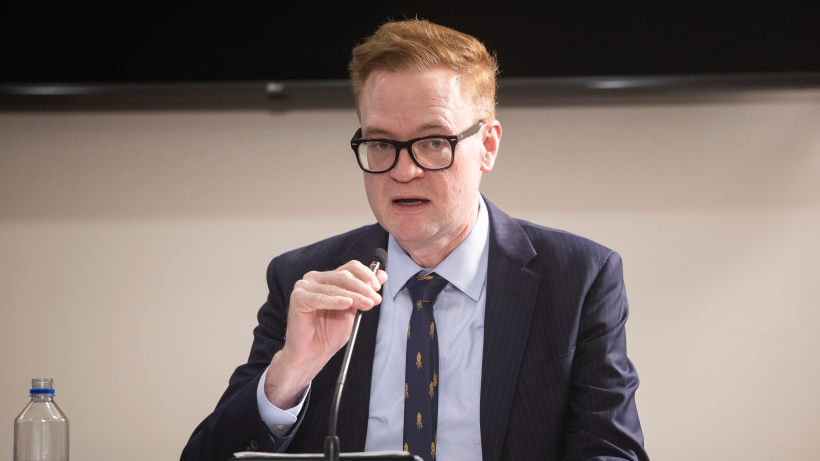
Former Health and Human Services Deputy Secretary Jim O’Neill speaks at a Make America Healthy Again event in September 2025.
Francis Chung / POLITICO via AP Images
Trump to nominate former HHS official to head NSF
The White House plans to nominate Jim O’Neill to be the next director of the National Science Foundation. Until recently, O’Neill was serving as acting director of the Centers for Disease Control and Prevention, a position now assumed by National Institutes of Health Director Jay Bhattacharya. O’Neill worked for the Department of Health and Human Services during George W. Bush’s administration and later became an investor, including for the Thiel Foundation program Breakout Labs, which funded early-stage commercialization of scientific research.
“Jim O’Neill spent over a decade in the private sector helping identify and finance cutting-edge technologies of the future. In the Trump administration, Jim O’Neill played a key role at HHS by slashing fraud and restoring the Gold Standard of Science over ideology as the driving factor behind agency decision-making,” White House spokesperson Kush Desai said. Previous confirmed NSF directors have typically had experience conducting science or engineering research.
NSF has been without a director since Sethuraman Panchanathan resigned in April of last year amid widespread grant cuts, a proposed 50% cut to the agency’s budget in the presidential budget request, and the threat of staff cuts. Brian Stone, the agency’s chief of staff, currently serves as acting director.
House Science Democrats probe new NIST restrictions on foreign researchers
Democrats on the House Science Committee are pressing the National Institute of Standards and Technology for answers on policy changes limiting access for foreign researchers. Boulder Reporting Lab reported earlier this month that the agency has begun implementing a three-year limit for international graduate students and postdoctoral researchers to conduct research at NIST. The letter from House Science Democrats says this “effectively prevents any foreign student from being able to complete a doctorate at NIST.” NIST did not reply to a request for comment, but the agency released a statement to some outlets saying that the policy remains “under development.”
NIST said its change was a “proposed update to decision-making criteria for safeguarding U.S. science at NIST” that aligns with a presidential memo on national security and the agency’s own research security framework. The letter from House Science Democrats criticizes the reported changes, saying they “radically overstep... what is reasonable and appropriate to protect research security.” It asks for documentation of the policy or proposed change and how the policy has been communicated to NIST staff, adding that these questions were sent to NIST in late January with a deadline of Feb. 13 and were not answered.
House Science Republicans request review of AI laws
Republicans on the House Science Committee have asked the Government Accountability Office to review federal and state AI regulations “to inform future legislative efforts.” A letter, sent by Science Committee Chair Brian Babin (R-TX) and Research and Technology Subcommittee Chair Jay Obernolte (R-CA), references an executive order relating to AI issued during President Donald Trump’s first term, but not the president’s December order seeking to block state-level AI regulations that do not use a “minimally burdensome national policy framework.” Meanwhile, NIST announced the launch of its AI Agent Standards Initiative last week, which aims to “foster the emerging ecosystem of industry-led AI standards and protocols,” in collaboration with the National Science Foundation.
Also on our radar
- The Merit Systems Protection Board has issued a final rule removing certain appeal rights for federal workers moved into excepted service positions. The rule is a response to a final rule by OPM that will allow agencies to reclassify potentially thousands of federal jobs as Schedule/Policy Career positions. Both rules go into effect March 9.
- Republicans in Congress are investigating NASA’s compliance with the Wolf Amendment, which prohibits the agency from direct cooperation with China or Chinese-owned companies unless authorized by the FBI.
- DOD formally established its Science, Technical, and Innovation Board, which merges the former Defense Science Board and Defense Innovation Board.
- Alabama enacted a law that sharply limits the research that state agencies can rely on when creating environmental regulations and prohibits those regulations from being more stringent than their federal equivalents.
- Thirty-one universities agreed to end partnerships with The Ph.D. Project, which supports business doctoral candidates from underrepresented backgrounds, following investigations by the Department of Education, which said the organization “unlawfully limits eligibility based on the race of participants.”
- GAO issued a report on march-in rights, which allow a funding agency to grant third-party licensing of inventions from federally funded research. The report indicates that using march-in rights to lower prescription drug costs would affect only a small number of drugs.


All events are Eastern Time unless otherwise noted. Listings do not imply endorsement. Events beyond this week are listed on our website.
Monday, February 23
Air & Space Forces Association: Warfare Symposium (continues through Wednesday)
CSIS: How will the Supreme Court’s IEEPA ruling impact US-China tech competition?
11:00 - 11:30 am
Brookings: Supporting STEM teachers: Insights from The Robert Noyce Teacher Scholarship Program
2:00 - 3:30 pm
AEI: Moral questions in the age of AI: The need for a council on AI ethics
2:30 - 5:15 pm
Carnegie Endowment for International Peace: Nuclear threats and the limits of international law
7:00 - 8:30 pm
Tuesday, February 24
RISC Institute: Academic & Security Counter Exploitation (ASCE) conference (continues through Thursday)
Senate: Rebuilding American critical mineral supply chains
9:30 am, Armed Services Committee
House: Powering America’s AI future: Assessing policy options to increase data center infrastructure
10:00 am, Science Committee
NASA: Earth science Faster to Science community briefing
2:00 - 3:00 pm
House: Building an AI-ready America: Teaching in the AI age
2:00 pm, Education and Workforce Committee
Congress and the White House: State of the Union address
9:00 pm
Wednesday, February 25
ASCENDxTEXAS: Interlocking orbits — civilian, commercial, and defense (continues Thursday)
Beyond Earth Institute: Annual meeting
7:30 - 8:30 am
Senate: Nomination hearing for Kyle Haustveit to be under secretary of energy
9:30 am, Energy and Natural Resources Committee
AEI: A conversation with Darío Gil: AI for Scientific Discovery
10:00 - 11:00 am
NSF: National Science Board Meeting
11:35 am - 4:20 pm
The Planetary Society: How we used AI to help save NASA science
3:00 pm
Belfer Center: Nuclear proliferation and American security: The inaugural Carnesale Convening
6:00 - 7:15 pm
Thursday, February 26
Senate: Meeting to consider several bills, including some related to STEM education
10:00 am, Health Committee
Atlantic Council: Pick your poison: The enduring threat of biological toxins
10:30 am
Research!America: 2026 National Survey findings discussion
12:00 pm
National Academies: Frontiers of Statistics in Science and Engineering: 2025 and Beyond report release webinar
2:00 - 3:00 pm
Smithsonian Libraries and Archives/AIP: City of knowledge: Science, power and place
6:00 pm
Friday, February 27
Brookings: US policy in a changing nuclear landscape
9:30 - 11:55 am
Monday, March 2
ITIF: Tech Policy 202: Spring 2026 educational seminar series for congressional and federal staff (continues through March 30)
National Academies: Review of the draft US National Assessment by the Nature Record (continues Tuesday)
CSIS: China’s great tech leap forward and the implications for the US
10:00 - 11:15 am
Deadlines indicated in parentheses. Newly added opportunities are marked with a diamond.
Job Openings
House Science Committee: Communications staffer
(ongoing)
NSCEB: Emerging biotechnology policy and operations intern
(ongoing)
APLU: Senior vice president for academic affairs
(ongoing)
APS: Chief marketing and communications officer
(ongoing)
WIRED: Senior editor, science
(ongoing)
Quanta Magazine: Video intern
(ongoing)
AIP: Director of science policy news
(ongoing)
AIP: Senior editor, Physics Today
(ongoing)
AAAS: Associate or senior editor
(Feb. 27)
Council on Foreign Relations: Technologist-in-residence fellowship
(Feb. 28)
California Council on Science and Technology: Science and technology policy fellowship
(March 2)
◆Economist: 2026 Richard Casement science and technology journalism internship
(March 6)
ANS: Congressional Science and Engineering Fellowship
(June 6)
Solicitations
ITIF: Call for applicants to participate in the March 2026 tech policy educational seminar series for congressional and federal staff
(ongoing)
DOE: RFI on mobilizing talent for the Genesis Mission and developing an American workforce to advance AI for science and engineering
(March 4)
NIST: RFI on security considerations for AI agents
(March 9)
OSTP: RFI for the National Strategic Plan for Advanced Manufacturing
(March 30)
◆NSF: RFI on the NSF Research Traineeship program monitoring system
(March 31)
IEEE: Call for nominations and applications for IEEE leadership
(multiple deadlines)
◆NSF: RFC on NCSES data collection
(April 7)
Know of an opportunity for scientists to engage in science policy? Email us at fyi@aip.org.
Do you have a story to tell about how science policy is impacting you?
AIP’s research team is gathering first-hand accounts from scientists, engineers, students, and staff whose careers have been affected by policy and funding changes over the past year. Volunteers can submit their stories via this online form. Participants’ stories will be added to the Niels Bohr Library & Archives digital repository as searchable, citable records — with options for anonymity and a five-year embargo period. Read more about the initiative here.
News and views currently in circulation. Links do not imply endorsement.
White House
Science: Trump’s NSF pick is a stranger to its research community
Chemistry World: ‘We’re in the rupture’: AAAS leadership reflects on past year under Trump
Scientific American: Trump’s order to release evidence for aliens obscures the scientific search for extraterrestrial life
(perspective by Lee Billings)
Carbon Brief: Q&A: How Trump is threatening climate science in Earth’s polar regions
Roll Call: State politics color reception to Trump’s AI ‘framework’ order
White House: US promotes AI adoption, sovereignty, and exports at India AI Impact Summit
NPR: Supreme Court strikes down Trump’s tariffs
GovExec: OPM finalizes Biden-era reg revamping federal hiring of college students
Congress
E&E News: House Science Committee takes on data center permitting
Sen. Mark Warner (D-VA): Warner, colleagues demand Department of Education reverse its decision to end federal funding for minority-serving institutions
Rep. Zoe Lofgren (D-CA): Statement on program investigation team report for Starliner crewed flight test
Science, Society, and the Economy
Nature: Science journalism on the ropes worldwide as US aid cuts bite
Undark Magazine: The societal impact of genetic research
(book review)
The Guardian: Suspect arrested after Caltech scientist fatally shot at his home outside LA
NAI: NAI announces top 100 patenting universities worldwide of 2025
Education and Workforce
LA Times: Trump administration drops appeal of court order blocking $1.2-billion UCLA settlement
Science: Reimagining STEM doctoral training
(perspective by Ian Banks and Prineha Narang)
The Guardian: ‘We’re no longer attracting top talent’: The brain drain killing American science
Washington Post: Colleges quietly cut ties with organizations that help people of color
Inside Higher Ed: The national campaign to change America’s mind about higher ed
Science: Fired federal scientists reflect on a year of turmoil
Nature: AI is threatening science jobs. Which ones are most at risk?
Research Management
New York Times: On an ambitious Antarctic quest, one nation is on the sidelines
Stat: With federal research funding uncertain, states debate new science initiatives
Financial Times: Nobel chemistry laureate Frances Arnold: ‘Whole swaths of science are just going to die on the vine’
Center for Research Security and Integrity: Are research security policies in the US working?
Science: Journal giant Elsevier unveiled an AI tool that scans millions of paywalled papers. Is it worth it?
Science: Playing the game of science
(book review)
Labs and Facilities
HPCwire: NSF transition plan for NCAR-Wyoming raises questions in science community
Idaho National Lab: Extraterrestrial strategy: How the US could achieve energy dominance in space
Los Alamos National Lab: AI accelerates elucidation of nuclear forces with explosive neutron star data
CERN: Machine learning to reveal more about LHC particle collisions
Computing and Communications
AAU: Universities, DOE kick off partnership to accelerate science through AI at Genesis summit
NPR: AI is helping individual scientists, study suggests — but not science
Nature: Will self-driving ‘robot labs’ replace biologists? Paper sparks debate
IEEE Spectrum: The US and China are pursuing different AI futures
Science: The science and practice of proportionality in AI risk evaluations
Wired: Big Tech says generative AI will save the planet. It doesn’t offer much proof
Export Compliance Daily: Researchers warn of tech industry harm from export control ‘death spiral’
Bloomberg: OpenAI sees chip supply visibility despite industry shortage
Space
Science|Business: ESA seeks more autonomy but continued partnership with NASA
BBC News: NASA boss says Boeing Starliner failure one of worst in its history
BBC News: NASA astronauts’ Moon mission delayed due to rocket issue
Space Review: Musk’s Moon mania
(perspective by Jeff Foust)
SpaceNews: The space nuclear power bottleneck — and how to fix it
(perspective by David Schleeper)
Weather, Climate, and Environment
E&E News: US succeeds in erasing climate from global energy body’s priorities
E&E News: EPA endangerment repeal could expose industry to legal blowback
The Hill: Blue states sue Trump administration over canceled green funds
GAO: Weather modification: NOAA should strengthen oversight to ensure reliable information
(report)
Quanta Magazine: Climate physicists face the ghosts in their machines: Clouds
Energy
Science: New Energy Department science advisory committee reflects Trump’s AI push
Science: Scientists decry rush to loosen radiation standards
CSIS: Satellite imagery analysis of China’s alleged 2020 nuclear test at Lop Nur
The Information: Altman says data centers in space idea is ‘ridiculous’
IEEE Spectrum: AI data centers turn to high-temperature superconductors
Defense
Nature: Five ways increased militarization could change scientific careers
Inside Defense: Pentagon CTO: Innovation ecosystem reorganization will realign focus, speed progress on research and technology priorities
Emerging Technologies Institute: Reshaping defense technology innovation: Inside the Pentagon’s new 2026 innovation memo
(video)
Defense News: SpaceX and Blue Origin abruptly shift priorities amid US Golden Dome push
Inside Defense: Dalton: Golden Dome faces ‘four clocks’ to establish staying power as an enduring project
GAO: National security snapshot: Intercontinental ballistic missile modernization faces critical risks and opportunities
Biomedical
Science: Leaving WHO does not serve America’s—or the world’s—best interests
(perspective by Seth Berkley)
Washington Post: After leaving WHO, Trump officials propose more expensive replacement to duplicate it
Nature: Key US infectious-diseases center to drop pandemic preparation
Stat: Sometimes, it would be unethical not to use AI in medicine
(perspective by Morish Shah and Ami Bhatt)


