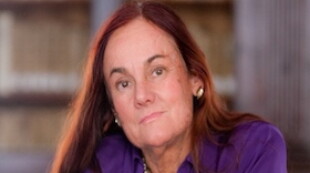
Virginia Trimble in the mid-1970s.
Photo courtesy of American Association of Physics Teachers, AIP Emilio Segrè Visual Archives.
Virginia Trimble is many things: an astrophysicist, a historian of her discipline, and, by her own cheerful account, a “third-generation atheist” and “born dictator.” For sixteen years, she read every paper published in twenty-three astronomy and astrophysics journals and synthesized them into an annual review essay for the Publications of the Astronomical Society of the Pacific. It was a feat of intellectual stamina that eventually fed a second research interest: scientometrics, the statistical study of how science itself is published and practiced, which she has said she found herself contributing to “for quite a while before I knew the name.”
Her own publication list now exceeds 900 items. An asteroid bears her name. Here at AIP, she is a longtime friend of our history program and in 2013 endowed our Lyne Starling Trimble Public Event Series, which holds several historical lectures each year and is named in honor of her father.
Now, we can know a lot more about Virginia Trimble with the posting of an oral history that historian David DeVorkin recorded with her over five sessions between 2011 and 2014, usually while she was eating lunch in a hotel room during a professional meeting. It is a chatty, meandering, and entertaining set of conversations, owing to Trimble’s legendary frankness and also her long friendship with DeVorkin, which goes back to when they were undergraduates at UCLA. Above all, it is an engaging narrative of how a life in science actually unfolds: less a straight trajectory than a series of well-timed accidents and accidents narrowly avoided.
On not being able to see, and not knowing it
Trimble was born severely nearsighted (roughly 20/200) and nobody discovered it until she was in seventh grade. Her surname began with “T,” which meant she came near the end of the alphabet during school eye exams; by the time it was her turn to read the chart, she had memorized it from listening to everyone else. She navigated childhood by counting her steps. She couldn’t find the bathroom at nursery school.
“I had no way of knowing other people could see,” she told DeVorkin. “I just thought I was inferior. But I changed my mind about that eventually.”
The discovery, when it finally came, was made not by a doctor—the family couldn’t afford one—but by her seventh-grade math teacher, who noticed that she performed perfectly on problems from the textbook and poorly on the same problems written on the board. “At first she thought I was cheating,” Trimble said.
The moment she got glasses: “The first thing I noticed was the trees had individual leaves. I had never known that before.”
On how she became an astronomer
What Trimble originally wanted to study was ancient Egyptian archaeology. UCLA, in the early 1960s, did not offer an undergraduate archaeology major; you had to complete anthropology first. That meant, as she put it, “four years of the marriage customs of the Yangna Indians. I exaggerate, but not very much.”
So she sat on the living room floor with her father, going through the course catalog. They reached the A’s. “Art” was eliminated: her junior high art teacher had offered her a B if she would “promise never to draw in public.” Astronomy was next.
“He says, ‘Well, you’ve always been interested in astronomy,’” Trimble recalled. “This was the first I knew about it.”
The interest, such as it was, had consisted largely of looking through her Uncle Roy’s telescope and pretending to see things she couldn’t see. “When you look through a telescope and your vision is 20/200, you don’t see very much,” she said, “but you also don’t admit this or you’ll never get to go indoors where it’s warm. You just have to say, ‘Isn’t that wonderful. Thank you so much, Uncle Roy.’”
She enrolled as an astrophysics major and graduated in three and a half years, partly by accident. “I happened to fulfill the last of the requirements” earlier than expected, she said.
On graduate studies at Caltech
Finishing at UCLA, Trimble secured a Woodrow Wilson Fellowship that required her to attend a different institution. She targeted Caltech, which was the only other astronomy program she could reach without leaving Southern California, where she was close to her parents and earning money appearing in commercials. As an undergraduate she spent a year as “Miss Twilight Zone,” and she would continue as a graduate student. Recalling being photographed for Datsun car ads, she reflected, “If they were run at all, they were run in Japan.”
“I didn’t know Caltech was prestigious,” she told DeVorkin. “I only discovered that when I got there.” Caltech was also unapologetically unwelcoming to women. It did not begin admitting them as undergraduates until 1970, and its graduate catalog in the early 1960s flatly stated they would be admitted at that level “only under exceptional circumstances.” The admission letter she received from graduate advisor J. Beverly Oke acknowledged that, on the basis of her record, they felt they “couldn’t deny” her admission, but suggested she “might be happier elsewhere.” Her mother’s advice: “Just ignore the last line.” Mentioning the letter to Oke years later, she recalled, “He blushed a little bit.”
Trimble is candid in discussing what it was like to be one of only a few women at Caltech. Astronomy continues to struggle with a culture that enables sexual harassment, but Trimble regarded her own romantic relationships with colleagues, as well as with her thesis advisor, differently. Asked by DeVorkin whether she felt exploited, she replied, “I don’t think I was being exploited. Not at all.” What she got out of those relationships, she said, was “a lot of fun, lots of good meals, good music. No quarrels.” While forthright about her own experiences, she didn’t speak about what they might say about the experiences of women for whom such an environment was outright hostile.

Virginia Trimble at AIP’s symposium marking the retirement of Spencer Weart as director of its history program.
Emilio Segrè Visual Archives General Collection.
On scientific ideas and their significance
Trimble’s thesis at Caltech was on the motion and structure of the Crab Nebula’s filamentary envelope. It garnered 198 citations, which, she noted, was “a lot for those days.” The pulsar discovery partway through her graduate work gave the thesis an unexpected significance: Once astronomers confirmed a pulsar at the Crab’s center, the energetics of the nebula became a live question, and her structural work was already in hand. “It was important to have a good distance and to have some idea of where the filaments were,” she said.
Her most-cited paper, with 353 citations at the time of the interview, came later: a 1987 survey in Annual Reviews of Astronomy and Astrophysics on the existence and nature of dark matter. She was matter-of-fact about the timing. “I did it just as dark matter was becoming ‘in.’ Well, that’s why I did it.” She also did early work on the distribution of binary star mass ratios, work she was eventually proved right about, she noted dryly, after “it’s taken thirty years for the rest of the community to notice I was actually right: The distribution is bi-modal.” Credit, in her view, mattered only modestly. “But yes,” she told DeVorkin, “one wants some credit for things one does.”
On philanthropy
By the time she sat down with DeVorkin for their final session in January 2014, Trimble had begun to direct the proceeds from selling family property into scientific institutions.
Following the sale of the house in Maryland that she shared with her late husband, Joseph Weber, she funded the Joseph Weber Award at the American Astronomical Society. Her philanthropic relationship with AIP’s history program started with a bet with its director, Spencer Weart, that they did not have an oral history discussing Weber, who had become best known for his early unsuccessful efforts to detect gravitational radiation. Presented with a relevant section of an interview discussing Weber’s earlier work on masers, she donated $10,000. Later, when she sold her parents’ house, she donated $100,000 for the lecture series she named after her father. The sale also funded five years of a graduate student workshop at the Lick Observatory.
Explaining her philanthropy to DeVorkin, she opined, “Look, what are you going to do with all this money?”
—
Rebecca Charbonneau
American Institute of Physics
rcharbonneau@aip.org
You can sign up to receive the Weekly Edition and other AIP newsletters by email here.
More from AIP