
Williamina Fleming and the peculiar spectrum of ζ Puppis

The day of the discovery of an “unknown element not seen in stars or on earth” is recorded in Williamina Fleming’s logbook of October 29, 1896, along with the wavelengths of the unknown element’s spectral lines. These wavelengths are written down in her hand on the left margin of page 147. Also recorded are the wavelengths of the omnipresent Balmer lines of atomic hydrogen.
Courtesy of Harvard College Observatory.
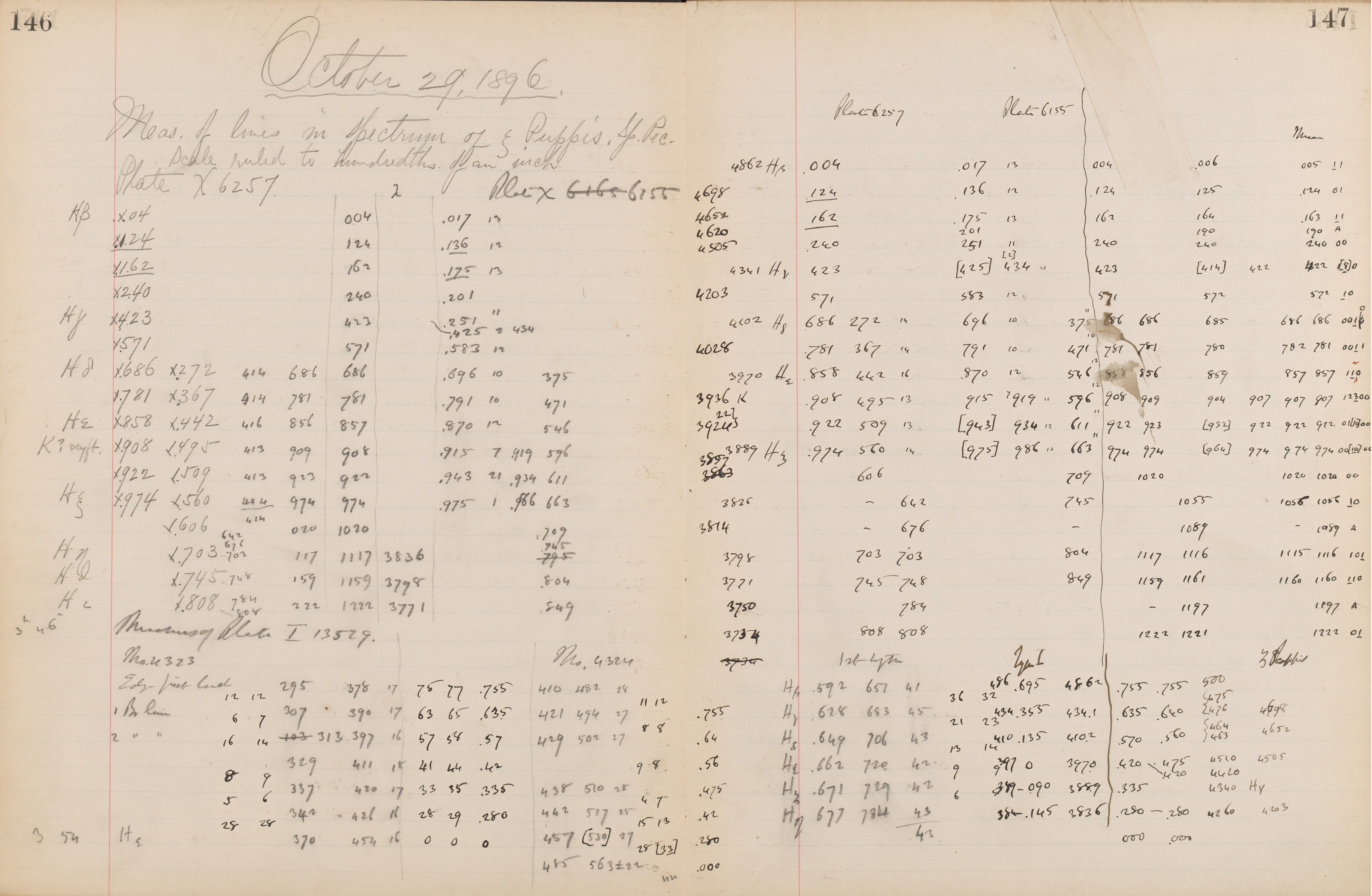
In one of Williamina Fleming’s many logbooks, the notes dated October 29, 1896 stand out as particularly striking. On pages 146 and 147 in sequence no. 9 of her logbook series, in which she examined photographic plates for the presence of variable stars, appears the note “Meas. of lines in Spectrum of ζ Puppis,” which records her documentation of the wavelengths found in the image borne on plate X6257.1 The spectrum photograph had been obtained on December 17, 1894, using the 13-inch Boyden refractor at Arequipa, Peru, as denoted by the X at the start of its label.
With astounding speed, Fleming’s documentation appeared swiftly in print in the form of Harvard College Observatory Circular no. 12 on November 2, 1896.2 The same announcement, slightly tailored to the individual journals, also appeared under Pickering’s name in the December 1896 issue of the Astrophysical Journal and in 1897 in Astronomische Nachrichten.3

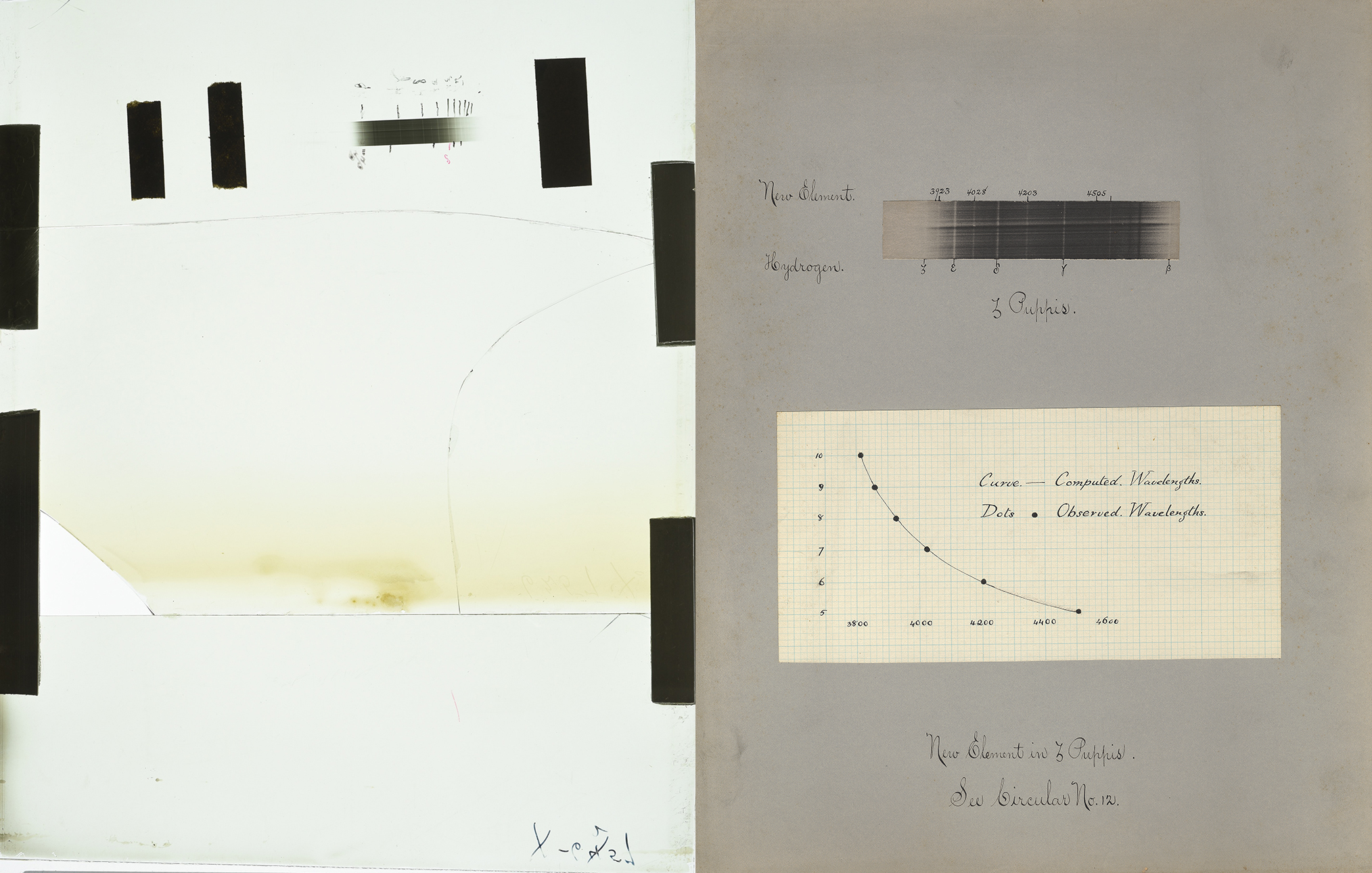
At left, photo of the glass plate X-6257 with the spectrum from ζ Puppis, photographed on December 17, 1894, with the 13-inch Boyden refractor (as denoted by the label “X”) at Harvard College Observatory’s station in Arequipa, Peru. At right, the upper panel is the same spectrum, evaluated by Williamina Fleming on October 29, 1896. The wavelengths shown along the upper abscissa pertain to the spectrum of a “new element,” now known as the Pickering series of He+, while the absorption lines of the Balmer series (β through ζ) of atomic hydrogen are shown on the lower abscissa and serve as wavelength standards. The lower panel is a numerical fit of the wavelengths of the Pickering series of He+, obtained by inverting the empirical Balmer-series-like fit featured in Edward Pickering’s 1896 aritcle, “Stars having peculiar spectra. New variable stars in Crux and Cygnus.” Note that the handwriting in the panels is likely Williamina Fleming’s.
Left: Courtesy of Harvard College Observatory. Right: Published with permission from the Collection of Historical Scientific Instruments, Harvard University.

In these announcements, Pickering wrote, “A list of stars having peculiar spectra and found by Mrs. Fleming in her regular examination of the Draper Memorial photographs are given in the annexed table.” He then goes on to say that the first star on the list, ζ Puppis, exhibits a spectrum...
...which is very remarkable and unlike any other yet obtained. The continuous spectrum is traversed by three systems of lines, First, the hydrogen lines and the line K, which are dark, as in stars of the first type. Second, two bright bands or lines whose approximate wave lengths are 4652 and 4698, which may be identical with the adjacent lines in spectra of the fifth type. Third, a series of lines whose approximate wave lengths are 3814, 3857, 3923; 4028, 4203, and 4505, the last line being very faint. These six lines form a rhythmical series like that of hydrogen and apparently are due to some element not yet found in other stars or on earth [our emphasis].
He then concluded, “The formula of Balmer will not represent this series”—known since as the Pickering series—but went on to show that, when suitably modified, a Balmer-like formula involving squares of an integer pertaining to the individual lines fit the spectrum with λ the wavelength in Å and m an integer.
These wavelengths were featured along with the Balmer-series-like fit in the Astronomische Nachrichten and Astrophysical Journal articles. The formula for the Balmer series of atomic hydrogen has been found empirically in 1885 by the Swiss high-school teacher Johann Jakob Balmer and generalized in 1890 by Johannes Rydberg for spectral series of other atoms, especially those of Groups 1–3.4
In a follow-up paper, “The spectrum of ζ Puppis,” published in 1897 in Harvard College Observatory Circular no. 16, in Astronomische Nachrichten, and in the Astrophysical Journal, Pickering confirmed the wavelengths of the lines of the Pickering series but changed tack and ascribed them to atomic hydrogen. He reported a unifying empirical formula involving squares of an integer that reproduced the Balmer series and Pickering series for the integer’s even and odd values, respectively.5 This was very much in the spirit of the times when physicists were groping for the conceptual foundations of spectroscopy.6
In the 1897 follow-up, Pickering noted: “Miss A. J. Cannon has found that the same series of lines [i.e., the Pickering series] occurs in the star 29 Canis Majoris.” In 1901, Harvard College Observatory Circular no. 55 added further updates to the findings related to the spectral significance of ζ Puppis as more and better plates could provide sharper images.9
A note related to both ζ Puppis and 29 Canis Majoris appears in the 1979 work by Cecilia Payne-Gaposchkin, Stars and Clusters:8
It is not without significance that the known stars of very high mass are luminous blue stars: once they have left the main sequence, such stars cannot last long. The giant eclipsing variable UW Canis Majoris (29 Canis Majoris, another star of many names) and the second magnitude ζ Puppis, one of the hottest known stars, are of very high mass, at least thirty times the sun’s. We do not know what the future holds for them.
Today, we know that ζ Puppis is a blue supergiant of type O4, one of the hottest and most luminous stars of the Milky Way with a surface temperature of K, where ionized helium, or He+—the “element not yet found”—is especially abundant.9

Williamina Fleming’s last paper, “Stars having peculiar spectra,” was published solely under her name, with a preface by Pickering. The paper featured the term “Pickering Series” and was published posthumously in 1912, a year after Fleming’s death.
Williamina P. Fleming, “Stars having peculiar spectra,” Annals of the Harvard College Observatory, 56, no. 6, 1912. 165–226. Courtesy of the Astrophysics Data System, funded by NASA under Cooperative Agreement 80NSSC21M00561.
We note that in Fleming’s final published work, “Stars having peculiar spectra,” which appeared in the 1912 volume of the Annals of the Astrophysical Observatory of Harvard College, the discoveries of the peculiar spectra of both ζ Puppis and 29 Canis Majoris are credited to Pickering. The “reference” given for ζ Puppis in this work is the 1897 Harvard College Observatory Circular No. 16, “The spectrum of ζ Puppis,” while that for 29 Canis Majoris is the 1897 Harvard College Observatory Circular No. 17, “Stars having peculiar spectra,” which were both written by Pickering.10
Fleming’s “Stars having peculiar spectra” featured the “Pickering series” and was published, with a preface by Pickering dated October 21, 1912, more than a year after Fleming’s death. By the time she had authored and overseen the production of her final publication, the notion of a “Pickering series” may have gained such notoriety in scientific circles that she did not wish to detract from the renown of the director and left things the way they were.
References
- ζ Puppis is pronounced zeta pup-iss.
- Edward C. Pickering, “Stars having peculiar spectra. New variable stars in Crux and Cygnus,” Harvard College Observatory Circular, 12, 1896, pp. 1–2, https://ui.adsabs.harvard.edu/abs/1896HarCi..12....1P/abstract.
- Edward C. Pickering, “Stars having peculiar spectra. New variable stars in Crux and Cygnus,” Astrophysical Journal, 4, 1896, 369–370, doi:10.1086/140291; and Edward C. Pickering, “Stars having peculiar spectra. New variable stars in Crux and Cygnus,” Astronomische Nachrichten, 142, no. 6, 1897, 87–90, doi:10.1002/asna.18971420605.
- J. J. Balmer, “Notiz über die Spektrallinien des Wasserstoffs,” Verhandlungen der Naturforscher Gesellschaft zu Basel, 7, 1885, p. 548; and J. R. Rydberg, “On the structure of the line-spectra of the chemical elements,” London, Edinburgh, and Dublin Philosophical Magazine and Journal of Science, 29, no. 179, 1890, 331–337, doi:10.1080/14786449008619945.
- Edward C. Pickering, “The spectrum of ζ Puppis,” Harvard College Observatory Circular, 16, 1897, 1–2, https://ui.adsabs.harvard.edu/abs/1897HarCi..16....1P/abstract; Edward C. Pickering, “The spectrum of ζ Puppis,” Astronomische Nachrichten, 142, no. 24, 1897, 399–402, doi:10.1002/asna.18971422404; Edward C. Pickering, “The spectrum of ζ Puppis,” Astronomical Journal, 5, 1897, 92–94, doi:10.1086/140312.
- Nadia Robotti, “The spectrum of ζ Puppis and the historical evolution of empirical data,” Historical Studies in the Physical Sciences, 14, no. 1, 1983, 123–145, doi:10.2307/27757527.
- Edward C. Pickering, “The spectrum of ζ Puppis,” Harvard College Observatory Circular, 55, 1901, 1–2, https://ui.adsabs.harvard.edu/abs/1901HarCi..55....1P/abstract.
- Cecilia Payne-Gaposchkin, Stars and Clusters (Cambridge University Press, 1979), p. 43.
- Elena Schilbach and Siegfried Röser, “On the origin of field O-type stars,” Astronomy and Astrophysics, 489, no. 1, 2008, 105–114, doi:10.1051/0004-6361:200809936.
- Williamina P. Fleming, “Stars having peculiar spectra,” Annals of the Astronomical Observatory of Harvard College, 56, no. 6, 1912, https://ui.adsabs.harvard.edu/abs/1912AnHar..56..165F/abstract; Pickering, “The spectrum of ζ Puppis,” op. cit. (5); Edward C. Pickering, “Stars having peculiar spectra,” Harvard College Observatory Circular, 17, 1987, 1–2, https://ui.adsabs.harvard.edu/abs/1912AnHar..56..165F/abstract.
Explore further

Cite this resource
Bretislav Friedrich and Maria McEachern, “Williamina Fleming,” Women in the History of Quantum Physics collection, American Institute of Physics, 2026, https://www.aip.org/history/williamina-fleming.