
Harvard College Observatory: Stellar classification systems, 2

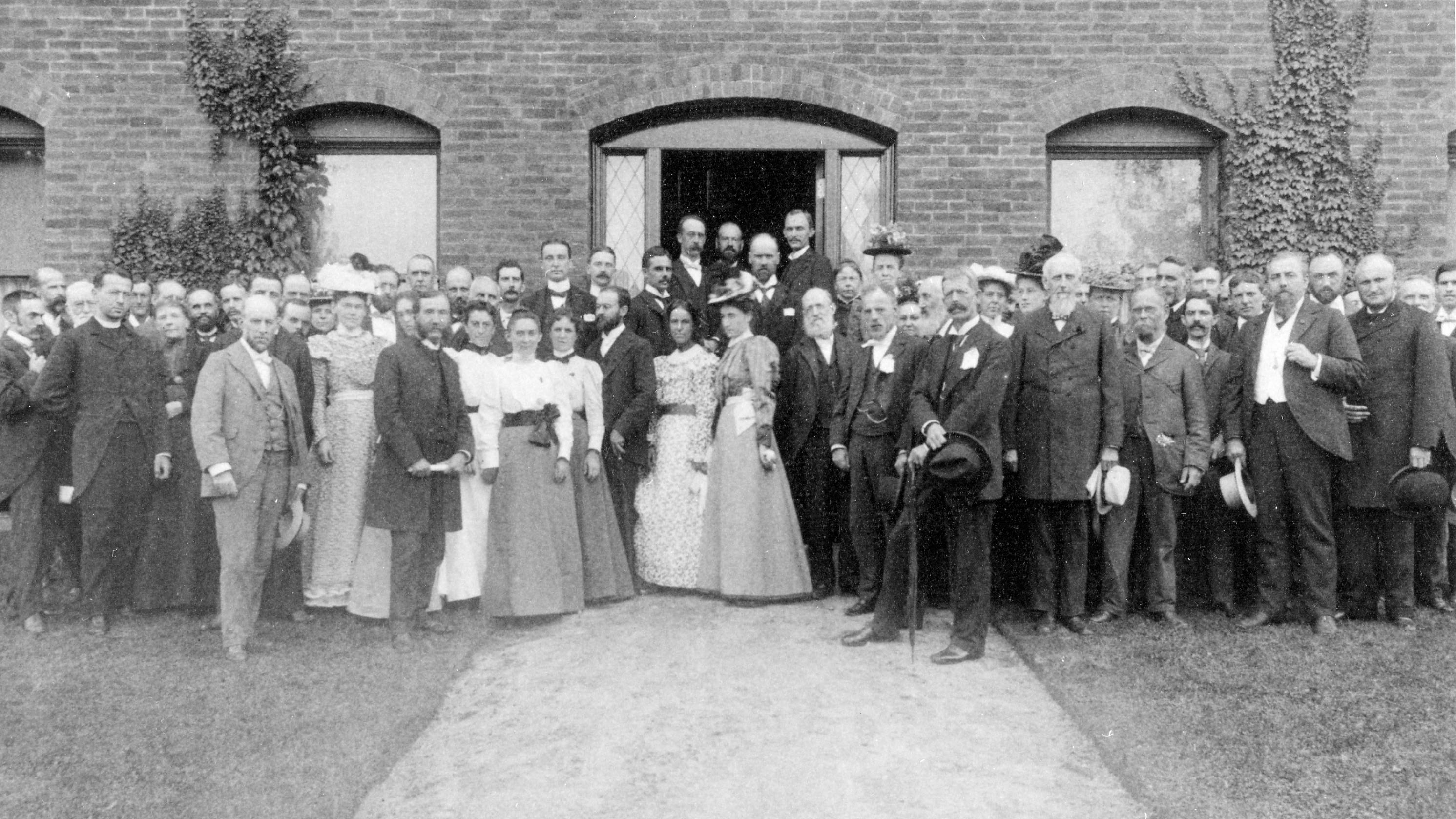
Attendees of the second in a series of annual conferences on astrophysics, held in 1898 at Harvard College Observatory. In the group of three women in white on the left side of the photo, Williamina Fleming is the furthest to the left.
Harvard College Observatory, courtesy of the AIP Emilio Segrè Visual Archives.

Discussing Williamina Fleming’s development of a system in the 1890s to classify stars according to their spectra, Annie Cannon later wrote:1
The divisions into five types made by Secchi proved altogether inadequate to represent the numerous differences seen on the photographs. A new system had to be adopted which would permit the reader to understand the various aspects of the spectra as shown by the photographs. … This classification is purely empirical, being based wholly on the external appearances, without any idea of expressing differences in temperature or stages of evolution.
Fleming elaborated on Secchi’s spectral classes and added a number of subdivisions, each of which received a letter designation: A, B, C, D, E, F, G, H, I, K, L, M, and N. Cannon explained:2
Stars of Type A and B were bright blue stars like Sirius and those in Orion … while stars of Type F and G had spectra similar to that of the sun, and K and M stars were characterized by reddish spectra containing strong dark bands, in addition to the narrow metallic lines seen in other stars.
More precise classifications enabled the identification of stars exhibiting noteworthy characteristics. Class Q would be added to Fleming’s system for stars with spectra that didn’t really fit into any other category. The letter “O” was added to indicate a set of stars that Fleming herself considered to be “the most striking class of stellar spectra, in fact the only one that is at once detected visually with a small telescope.”3 Included in this class, also known as the “fifth type,” would be Wolf-Rayet-type stars along with 21 stars that had been discovered in the Large Magellanic Cloud; a number of others were found to “occur near the central line of the Milky Way.”
In August 1898, a conference of astrophysicists was held at Harvard that is now best known for resolving to establish the Astronomy and Astrophysics Society of America, later renamed the American Astronomical Society. Among the scientific papers at the conference was one submitted by Fleming titled, “Stars of the fifth type in the Magellanic Clouds,” which was read by Pickering.
Up to that time, according to the paper, 92 such stars exhibiting the particular bright line spectra had been discovered. At the end of his reading of the paper, Pickering took the liberty of informing the crowd that, of those 92 stars, 78 had been discovered by Fleming—-who had not mentioned this fact in the paper and was in attendance. A spontaneous burst of applause impelled her to come forward, whereupon she responded to questions that had been generated by her paper from the astronomers in attendance.4
Exactly how stars should be classified remained a subject of debate for some time. Another of the women at the observatory, Antonia Maury, proposed another, more intricate system, which she published under her own name, but it was not adopted by Pickering.5 Annie Cannon later simplified Fleming’s system, combining certain classes and doing away with others, such as little-used C, D, E, H, I, L, N, and Q.
Cannon’s new ordering system did allow for differentiations in spectra to be expressed within the various types either by a supplementary letter such as Oa (“A broad bright band whose centre is at wavelength 4633 is the most conspicuous feature of this spectrum”) or by the addition of a digit such as F2 (“This spectrum resembles Class F, except that there is a slight appearance of continuity in band G”).6 Her system aligns with the abscissa of the Hertzsprung–Russell diagram of stellar luminosity versus temperature.
References
- Annie J. Cannon, “The Henry Draper Memorial,” Journal of the Royal Astronomical Society of Canada 9, no. 5, 1915, 203–215, https://scixplorer.org/abs/1915JRASC...9..203C/abstract.
- Ibid.
- Williamina P. Fleming, “Stars having peculiar spectra,” Annals of the Astronomical Observatory of Harvard College 56, no. 6, 1912, 165–226, on p. 177, https://scixplorer.org/abs/1912AnHar..56..165F/abstract.
- Harriet Richardson Donaghe, “Photographic flashes from Harvard Observatory,” Popular Astronomy 6, 1898, 481-487, on p. 483, https://scixplorer.org/abs/1898PA......6..481D/abstract.
- Antonia C. Maury, “Spectra of bright stars photographed with the 11-inch Draper telescope as a part of the Henry Draper Memorial,” Annals of the Astronomical Observatory of Harvard College 28, no. 1, 1897, 1–128, https://scixplorer.org/abs/1897AnHar..28....1M/abstract. On the broader efforts to establish a system of classification, see David H. DeVorkin, “Community and spectral classification in astrophysics: The acceptance of E. C. Pickering’s system in 1910,” Isis 72 (1981), 29–49, doi:10.1086/352649.
- Annie J. Cannon, “Classification of 1,477 stars by means of their photographic spectra,” Annals of the Astronomical Observatory of Harvard College 56, 1912, 65–114, on pp. 66 and 68, https://scixplorer.org/abs/1912AnHar..56...65C/abstract.
Explore further

Cite this resource
Bretislav Friedrich and Maria McEachern, “Stellar classification systems, 1,” Harvard College Observatory history guide, American Institute of Physics, 2026, https://www.aip.org/history/harvard-observatory/stellar-classification-2.
Note that this material was originally developed in concert with the Williamina Fleming history guide as part of the Women in the History of Quantum Physics collection.