
Careers, Identity, and Change Across the Physical Sciences


In summer 2026, AIP partnered with 11 scientific societies[1] from across the AIP Federation to survey their members about the issues shaping careers and professional communities across the physical sciences. Conducted in support of AIP’s 2026 Research Agenda , the survey was designed in response to participating societies’ interest in better understanding their members’ evolving professional identities, employment experiences, and needs during a period of significant change in federal policy. Overall, 2,384 individuals responded to at least part of the survey and 2,172 of those respondents completed the entire questionnaire. A companion PDF containing the full set of overview tables is also available which includes further information about the methodology and list of the participating scientific societies. (See the download below or click here .)
Levels of engagement and participation varied among societies. As a result, these findings offer insight into the participating respondents’ experiences and are not necessarily representative of the collective membership of societies across AIP’s Federation. Even so, these results offer a valuable cross-society perspective, revealing shared concerns among respondents about the future of science, tangible effects of policy change on their work and careers, and the extent to which professional identities span disciplines and roles across the physical sciences.
Report Highlights
- Federal funding, public trust, and artificial intelligence were respondents’ leading concerns for the future. When asked to identify the most important issues impacting the science and engineering enterprise today, respondents most frequently selected federal funding for science (74%), public trust in science (61%), and artificial intelligence (49%).
- Nearly one in five respondents reported losing funding for planned work as a result of federal policy changes. When asked about the effects of recent federal policy and funding changes on their work, 19% reported losing funding for a planned activity, such as a grant or contract.
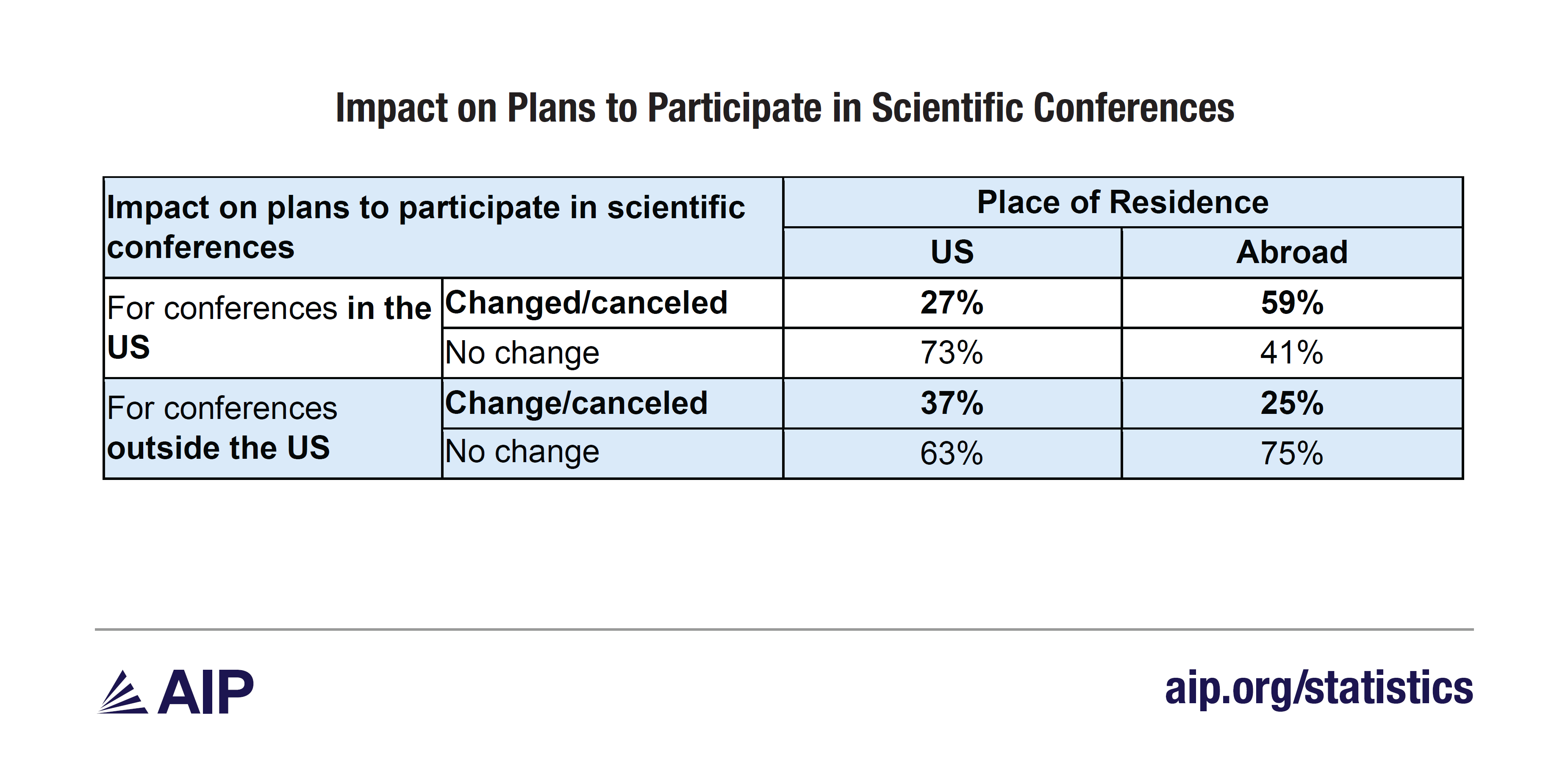
- US policy changes significantly disrupted conference participation among respondents abroad. When asked about changes to their conference plans resulting from U.S. policy changes since January 20, 2025, 59% of respondents living outside the United States who had planned to attend a meeting in the United States reported changing or canceling those plans.
Federal funding, Public Trust, and AI lead Concerns
We asked respondents to select up to three of the most important issues affecting the science and engineering enterprise at this moment. They chose from 11 predefined issues and could also identify another issue not included on the list.
Across participating respondents, three issues stood out.
- Nearly three-quarters selected federal funding for science (74%),
- approximately six in ten selected public trust in science (61%), and
- about half selected artificial intelligence (49%).
The next most frequently selected concerns included the educational pipeline for scientists (23%), climate change (18%), research integrity (16%), and eliminating barriers to access and opportunity (15%) in science. Because respondents could select as many as three issues, these percentages are not expected to total 100%.
Confidence in Physical-Science Careers Persists
Despite concerns about funding, policy, international engagement, and the changing nature of scientific work, respondents remained broadly positive about careers in the physical sciences.
Approximately 54% said they would definitely encourage an interested and talented young person to pursue a career in the physical sciences, while another 24% said they probably would. Eighteen percent said they would possibly encourage such a career, while 2% said they would not and 2% did not know.
Taken together, nearly four in five respondents would probably or definitely encourage a young person to enter the physical sciences. That finding reflects continued confidence in the value and promise of scientific careers, even during a period of significant uncertainty.
Federal Policy and Funding Changes Are Affecting Respondents’ Careers
Changes in federal policy and funding have already affected the work of some respondents.
- Nearly one in five reported losing funding for a planned activity, such as a grant or contract.
- Four percent experienced reduced work hours or responsibilities,
- 2% lost a job or position, and
- 2% retired or accepted a buyout earlier than they had intended.
Most respondents reported no direct employment impact at the time of the survey, but the loss of planned funding was widespread enough to indicate meaningful disruption to research and other scientific activities. Additionally, enough respondents (4%) explicitly chose not to respond to this question to suggest it was sensitive topic for some.
Respondents See Challenges in Attracting International Talent
Respondents expressed substantial concern about the effects of US policy on the country’s ability to recruit international science and engineering talent. Almost three-fourths of respondents residing in the US thought the impact was negative, while only one in twenty thought there had been no change or a positive impact. Respondents living abroad had similar thoughts but expressed more uncertainty in their responses.

Impact of US policy since January 20, 2025 on recruiting STEM talent to the US
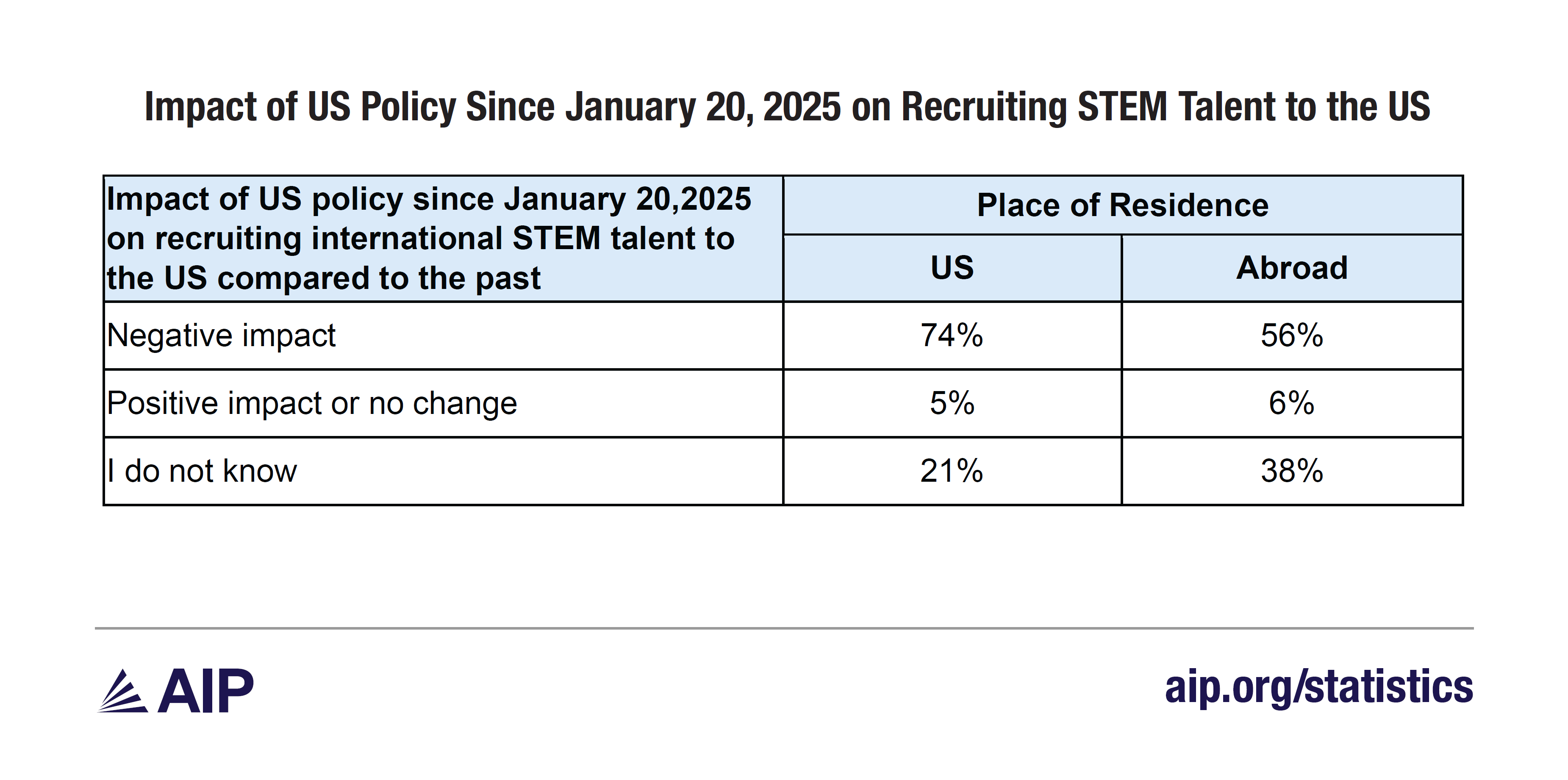
These findings point to broad concern about the ability of the United States to remain a welcoming and competitive destination for international scientific talent.
US Policy Changes Have Disrupted Scientific Meeting Participation
US policy changes also affected respondents’ plans to participate in scientific conferences. The effect becomes particularly clear when the analysis focuses on people who had plans to attend a meeting, particularly for people living abroad who had planned to attend a conference in the US.

Impact on plans to participate in scientific conferences
Professional Identities Span Disciplines and Roles
When asked to identify their primary professional identity, respondents indicated a wide range of identities including Physicist, Astronomer/astrophysicist, Educator, Medical physicist, Material scientist, Planetary scientist, Crystallographer, Chemist, and Chemical engineer. Respondents were also asked to identify any additional professional identities. While the responses are only illustrative of the survey participants and not the membership of AIP’s full set of societies, the resulting combinations of professional identities reveal ways that interdisciplinarity comes together across professional identities of respondents from 11 societies across the physical sciences community. Respondents affiliated with every participating society reported multiple professional identities, suggesting that interdisciplinarity is not confined to a particular field or organization and may extend across other parts of the Federation. Approximately three-quarters selected at least one identity in addition to their primary one; there were 140 observed combinations.
Given the centrality of physics to AIP’s federation, it should be no surprise that Physicist is an especially important connecting identity across respondents. Overall, four in ten respondents identified as Physicists for either their primary or secondary professional identity. Yet relatively few described Physicist as their only professional identity: just 7% of all substantive respondents selected Physicist as their primary identity and explicitly reported having no secondary identity.
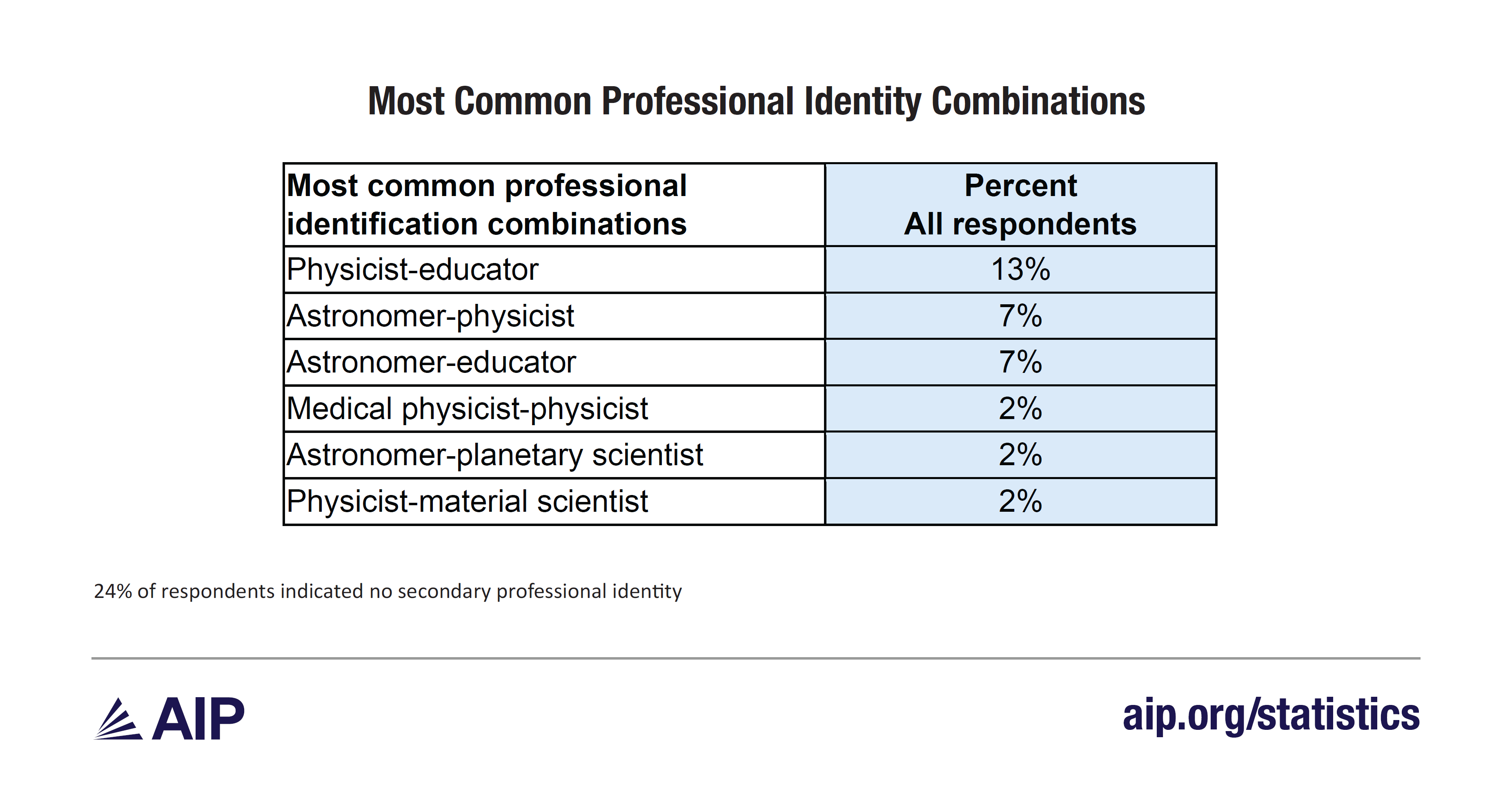
Education also emerged as a major cross-cutting professional identity. Thirteen percent of respondents identified primarily as Educators, and another 18% selected educator as a secondary identity. Taken together, nearly one in three respondents identified as an educator in some capacity. Educator frequently connected with other identities: physicist–educator was the most observed pairing, while astronomer–educator and medical physicist–educator were also among the recurring pairings.
The range of combinations extended well beyond physics and education. Respondents connected astronomy with planetary science and data science, medical physics with physics and biomedical engineering, crystallography with chemistry, materials science with physics and engineering, and rheology with chemical engineering. Altogether, respondents reported 140 distinct pairings between professional identities. The top six identity pairs are shown below.

Most common professional identity combinations
These findings also build on patterns documented more than two decades ago in AIP’s comprehensive 2004 Society Membership Profile which found a similarly wide range of scientific and engineering self-identifications within the Federation at that point. Although the two surveys are not directly comparable, the current results add a new dimension by illustrating how frequently multiple identities intersect within individual careers.
These findings illustrate a professional community whose members frequently work across disciplinary and occupational boundaries. They also suggest that scientific societies serve people whose careers connect multiple fields, professional roles, and communities rather than identifying with only one traditional discipline.
Reference
[1] The full list of participating Member Organizations is available in the Methodology section of the full report.


