More US Trained Physics PhDs are Leaving the US


- Between the 2023–24 and 2024–25 academic years, the proportion of new physics PhDs leaving the United States after earning their degree increased more than in any other year-over-year period observed during the past 30 years.
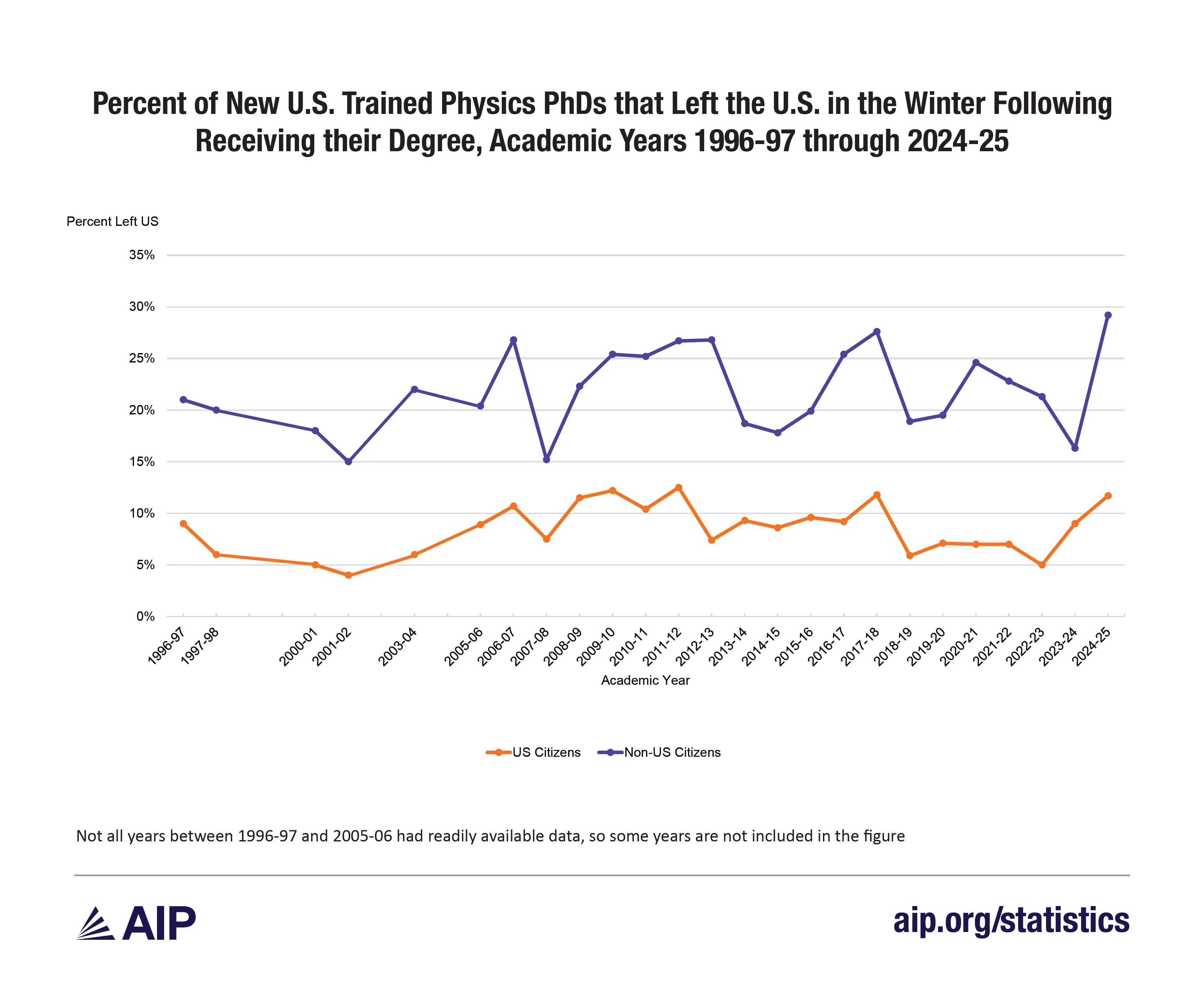
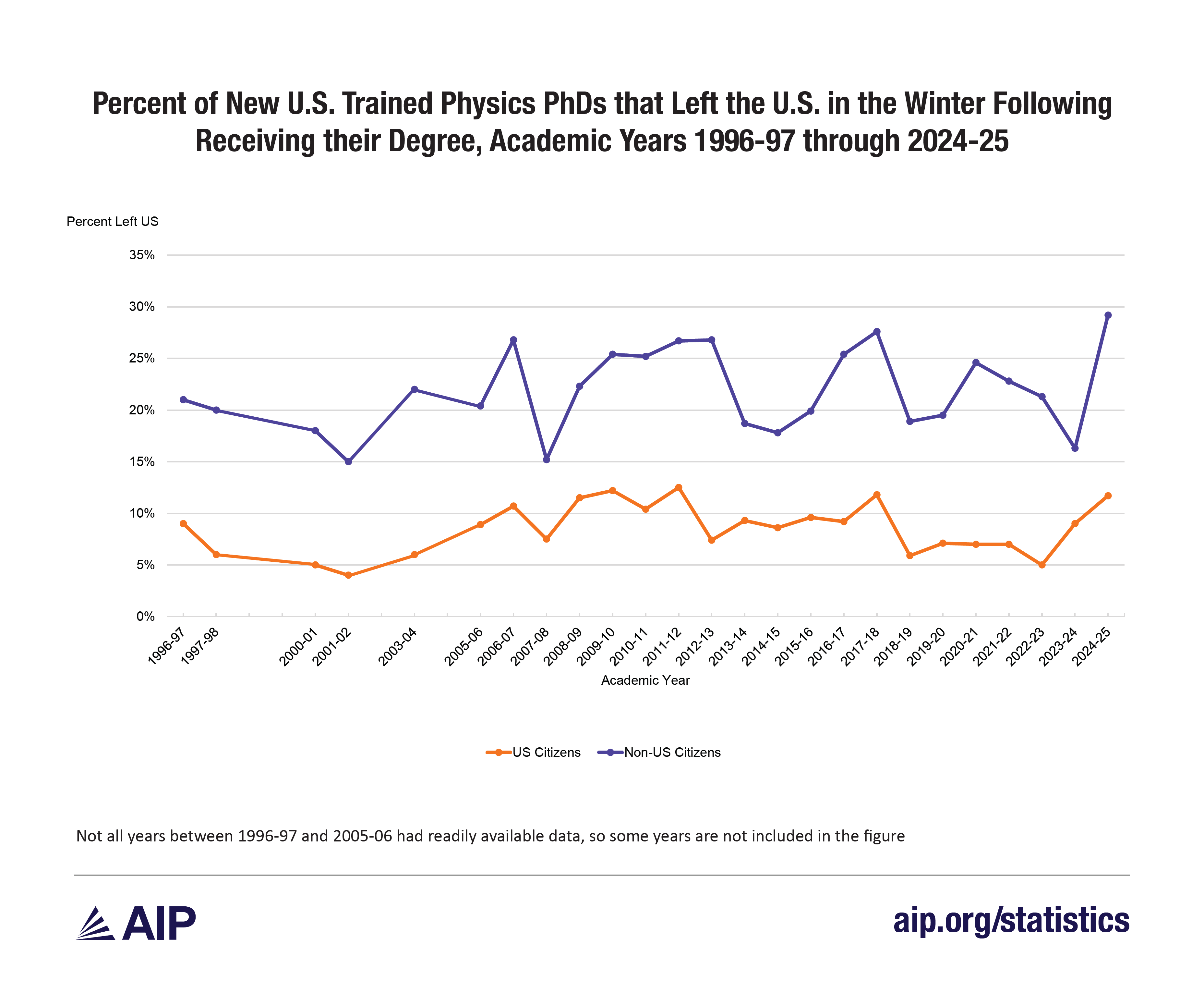
- The proportion of non-U.S. citizens leaving the U.S. post-degree nearly doubled, from 16% to 29%.
- Recent research from the National Bureau of Economic Research suggests that young scientists in general are more often considering leaving the U.S. than they had in previous years.
Background
Recent data from AIP show that the proportion of new physics PhDs residing outside the United States in the winter following graduation has increased sharply for both U.S. citizens and non-U.S. citizens. The increase among non-U.S. citizens is especially pronounced. Recent AIP research has also documented significant declines in first-year graduate physics student enrollments among both U.S. and international students (Mulvey et al., 2026 ). Together, these changes coincide with a period of substantial shifts to federal science funding, and visa and immigration policies implemented over the past 18 months under the Trump administration. Many of these policies have directly affected the U.S. research enterprise, particularly international students and early-career researchers.
AIP’s Visa and Immigration Policy Guide provides additional information and resources related to the recent visa and immigration policy impacts. You can visit the guide here: https://www.aip.org/research/visa-immigration
Figure 1

AIP has been conducting an annual follow-up survey of physics PhD recipients for decades, tracking a large amount of outcome data across different categories. The survey is distributed to recent physics PhD recipients in the winter following their degree. Among the initial outcome tracking is the current location of the respondent, including whether they were residing outside the U.S. in the winter following receiving their PhD.
Over the last three decades, this proportion has remained mostly stable for U.S. citizens (Figure 1). In contrast, non-U.S. citizens show considerably more year-to-year variation over the same time period. Even with the year-to-year changes in the proportion of non-U.S. citizens leaving the U.S., the proportion from the 2024-25 academic year increased significantly; it is the largest single year-to-year increase for which we have reliable data. For academic year 2023-24 (pre-current administration), our follow-up data shows that about 16% of non-U.S. citizens left the U.S. after receiving their PhD. One academic year later (2024-25), that proportion was about 29%, a near doubling. Similarly, the proportion of U.S. citizens leaving the U.S. has also experienced a notable increase in the past two academic years. About 5% of U.S. citizens receiving their physics PhD in the 2022-23 academic year were residing outside the U.S. in the winter following receiving their degree, that proportion rose to almost 12% two years later for degree recipients from the 2024-25 academic year, more than doubling.
This change in the proportion of new PhDs remaining in the U.S. after receiving their degree is likely not limited to just physics PhDs. The National Bureau of Economic Research (NBER) compiled survey data from a sample of biomedical research laboratories across the U.S., and it shows a similar shift in the proportion of researchers planning to leave the U.S.. The study compared the likelihood of young biomedical researchers choosing to stay in the U.S. before and after the administration’s funding changes. For those who were U.S. citizens, the proportion indicating they were likely to remain in the U.S. declined by 15.8%, while for non-U.S. scientists, it declined by 30.8% (Azoulay et al., 2026 ).
While the NBER study measures researchers’ intentions to remain in or leave the United States, the AIP data documents the actual post-graduation locations of recent physics PhD recipients, providing evidence that these intentions are consistent with real changes in PhD post-degree behavior.
The survey instrument used in the physics PhD follow-up survey did not ask degree recipients what influenced their decision to remain in the U.S. or to not. That said, the largest one-year increase in the proportion of non-U.S. citizens leaving the U.S. after receiving their degree seen between academic years 2023-24 and 2024-25 has certainly been influenced by changes in the nation’s science funding structures and in the significant changes in visa policies. These declines in stay rates and recent declines in first-year graduate physics student enrollments for both U.S. and non-U.S. students may not prove to be short term. If they persist, they are likely to negatively impact both physics and the broader scientific community.
Methodology
Each fall AIP conducts a Survey of Enrollments and Degrees, which asks all degree-granting physics and astronomy departments in the U.S. to provide information concerning the number of students they have enrolled and counts of recent degree recipients. At the same time, they are asked to provide the names and emails of recent degree recipients. We then use this degree recipient contact information to conduct our follow-up survey in the winter following the academic year in which students received their degrees. If a degree recipient does not reply after several attempts, their advisor is contacted with a shortened version of the survey, as well as a request for more current contact information for the individual.
Analysis on proportions of respondents leaving the U.S. includes data from a 30-year period and includes academic years 1996-97 through 2024-25. Not all years between 1996-97 and 2005-06 were readily available, so some years are not displayed in the figure.
References
Patrick Mulvey, Trevor Owens and Starr Nicholson, (2026). “Federal Funding and Visa Uncertainty Shape Fall 2026 Graduate Admissions in Physics and Astronomy,” AIP, Available at: https://doi.org/10.1063/sr.234de1fedd
Pierre Azoulay, Raffaella Sadun and Daniela Scur, (2026). “Before the Exodus? Young Scientists and the Future of U.S. Science,” NBER Working Paper 35330, https://doi.org/10.3386/w35330