Physics Bachelor’s Degree Recipients : Recent Trends, Educational Characteristics, and Influences


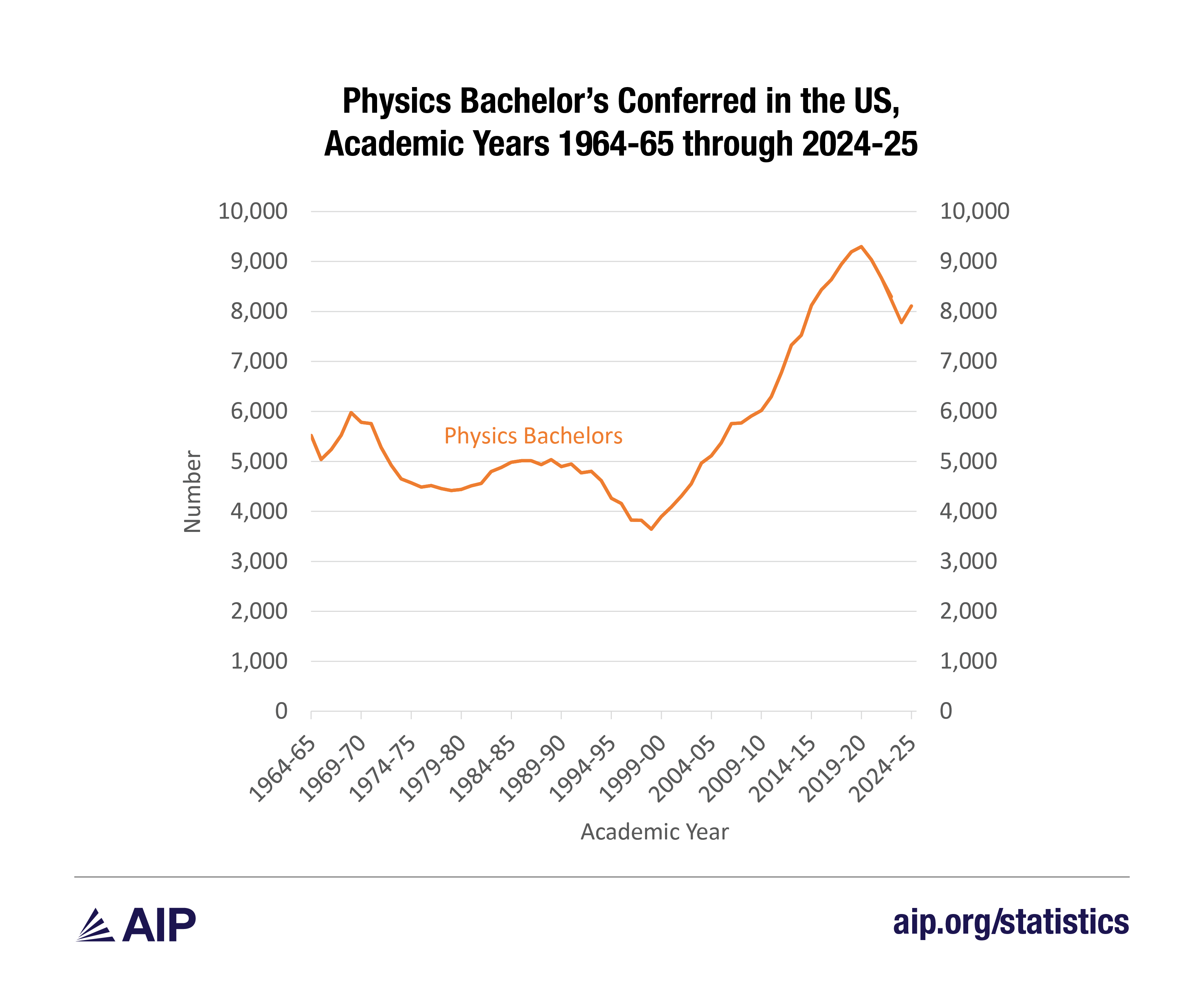
- After four consecutive years of decline, the number of physics bachelor’s degrees awarded increased by 4% in the 2024–25 academic year.
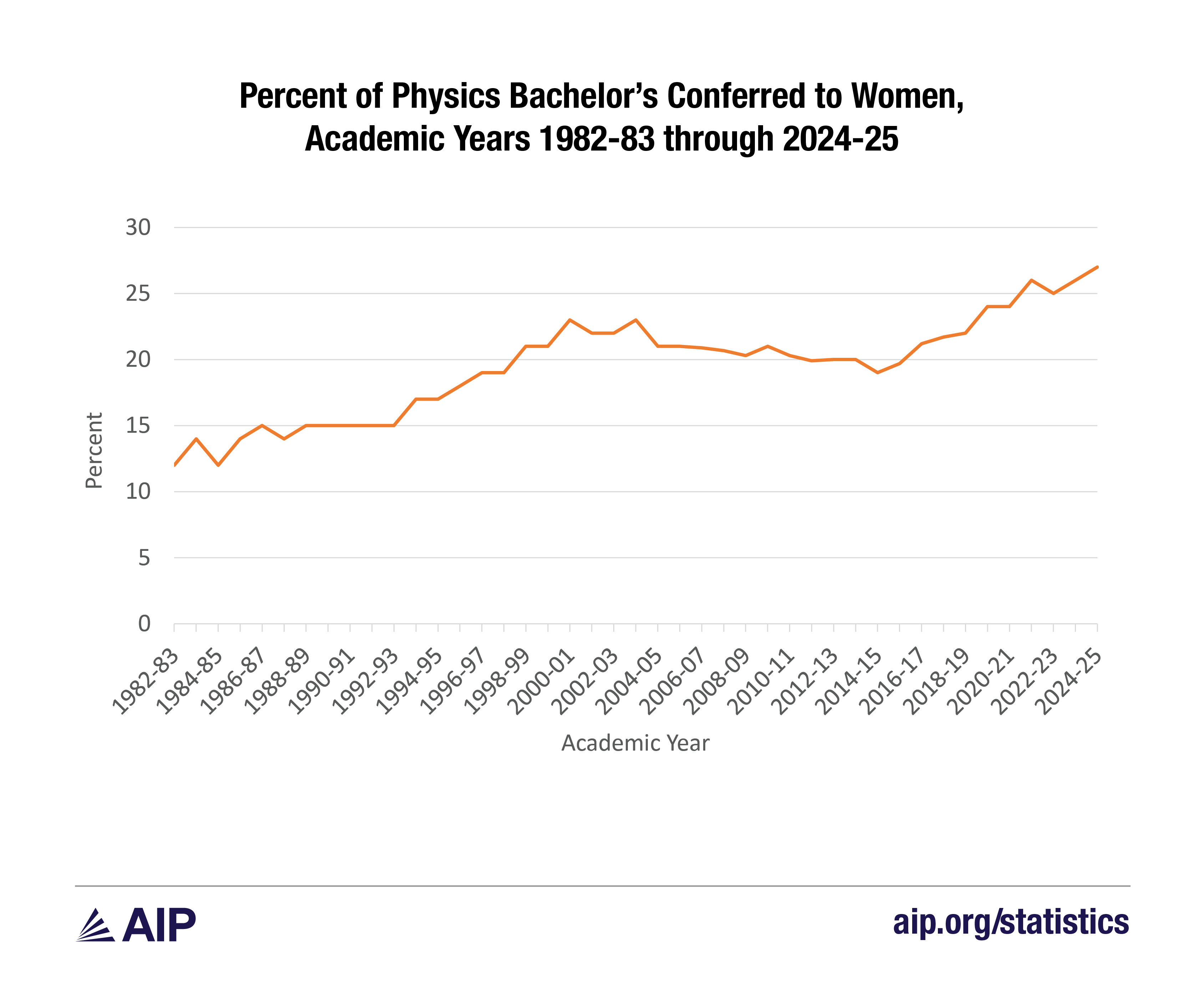
- Women earned 27% of the physics bachelor’s degrees awarded in the 2024–25 academic year, the highest proportion on record.
This report examines recent trends in physics bachelor’s degree production, including changes in the number of degrees awarded and the representation of women and other underrepresented groups. It also describes the educational characteristics of recent graduates and examines the factors that influenced their decision to pursue a bachelor’s degree in physics.
Degrees
Figure 1

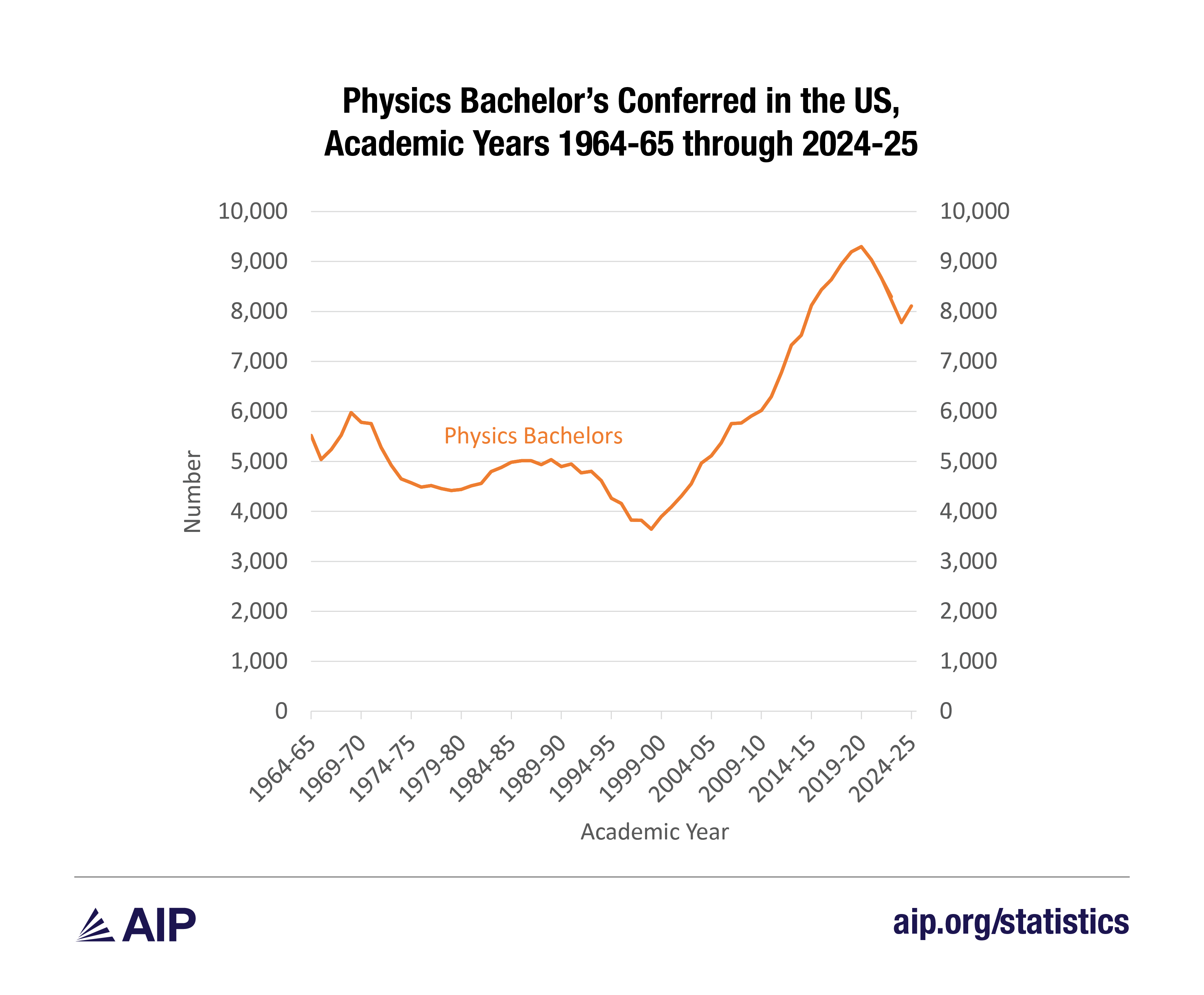
- Following four consecutive years of decline, U.S. institutions awarded 8,108 physics bachelor’s degrees in the 2024–25 academic year, a 4% increase from the previous year. This increase is still well below the all-time high of 9,296 bachelor’s degrees awarded in the 2019-20 academic year.
- Current enrollment patterns among upper-level physics majors suggest the recent increase in bachelor’s degree production is likely to continue for at least the next two years.
For additional discussion concerning trends in physics undergraduate degrees awarded, see the AIP report: Trends in Physics Bachelor’s Degrees: Decline and Signs of Stabilization
Table 1

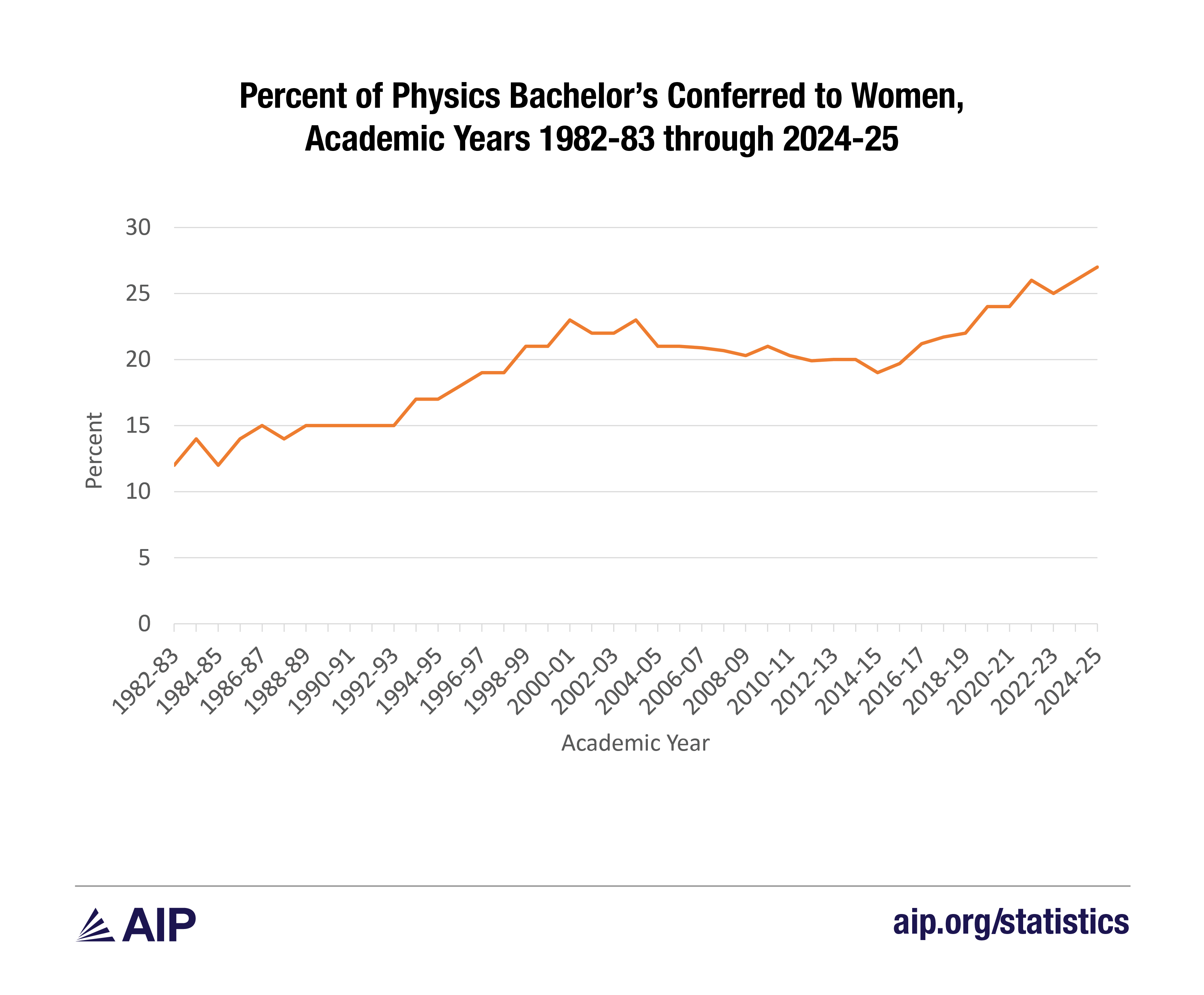
- Women earned 27% of the physics bachelor’s degrees awarded in the 2024–25 academic year—the highest proportion on record—but this remains well below the 58% of all U.S. bachelor’s degrees (NCES, 2024, Table 322.20 ) and the 39% of STEM bachelors awarded to women (2022-23 academic year) (NCES, 2024, Table 318.45 ).
- Non-U.S. citizens earned 13% of the physics bachelor’s degrees awarded in the 2024–25 academic year, more than three times the 4% share among all U.S. bachelor’s degrees and more than the 7% STEM bachelors awarded (2022-23 academic year) (NCES, 2024, Table 318.45 )
Figure 2

- The proportion of women among physics bachelor’s degree recipients has more than doubled since the early 1980s, reaching a record high of 27% in the 2024–25 academic year.
Table 2

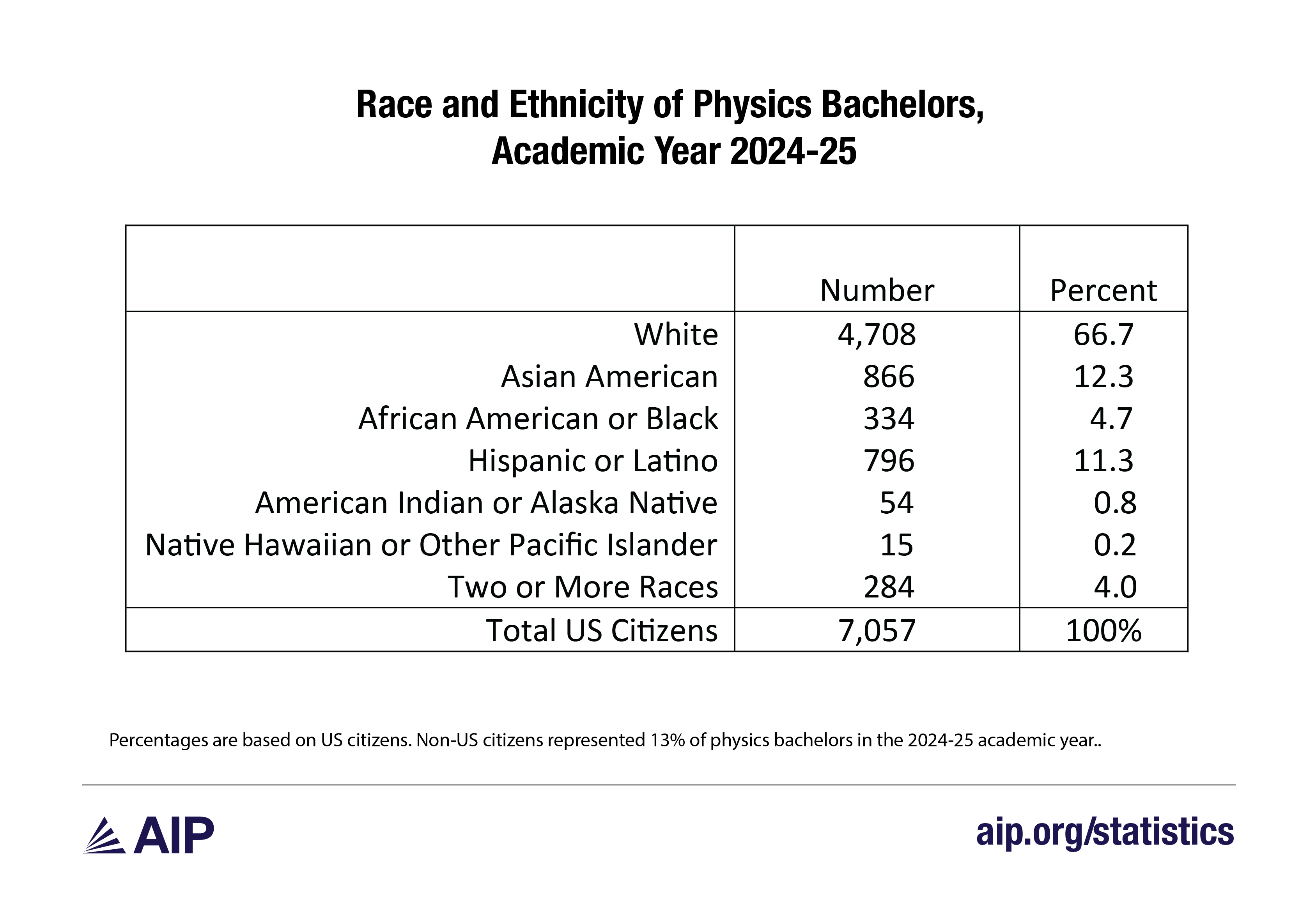
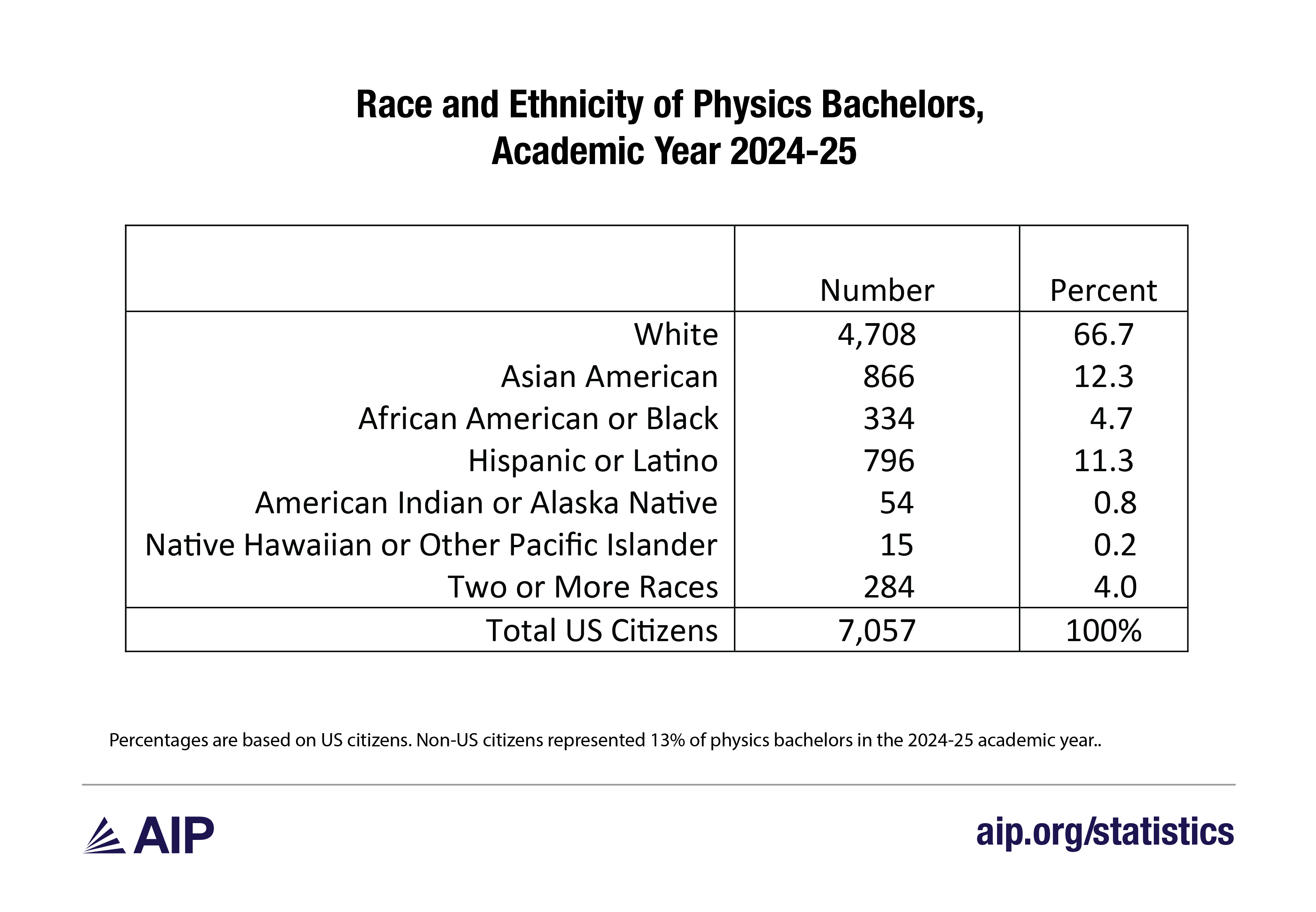
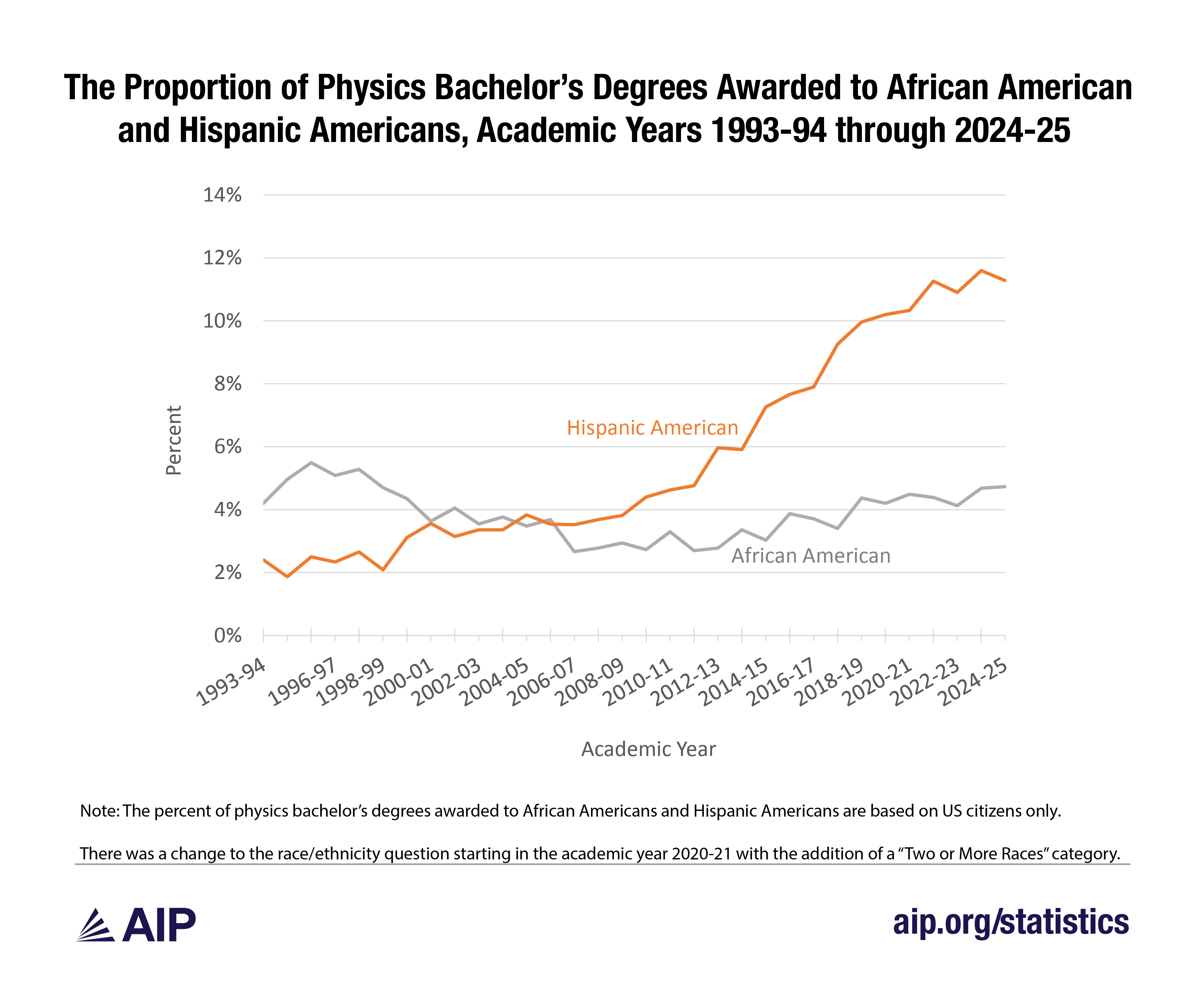
- African American and Hispanic American students earned 4.7% and 11.3%, respectively, of the physics bachelor’s degrees awarded in the 2024–25 academic year, compared with 10.2% and 17.5% of all U.S. bachelor’s degrees (NCES, 2024, Table 322.20 ) and 7.5% and 15.1% of STEM degrees awarded. (NCES, 2024, Table 318.45 ) (2022-23 academic year).
Figure 3

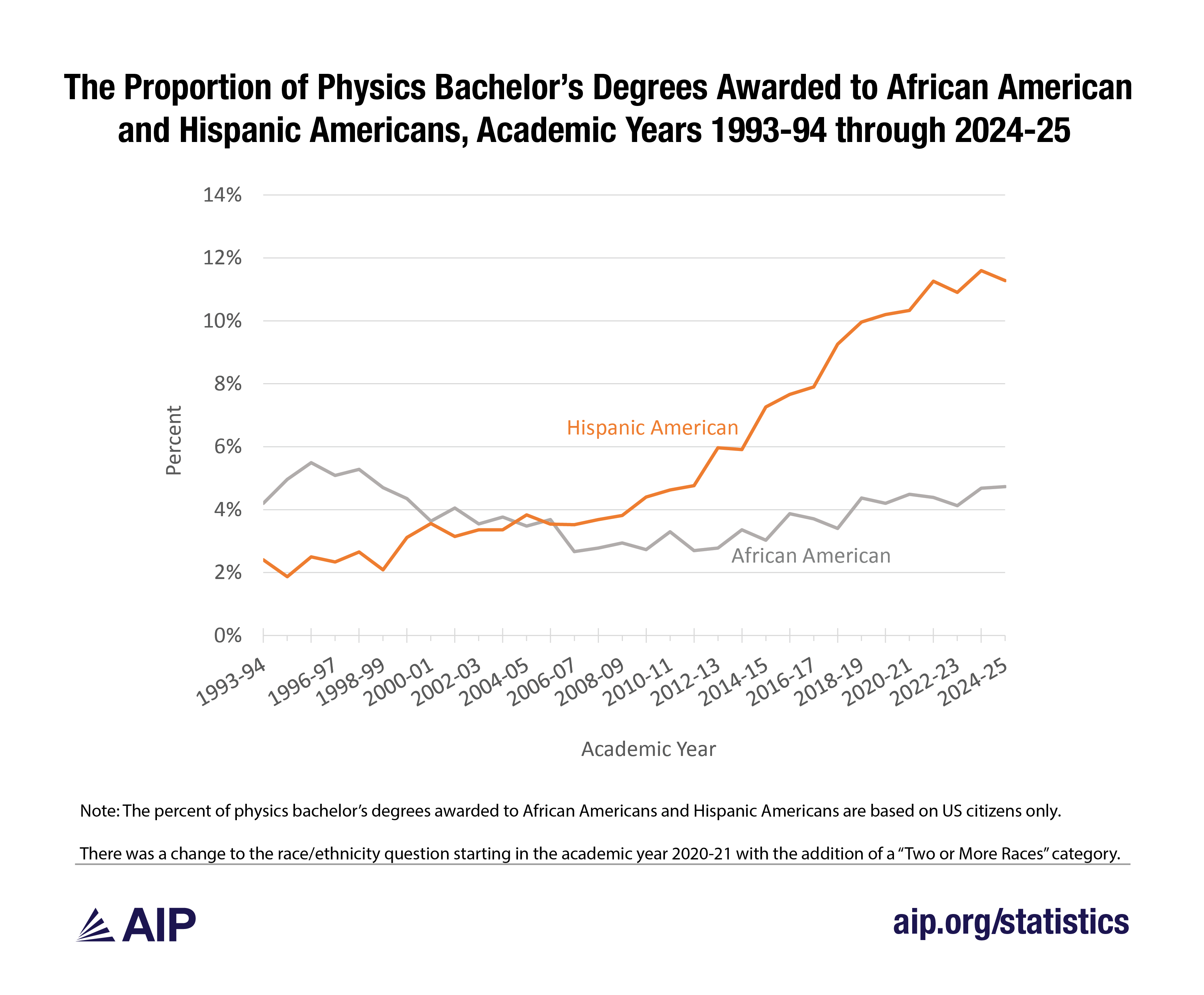
- Hispanic American students earned about 11% of physics bachelor’s degrees awarded in recent years, more than five times their representation two decades earlier.
- The proportion of physics bachelor’s degrees awarded to African American students has increased gradually since 2007, reaching nearly 5% in the 2024–25 academic year. Despite this growth, their representation remains about one percentage point below its mid-1990s level. At the same time, the total number of African American physics bachelor’s degree recipients has increased substantially over this period, just not as rapidly as the overall growth in physics bachelor’s degree production. The number of degrees awarded to African American students has increased 130% since 2007.
Educational Characteristics
Table 3

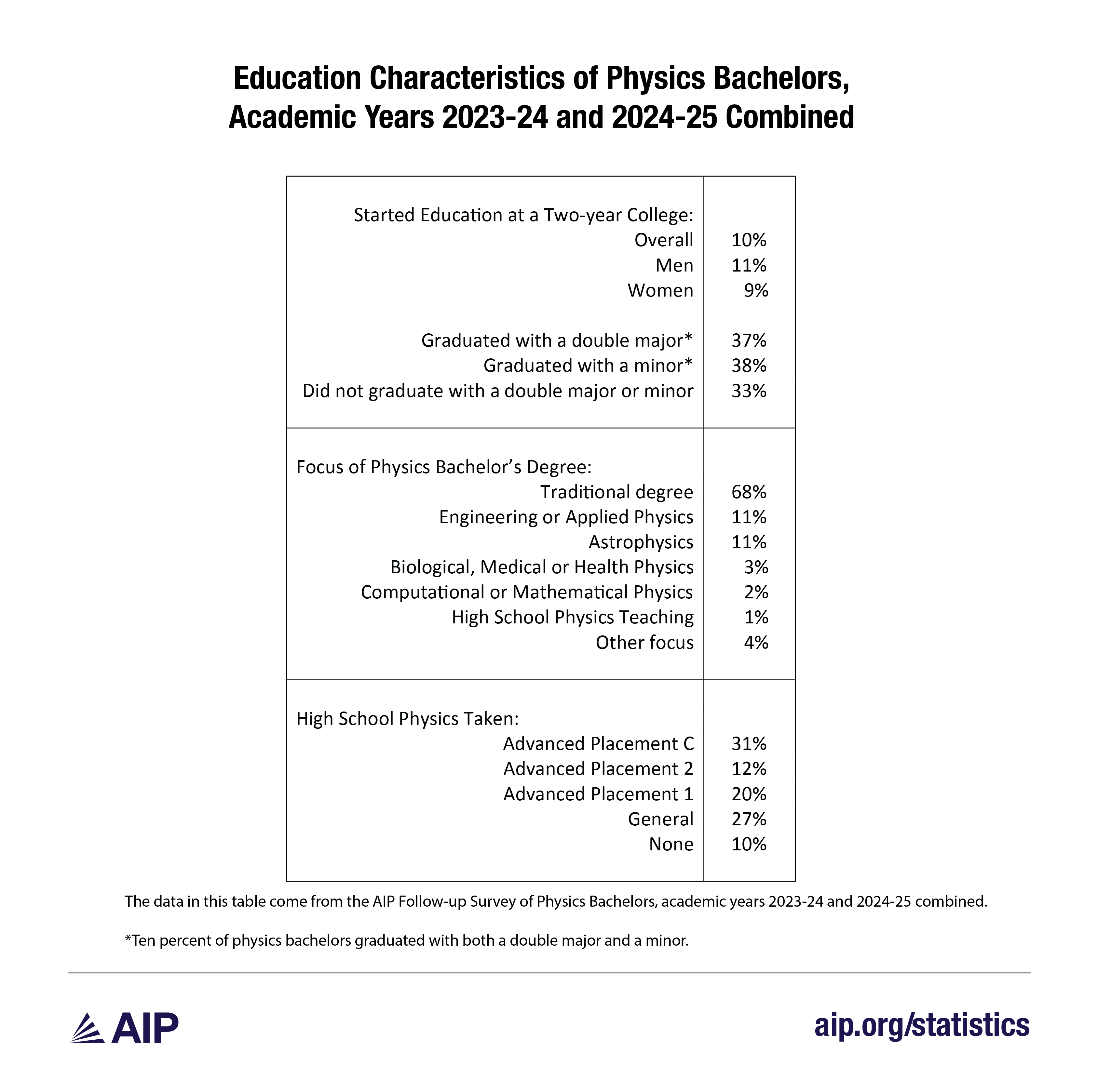
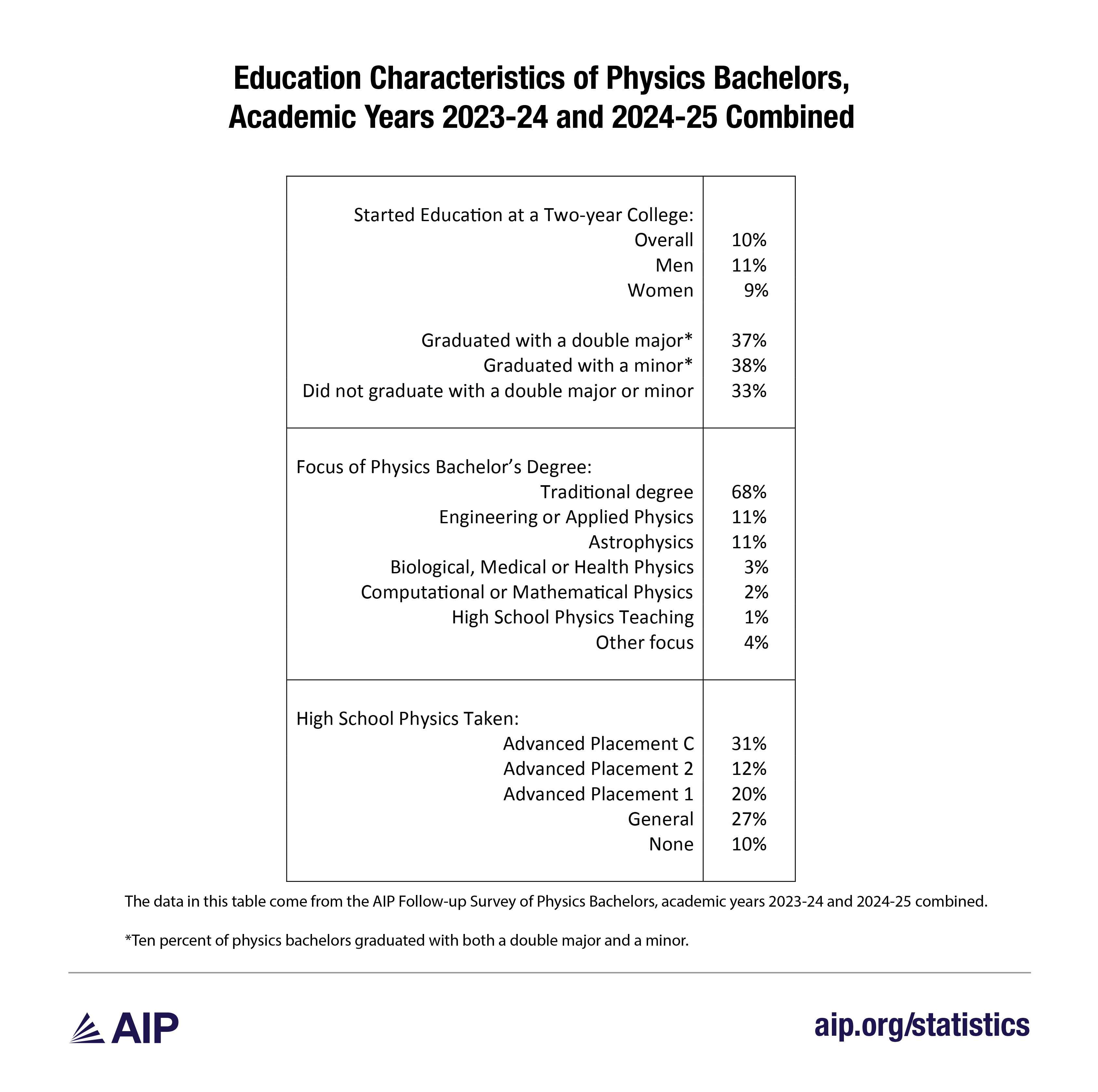
- Ten percent of physics bachelor’s degree recipients reported beginning their undergraduate education at a two-year college, down from 15% six years earlier.
- More than one-third (37%) of physics bachelor’s degree recipients graduated with a double major, compared with 9% for all U.S. bachelor’s degree recipients (Townsend, 2025 ). Among those with a second major, mathematics (31%) and astronomy (25%) were the most common.
- Nearly one-third (32%) of physics bachelor’s degree recipients completed a degree with a specific curricular focus, most commonly in engineering/applied physics or astrophysics.
- Nearly two-thirds (63%) of physics bachelor’s degree recipients reported taking an AP Physics course in high school, compared with about 8% for all U.S. high school graduates (Chu, 2024)
- One in ten (10%) physics bachelor’s degree recipients reported not taking a physics course in high school, compared with 63% for all U.S. high school graduates (Chu & White, 2026 ).
Figure 4

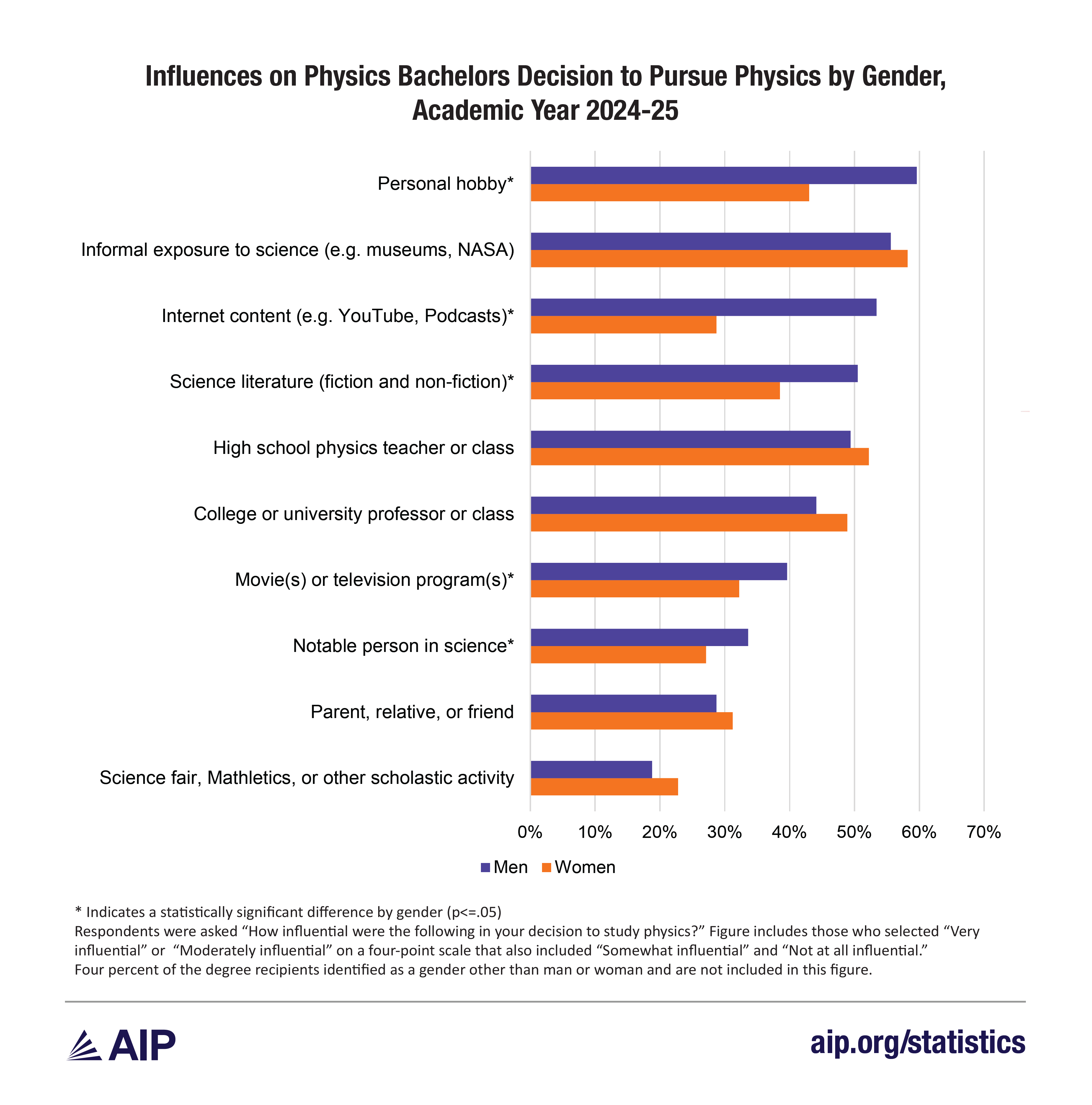
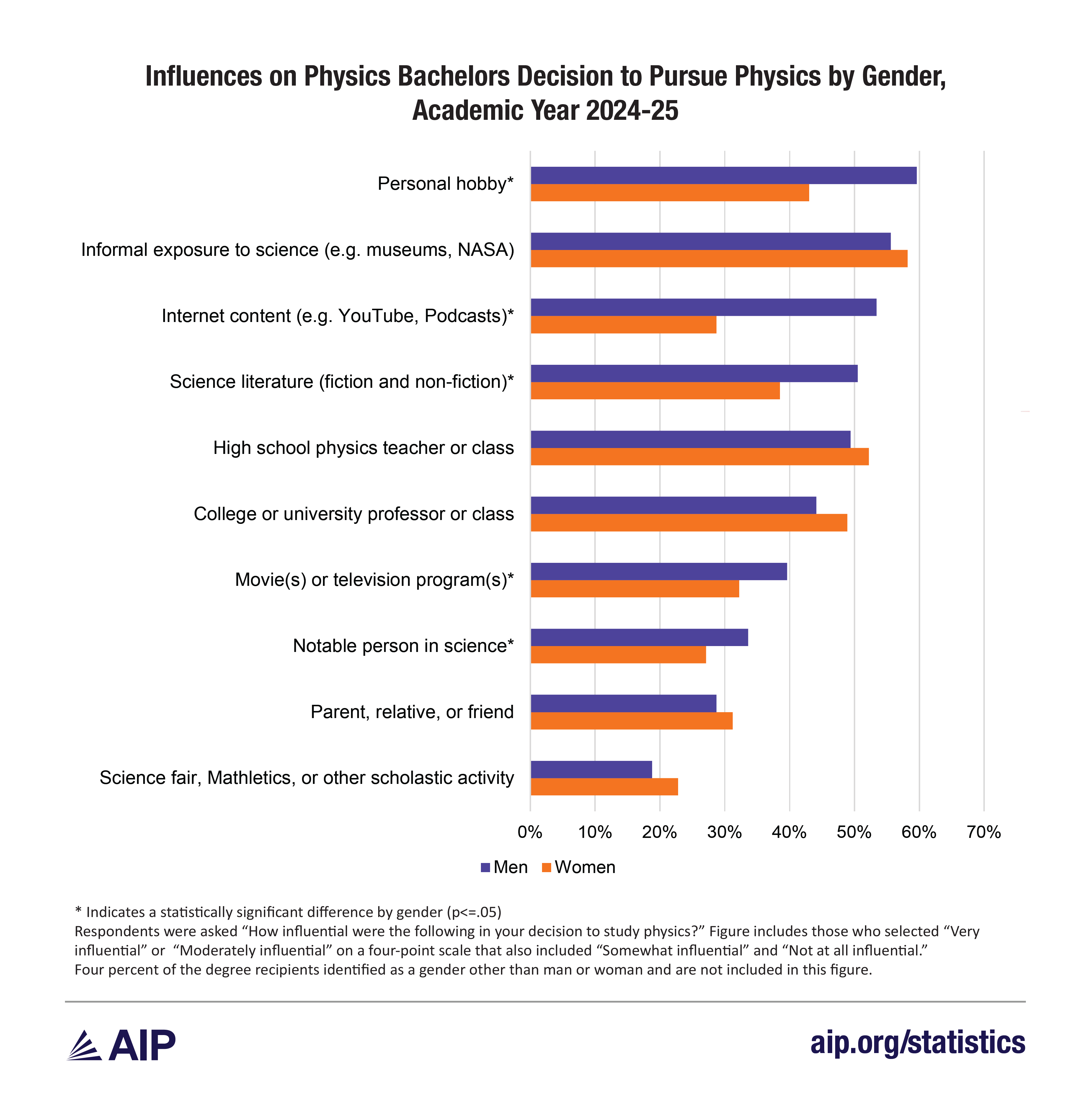
- Recent physics bachelor’s degree recipients reported that many factors influenced their decision to study physics, with the relative impact of some influences differing by gender.
- Men were more likely than women to report that many of the listed factors influenced their decision to study physics.
- High school and college teachers, faculty members, and courses were among the most cited educational influences for both men and women.
Methodology
Each fall AIP conducts its Survey of Enrollments and Degrees. The survey is sent to all degree-granting physics and astronomy departments in the United States, Puerto Rico, and the Virgin Islands. Departments are asked to provide information concerning the number of students they currently have enrolled and the number of degrees they conferred in the previous academic year as well as contact information for their recent degree recipients. AIP defines the academic year as September through August.
In the 2024-25 academic year, 707 departments offered bachelor’s degrees in physics. We received responses from 90% of these departments. For non-responding departments, we estimated their enrollment and degree data and included them in the totals reported.
Data from the Enrollments and Degrees Survey are also used to produce the “Roster of Physics Departments,” which provides a department-level enrollment and degree snapshot. A copy of the roster for the 2023-24 academic year can be found at: https://www.aip.org/statistics/roster-of-physics-departments-with-enrollment-and-degree-data-2024 .
This report also includes data from the AIP Bachelor’s Follow-up Survey. Using the degree recipient contact information obtained from the Enrollment and Degrees survey, we conduct our annual degree recipient follow-up survey in the winter following the academic year in which respondents received their degrees. We thank the many physics department chairpersons, faculty, and staff who made this publication possible by contributing their departmental data and student contact information.
References
Digest of Education Statistics, 2024, NCES: https://nces.ed.gov/programs/digest/d24/tables/dt24_322.20.asp
Digest of Education Statistics, 2024, NCES: https://nces.ed.gov/programs/digest/d24/tables/dt24_318.45.asp
Robert Townsend. (2025) From Matriculation to Completion: “How College Students Move Between Majors.” Available at: https://www.amacad.org/bulletin/winter-2025/matriculation-completion-how-college-students-move-between-majors
Raymond Chu. (2024) Nationwide Survey of High School Physics Teachers. AIP. [Unpublished raw data].
Raymond Chu & Susan White (2026) High School Physics Enrollments and Class Availability. AIP. Available at: https://doi.org/10.1063/sr.c60efffa51