
Harvard College Observatory: Stellar classification systems, 3

Fourth Conference of the International Union for Co-operation in Solar Research, held in 1910 at the then-new Mount Wilson Solar Observatory near Pasadena, California. Williamina Fleming is the woman at center, dressed in black. Pickering is third figure to the left of Fleming in the front row, wearing a dark suit.
Mount Wilson and Palomar Observatories, courtesy of AIP Emilio Segrè Visual Archives.
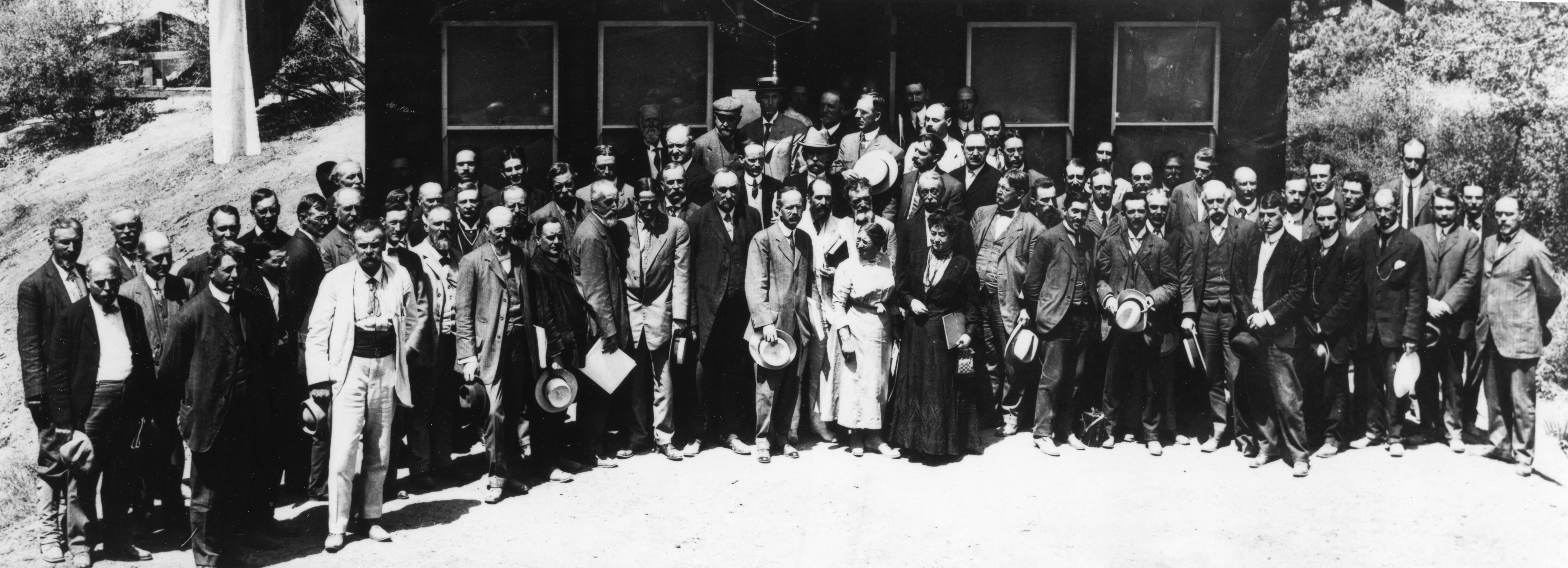

In 1910, Edward Pickering and Williamina Fleming attended the fourth meeting of the International Union for Cooperation in Solar Research, which was held on the summit of Mount Wilson, California, at the solar observatory of the Carnegie Institution. At that time, international astronomy did not abide by a single stellar classification system. Pickering saw an opportunity for the widespread adoption of the Harvard system developed by Fleming and Cannon.
Recording his thoughts in a diary on the long railroad trip to California, Pickering wrote that “the Harvard system will probably be the system of the world. I am repaid for my journey of 2,000 miles, had I done nothing else. … My part in this will be regarded as one of the most important things I have ever done.” To his great relief and delight, the union gave it “the strongest endorsement I could have desired.”1
While it was clear that spectral lines correlated with elements present in the stars, it remained unclear as to why stars exhibited different spectral patterns, or what in some cases caused “peculiar” lines to be present. Examples of peculiar patterns included an unexpectedly thick or thin spectral band or an unusually bright, dark, or curiously placed spectral line. Many such stars were of a type that had not yet been closely studied or were undergoing hitherto unseen processes in their evolution.
Certain elements, the existence of which altered the appearance of particular spectra were, as of yet, undetected when Fleming was classifying her multitudes of stars. Neither were other processes obvious, such as that of ionization, which strips away electrons due to elemental superheating and thereby changes the elements’ spectra.
Even Princeton University’s Henry Norris Russell, the acknowledged expert on stellar composition, opined in 1913:2
The first great problem of stellar spectroscopy is the identification of this predominant cause of the spectral differences. The hypothesis which suggested itself immediately upon the first studies of stellar spectra was that the differences arose from variations in the chemical compositions of the stars.
It would not be until further work was carried out by Cecilia Payne (later Payne-Gaposchkin) that an understanding of stellar nucleosynthesis would begin to take hold. She measured the output of the energies from stars of the various stellar classes and correlated their spectra with their elemental makeup. She observed and measured the abundances of the various elements related to each class and took into consideration the effects of ionization, employing a theory proposed in 1920 by astrophysicist Meghnad Saha.3 As summarized by William Sheehan:4
The spectral sequence is thus a result almost entirely of temperature progression in the atmosphere of stars … The higher the temperature, the faster the atoms are moving, and the more electrons will be stripped away. Since the number of atoms in one state of ionization versus another depends on competition between collisions of all kinds and radiation causing ionization and rates of electron-ion collisions producing recombination, temperature—not chemical composition—determines which absorption lines appear in a star’s spectrum.
References
- A detailed account of Pickering’s maneuvering around the meeting is included in David H. DeVorkin, “Community and spectral classification in astrophysics: The acceptance of E. C. Pickering’s system in 1910,” Isis 72 (1981), 29–49, on pp. 39–45, doi:10.1086/352649.
- Henry Norris Russell, “Relations between the spectra and other characteristics of the stars,” Popular Astronomy, 22, nos. 5 and 6, 1914, 275–294 and 331–351, on p. 276.
- John B. Hearnshaw, Analysis of star light: Two centuries of astronomical spectroscopy, 2nd edition (Cambridge University Press, 2014), pp. 138–140, doi:10.1017/CBO9781139382779.
- William Sheehan, Galactic encounters: Our majestic and evolving star system, from the Big Bang to time’s end (Springer, 2015), p. 162, doi:10.1007/978-0-387-85347-5.
Cite this resource
Bretislav Friedrich and Maria McEachern, “Stellar classification systems, 1,” Harvard College Observatory history guide, American Institute of Physics, 2026, https://www.aip.org/history/harvard-observatory/stellar-classification-3.
Note that this material was originally developed in concert with the Williamina Fleming history guide as part of the Women in the History of Quantum Physics collection.