
Harvard College Observatory: The labor and status of the women computers

Edward Pickering and Williamina Fleming, standing, in an 1891 posed photograph with the women computers of the Harvard College Observatory. Ordinarily, the computers would not have been working so closely to each other.
Harvard University Archives, UV 1210 (9-4), olvwork289689.
As a man of the new industrial age, Harvard College Observatory Director Edward Pickering believed in the specialization of labor. The observatory’s women astronomical computers, known as the Harvard Computers, were chosen “to work, not to think,” as Harvard astronomer Cecilia Payne-Gaposchkin later wrote.1
The computers’ work was to analyze and generally not to interpret the data derived from the astrophotographic glass plates. Thus, thanks to the growth of astronomical spectroscopy which enabled astronomical work in daylight, the Harvard College Observatory came to embody the “factory observatory.”2 In an address to the Harvard branch of Phi Beta Kappa, Pickering observed:3
A great observatory should be as carefully organized and administered as a railroad. Every expenditure should be watched, every real improvement introduced, advice from experts welcomed, and if good, followed, and every care taken to secure the greatest possible output for every dollar expenditure. A great savings may be effectuated by employing unskilled and therefore inexpensive labor, of course under careful supervision.
Inexpensive labor indeed: in 1900, Williamina Fleming’s salary as curator of astronomical photographs was about 50 cents per hour (about $19 in today’s dollars). Other female computers were paid just 25 cents per hour.4 For male assistants, the hourly salary was nearly five times as much.
In a journal she kept in March and April 1900, Fleming recorded for posterity her experiences and the mix of pride and frustration she felt about her work. It was among seventy-two journals from the Harvard community that were sealed in the “Chest of 1900,” a time capsule project organized to celebrate the new century.5
On March 5, Fleming mused, “If one could only go on and on with original work, looking for new stars, variables, classifying spectra and studying their peculiarities and changes, life would be a most beautiful dream, but,” she added, “you come down to its realities when you have to put all that is interesting aside in order to use most of your available time preparing the work of others for publication.” She concluded that she felt “contented to have such excellent opportunities for work … and proud to be considered of any assistance to such a thoroughly capable Scientific man [Pickering] as our Director.”
The work could exert a heavy toll. On March 4, Fleming explained that a Mrs. Christopherson arrived at 8:00 p.m. every Sunday to massage her right arm “and keep it in condition so that I can carry on my work.” She explained that the previous fall a doctor warned she might lose use of it for some time, but, she reported, “it is holding its own very well.”

The entries from March 11 and 12 in a journal Williamina Fleming kept in March and April 1900.
Harvard University Archives.
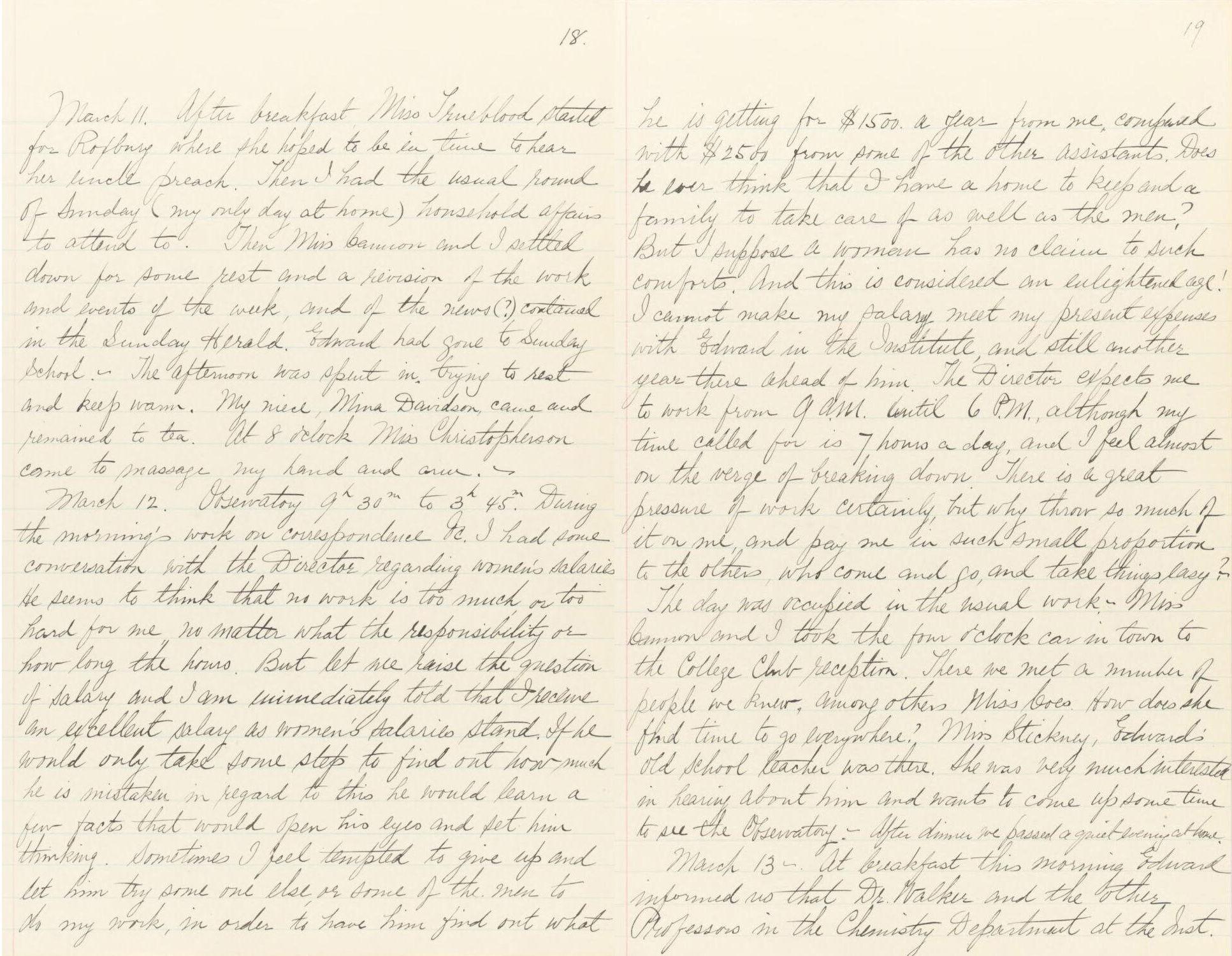
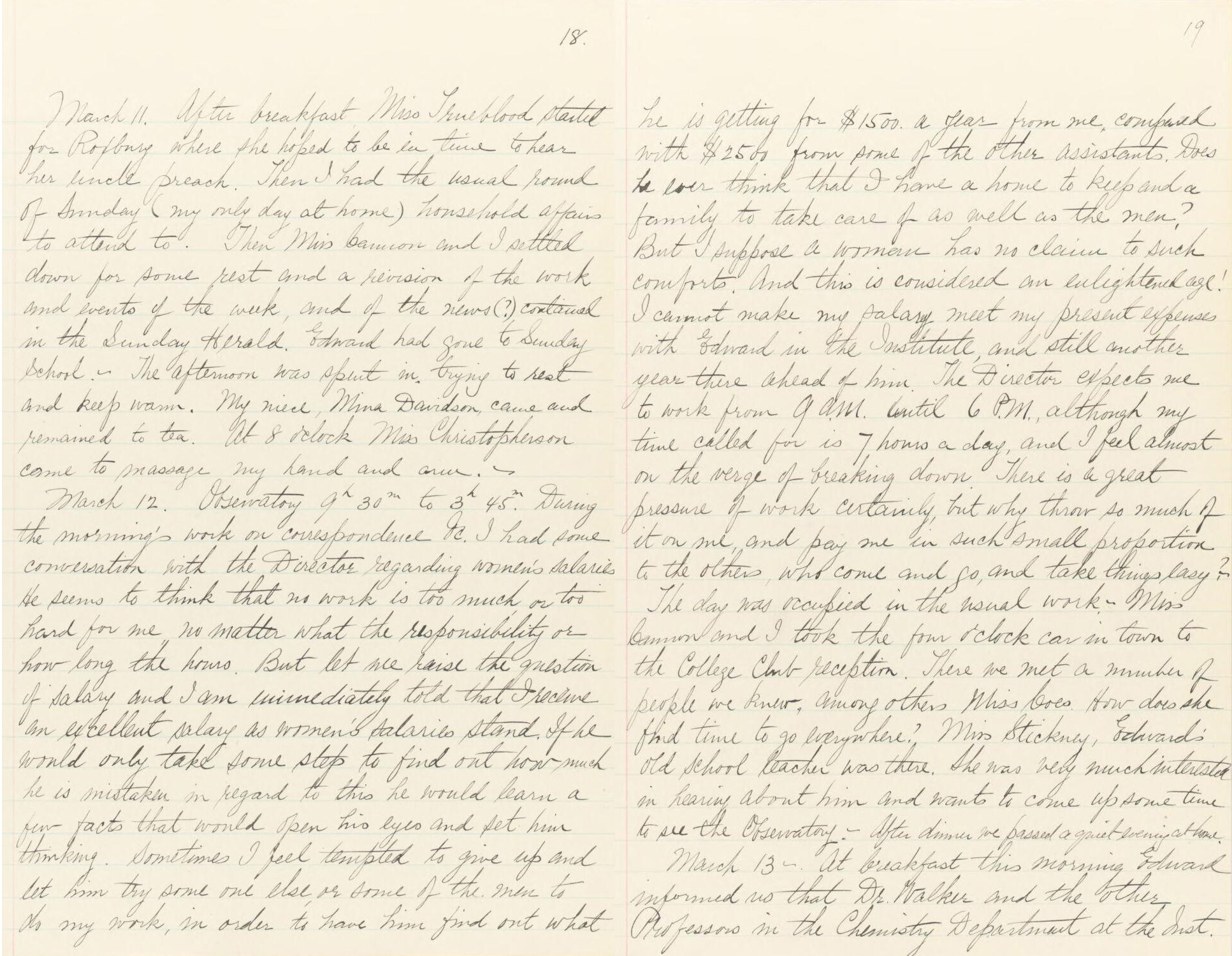
On March 12, she reflected further on the difficulty of her labor and the unfairness of her pay:
I had some conversations with the Director regarding women’s salaries. He seems to think that no work is too much or too hard for me, no matter what the responsibility or how long the hours are. But let me raise the question of salary and I am immediately told that I receive an excellent salary as women’s salaries stand. … Does he ever think that I have a home to keep and a family to take care of as well as the men? But I suppose a woman has no claim to such comforts. And this is considered an enlightened age! I cannot make my salary meet my present expenses with Edward [Fleming’s son] in the Institute [MIT] and still another year there ahead of time. The Director expects me to work from 9 a.m. to 6 p.m., although my time called for is 7 hours a day, and I feel almost on the verge of breaking down. There is a great pressure of work certainly, but why throw so much of it on me, and pay me in such small proportion to the others, who come and go, and take things easy?
The complicated sociology of the observatory’s labor was also addressed much earlier, in a play titled The Observatory Pinafore, written in 1879 by Winslow Upton, then a telescope assistant at Harvard and later professor of astronomy at Brown University.6 To the tune of Gilbert & Sullivan’s comic opera HMS Pinafore, which appeared the previous year, a chorus of computers opened the play, singing:7
We work from morn ‘till night,
For computing is our duty;
We’re faithful and polite,
And our record book’s a beauty;
With Crelle and Gauss, Chauvenet and Peirce,
We labor hard all day;
We add, subtract, multiply and divide,
And we never have time to play.
This telling satire was performed for the first time only in 1929, at the residence of the then observatory director Harlow Shapley, for about 100 members of the American Astronomical Society. We note that when the Observatory Pinafore was written, there were four women and several men computers employed by the observatory, but that the chorus was all women when it was performed a half-century later.8

The staff members of the Harvard College Observatory performed the The Observatory Pinafore once in 1929 and once in 1930. The satire was written in 1879 by Winslow Upton.
Courtesy of the AIP Emilio Segrè Visual Archives, Shapley Collection.
Explore further

References
- Cecilia Payne-Gaposchkin, The Dyer’s Hand: An Autobiography, 1979, p. 54. Initially published informally, a new edition appeared in 1996, published by Cambridge University Press and edited by Katherine Haramundanis.
- John Lankford, American Astronomy: Community, Careers, and Power (University of Chicago Press, 1997), pp. 309–310.
- George Johnson, Miss Leavitt’s Stars: The Untold Story of the Woman Who Discovered How to Measure the Universe (Norton, 2005), p. 18.
- Dava Sobel, The Glass Universe: How the Ladies of the Harvard Observatory Took the Measure of the Stars (Viking, 2016), p. 113.
- Ken Gewertz, “Time to Remember,” Harvard Gazette, Jan. 18, 2001, https://news.harvard.edu/gazette/story/2001/01/time-to-remember/. Fleming’s full journal can be found at the Harvard Library website.
- See Winslow Upton, “HCO Pinafore [sic],” in The Starry Universe: The Cecilia Payne-Gaposchkin Centenary, edited by A. G. Davis Philip and Rebecca A. Koopmann (Davis, 2001), 161–166. See also Andrew Fiss, “‘For Computing Is Our Duty': Algorithmic Workers, Servants, and Women at the Harvard Observatory,” in Algorithmic Modernity: Mechanizing Thought and Action, 1500–2000, edited by Morgan G. Ames and Massimo Mazzotti (Oxford University Press, 2023), 127–143, https://doi.org/10.1093/oso/9780197502426.003.0008.
- Jonathan McDowell has made the full text of the play available at https://planet4589.org/astro/cfa/play/play.html.
- Keith LaFortune, “Women at the Harvard College Observatory, 1877–1919: ‘Women’s Work,’ the ‘New’ Sociality of Astronomy and Scientific Labor,” master’s thesis, University of Notre Dame, 2001.
Cite this resource
Bretislav Friedrich and Maria McEachern, “The labor and status of the women computers,” Harvard College Observatory history guide, American Institute of Physics, 2026, https://www.aip.org/history/harvard-observatory/williamina-fleming-labor-status.
Note that this material was originally developed in concert with the Williamina Fleming history guide as part of the Women in the History of Quantum Physics collection.