A Symphony of Scientsts


‘Doctor-Quartet’ arranged for Einstein during his stay with Felix Ehrenhaft in Vienna in 1931. Ehrenhaft is standing behind Einstein, who is third from right, holding a violin.
Einstein Albert D99 . Credit: AIP Emilio Segrè Visual Archives
“Life without playing music is inconceivable for me. I live my daydreams in music. I see my life in terms of music … I get most joy in life out of music.”
—Albert Einstein
AIP’s photograph and oral history collections are rich with stories of scientist’s instrumental endeavors, with anecdotes about impromptu chamber music gatherings at conferences, singing and playing piano at each other’s houses, and several scientists who actively played in orchestral ensembles and semi-professional settings. We hope you enjoy this selection of musical scientists.
William F. G. Swann
Physicist | Cellist | Conductor
Our first featured musician is William F. G. Swann (1884-1962), an English particle physicist who studied cosmic rays and whose talents as a conductor and cellist are well documented in the ESVA. Swann emigrated to the United States in 1913 to head the physics research division at the Carnegie Institute Department of Terrestrial Magnetism, after which he went on to work at the National Bureau of Standards and teach at several universities. In 1927, he became the first director of the Franklin Institute’s Bartol Research Foundation , a physics research institute studying astrophysics, cosmic rays, and nuclear physics, which he set up at nearby Swarthmore College (where it would remain until 1977 when it was moved to the University of Delaware and renamed to the Bartol Research Institute). Swann also was a member of the American Philosophical Society (where his archives are held), president of the American Physical Society from 1931-1933, and a well-known science communicator; he wrote a popular book on astronomy and was a frequent figure on local radio and television shows to explain science to the public.

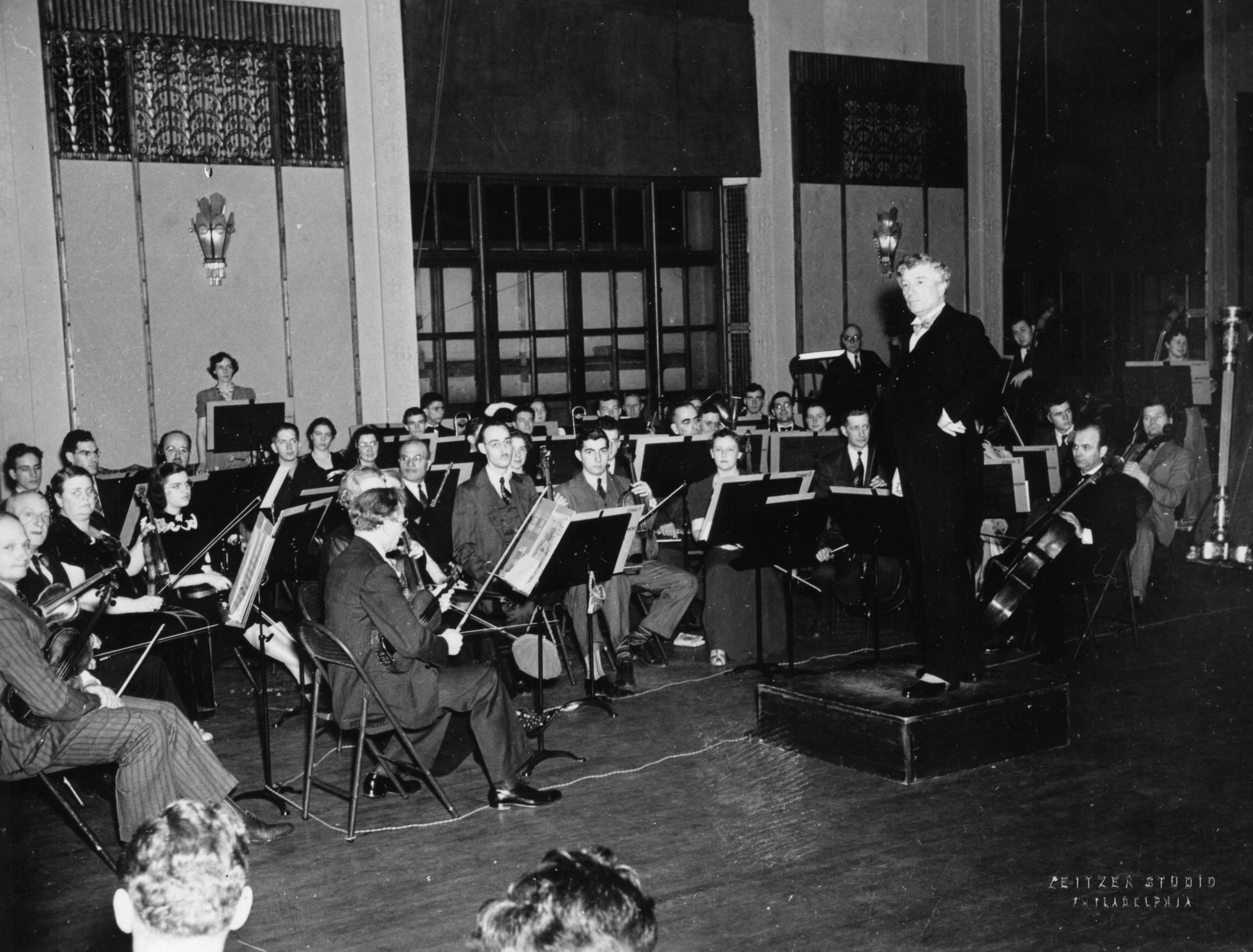
William Swann conducting an orchestra at Convention Hall in Philadelphia, Pennsylvania.
Swann William D4 . AIP Emilio Segrè Visual Archives, Physics Today Collection
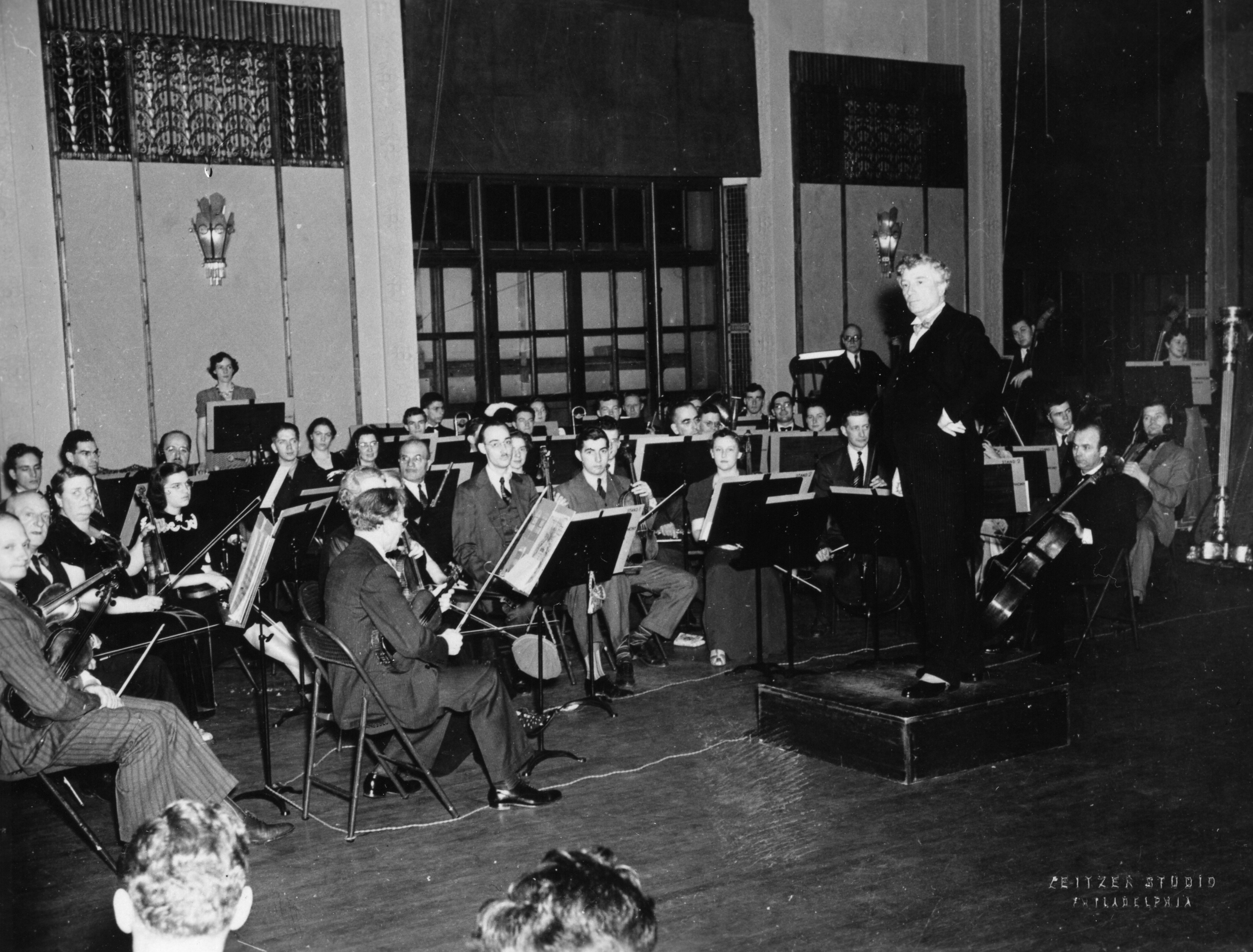
In addition to directing scientists, Swann also directed orchestras. While at the National Bureau of Standards, he led their newly formed orchestra (see the next section on William F. Meggers), and during his time at Bartol he served as the assistant conductor to the Main Line Symphony Orchestra, director of the Philadelphia Academy of Music, and founder of the Swarthmore Symphony Orchestra. The latter ensemble (seen in the photo above) was a volunteer community orchestra for the town. Several Bartol research scientists played in the Swarthmore Symphony, as did Swann’s first wife, Sarah Frances Mabel Thompson, who played the viola.
When Swann first formed the Swarthmore Symphony Orchestra, the ensemble was lacking French horn and bass clarinet players, so Swann had his assistant, William Edgar Danforth, a fellow cellist and scientist at Bartol, devise an electrical vacuum tube instrument that could play the wind instrument parts for the orchestra. They called it the “oscillion” and it worked by simply moving a finger over a metal box and could be made to sound either like the French horn or clarinet when played.
The oscillion was featured in May 1937 issue of Time Magazine, which describes it as:
The Danforth & Swann Oscillion is a simple-looking oblong wooden box with an electrical circuit inside. Current flows through a resistance, is stored up in a condenser, spills into a neon tube, becomes a series of electrical “pulses.” A loud speaker translates the pulses into sound.
A photo that can be seen in this archived post on 120 Years of Electronic Music .

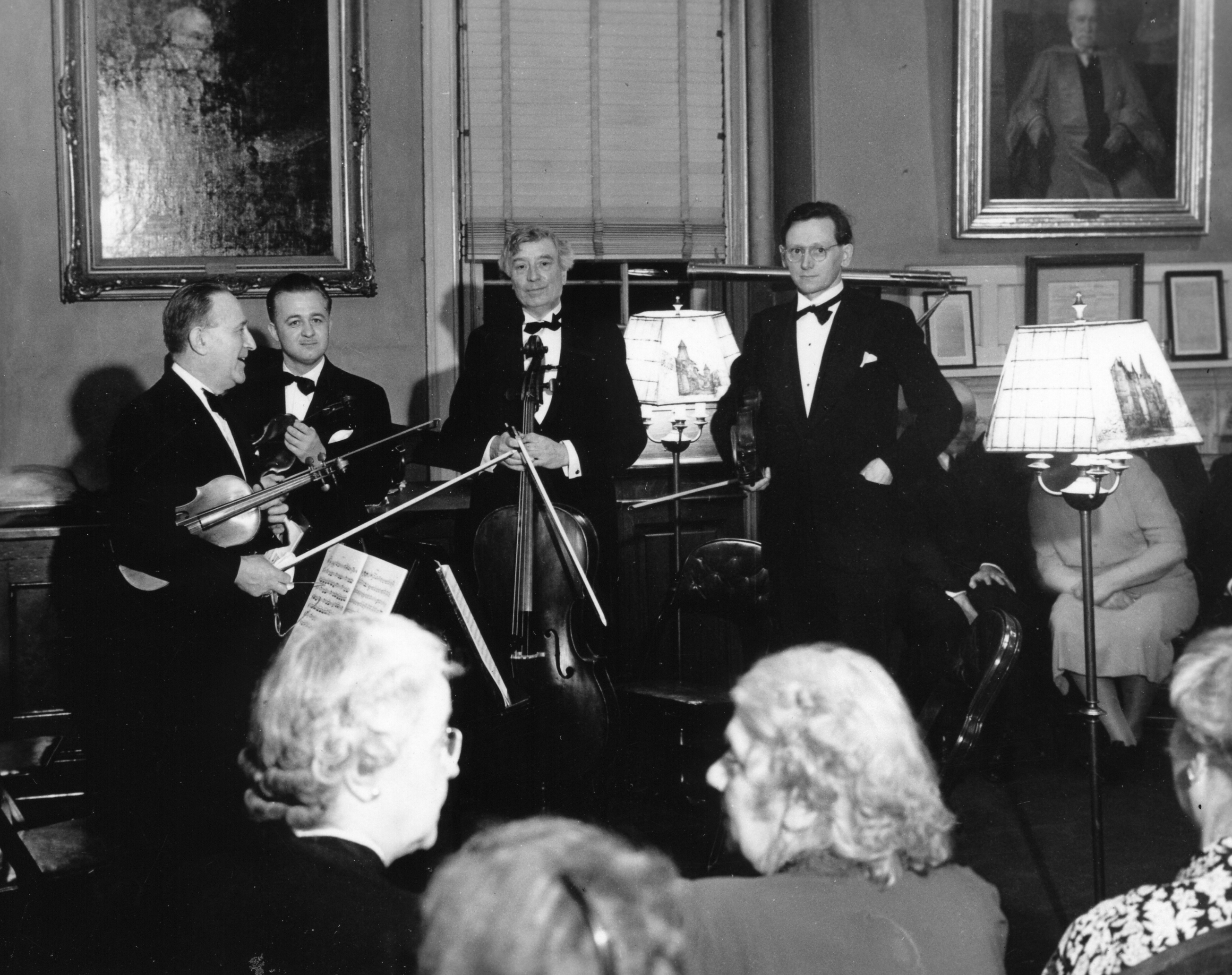
String quartet playing a concert for the American Philosophical Society (APS) on the bi-centenary of the birth of Thomas Jefferson. L-R: Jani Szántó (violin), unkown violinist, William Swann (cello), Peter van de Kamp (viola). Women in foreground are Marie Aydelotte [wife of Frank Adyelotte] and Sarah Fraces Mabel Swann.
Swann William D1 . AIP Emilio Segrè Visual Archives, Physics Today Collection
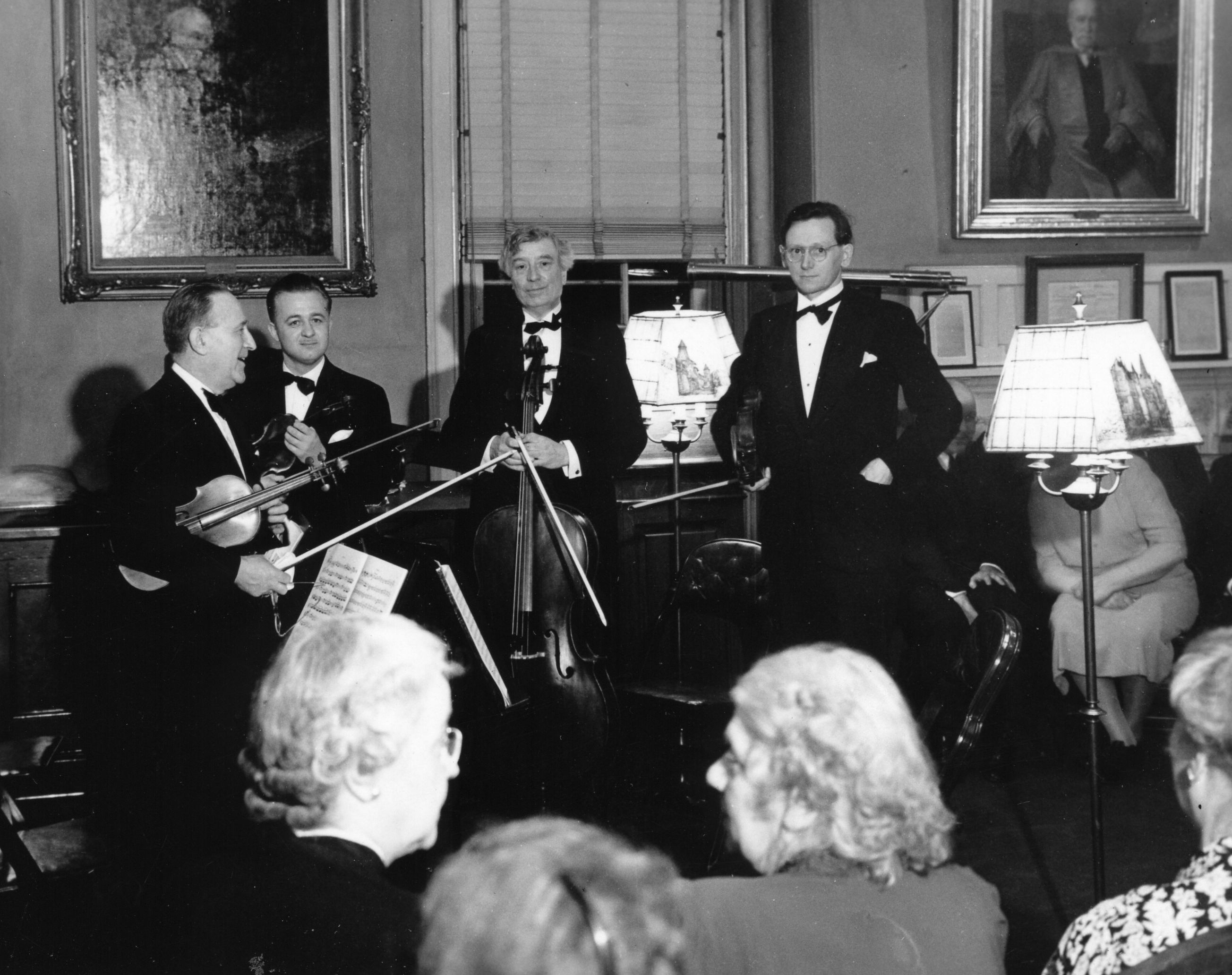
William Swann was also an accomplished cellist — he studied under the Armenian cellist Diran Alexanian and was friends with renowned Spanish cellist Pablo Casals . Swann would often play his cello at science conferences and parties, which is showcased in the above photograph. Here Swann is seen performing in a quartet at the April 1943 meeting of the American Philosophical Society in Philadelphia, which was devoted to the celebration of the 200th Anniversary of the Birth of Thomas Jefferson. According to the conference proceedings, Swann’s group performed a selection of musical pieces that were known to have been among Jefferson’s favorites. The violist in the quartet (on the right) is also a scientist: Dutch astronomer Peter van de Kamp , who was a Professor of Astronomy at Swarthmore College and the director of the Swarthmore College Orchestra (not to be confused with Swann’s Swarthmore Symphony). While the other ensemble members’ identities are not confirmed, the first violinist (on the left) is likely Hungarian violinist Jani Szántó, who was the director of Philadelphia Musical Academy at the time.
William F. Meggers
Spectroscopist | Violinist | Trombonist
Spectroscopist William F. Meggers was a gifted musician who, in addition to playing the violin, also played the trombone and trumpet. Born near Clintonville, Wisconsin, in 1888, he attended Ripon College where he got a degree in physics in 1910. While he was a student, he used his musical talents to earn some cash and help pay the bills by forming a dance band in which he played various instruments. Meggers’ professional career was spent entirely at the National Bureau of Standards (now NIST) in Washington, DC, working on atomic spectroscopy research. He retired in 1958 as Chief of the Spectroscopy Section after nearly 50 years of service.

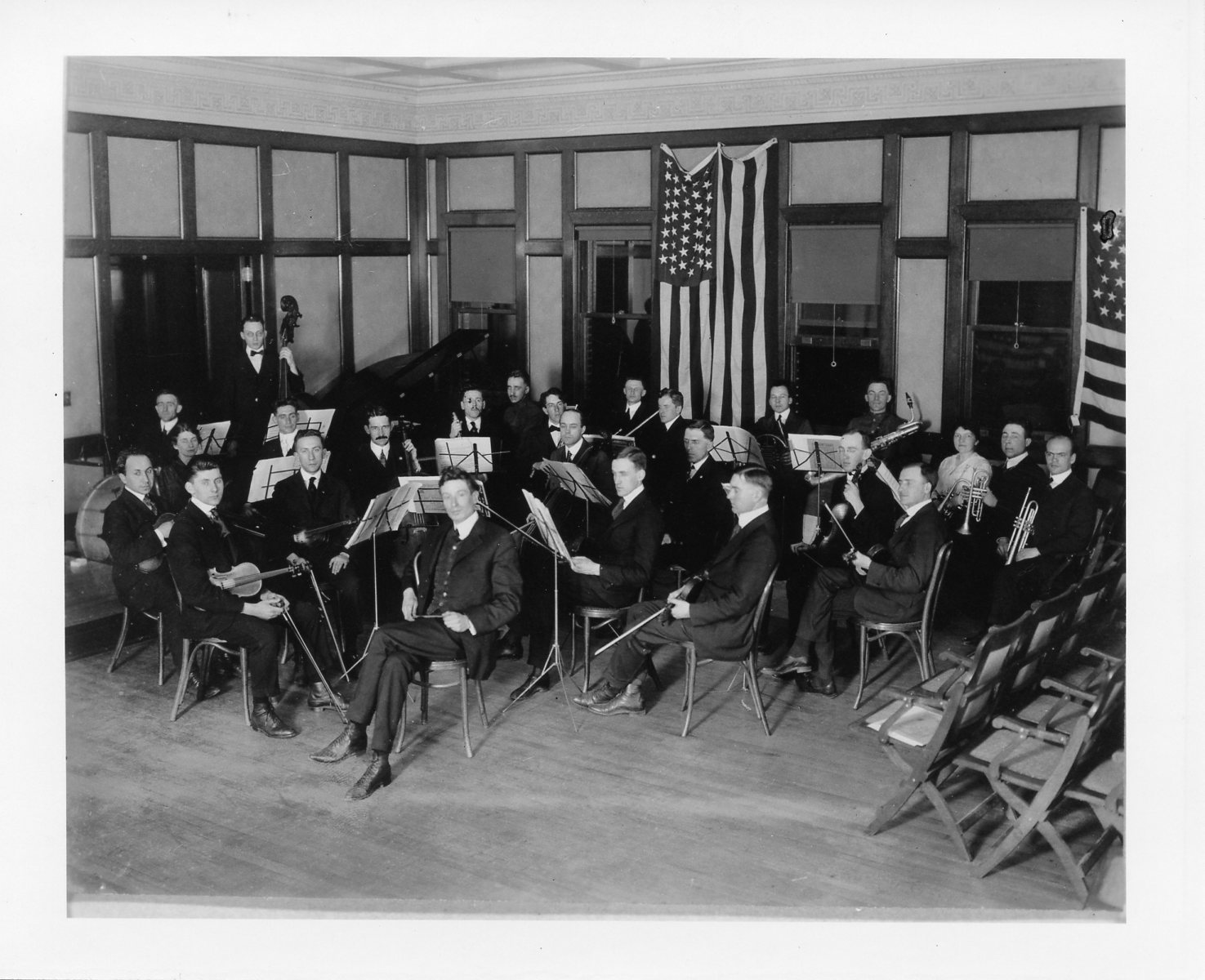
William F. G. Swann, conductor, with the the Bureau of Standards Orchestra at a concert on April 17, 1918.
Swann William D5 . Credit Line: NIST, courtesy of AIP Emilio Segrè Visual Archives, Physics Today Collection
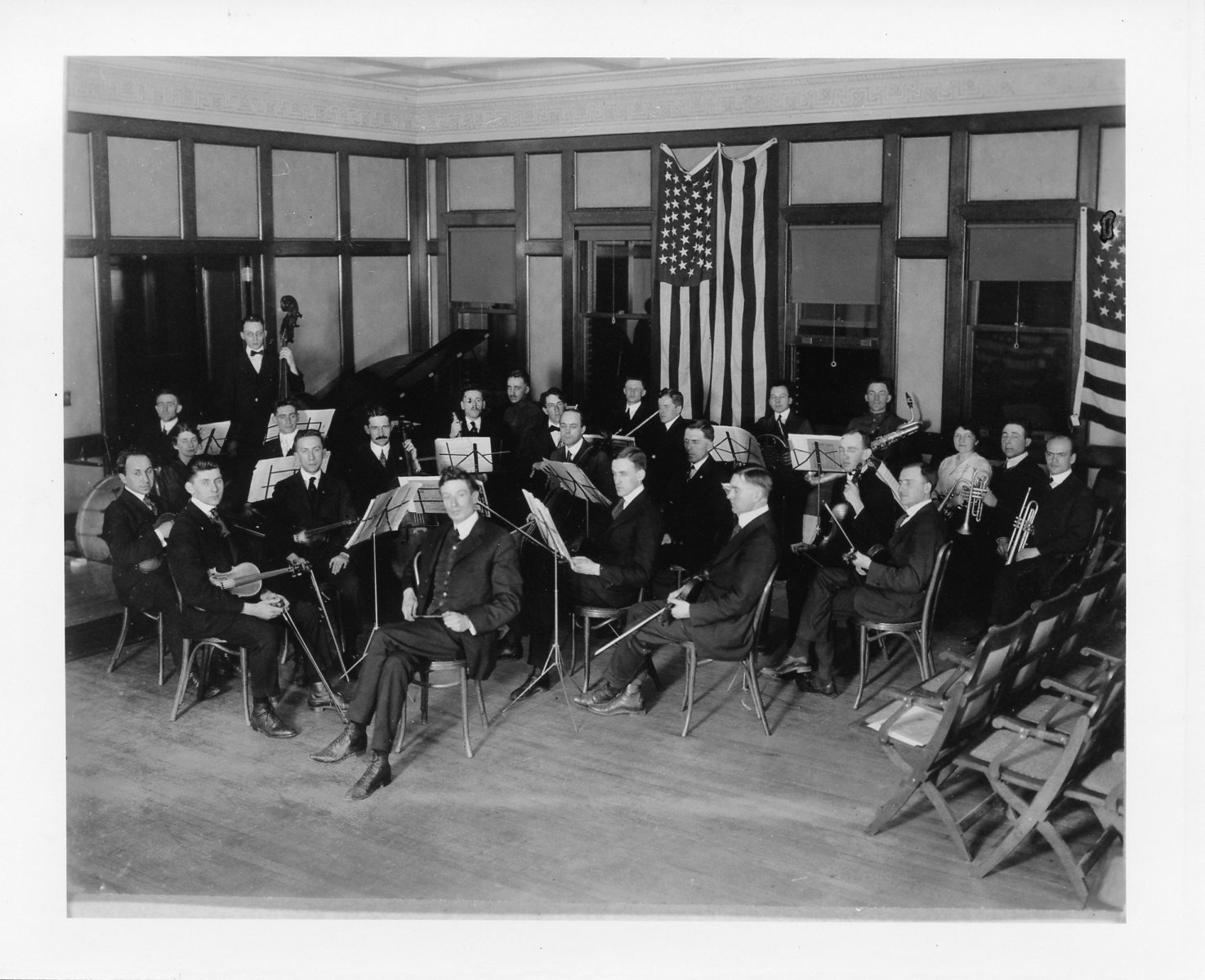
While at the National Bureau of Standards (NBS), Meggers continued his musical interests by playing in the NBS Orchestra, seen above in a concert from 1918. Meggers is playing the trombone in the center back near the flag. (A better shot of him with a trombone can be seen here ). The orchestra was formed by NBS director Dr. Samuel W. Stratton, who proposed it as a way to create social culture at the Bureau and improve staff morale, and its first conductor was coincidentally William F. G. Swann (featured earlier in this post). The somber expressions on many of the musicians in this photograph may be because the the concert was not one of their best. Dr. Paul D. Foote, an engineer and clarinetist in the group, recalled “with embarrassment” that this picture was taken during the performance on the evening of April 17, 1918, when “the rendition of a quartet encore [of ‘Moment Musicale’] failed to indicate sufficient coordination and practice.”
1
In addition to Dr. Meggers, Swann and Foote, several other scientists were part of the ensemble, including Chanucey G. Peters, Harold F. Stimson (cello and flute), Richard F. Jackson, Fred L. Mohler (violin), James F. Skogland, Laurens E. Whittemore (violin), John Howard Dellinger (2nd violin), W. Orland Lytle (trumpet), Miss Grace C. Neidig (trumpet), and Harry J. McNicholas (trumpet). Frances Mabel Swann, wife of the conductor, is also playing violin.

‘Music is a principal pleasure for the Meggers, means more than just listening. Here is the ‘family trio’ of Betty Jane, Dr. Meggers and William in action.’ Appeared in the Washington Post Rotogravue Section, February 23, 1941.
Meggers William G23. Credit: Photo by Joseph S. McCoy, Jr., Washington Post, W. F. Meggers Collection, Restricted Collection.
William Meggers’ music making extended to his home life as well. In 1941, the Meggers family was featured in the Rotogravure Section of the Washington Post . Meggers was photographed playing the violin in a trio with his daughter, Betty Jane, on piano and son, William Jr., on the trumpet. Meggers was also a collector of musical records and the proud owner of a pedal-operated player piano.
Charles G. Abbot
Astrophysicist | Cellist
Charles Greely Abbot (1872-1973) was an astrophysicist best known for his work in solar radiation and his nearly five decades-long tenure at the Smithsonian Institution. He succeeded Samuel P. Langley as the director of the Smithsonian Astrophysical Observatory in 1907, and starting in 1928, served as the fifth Secretary of the Smithsonian Institution until his retirement in 1944. He also was an avid player of the cello.

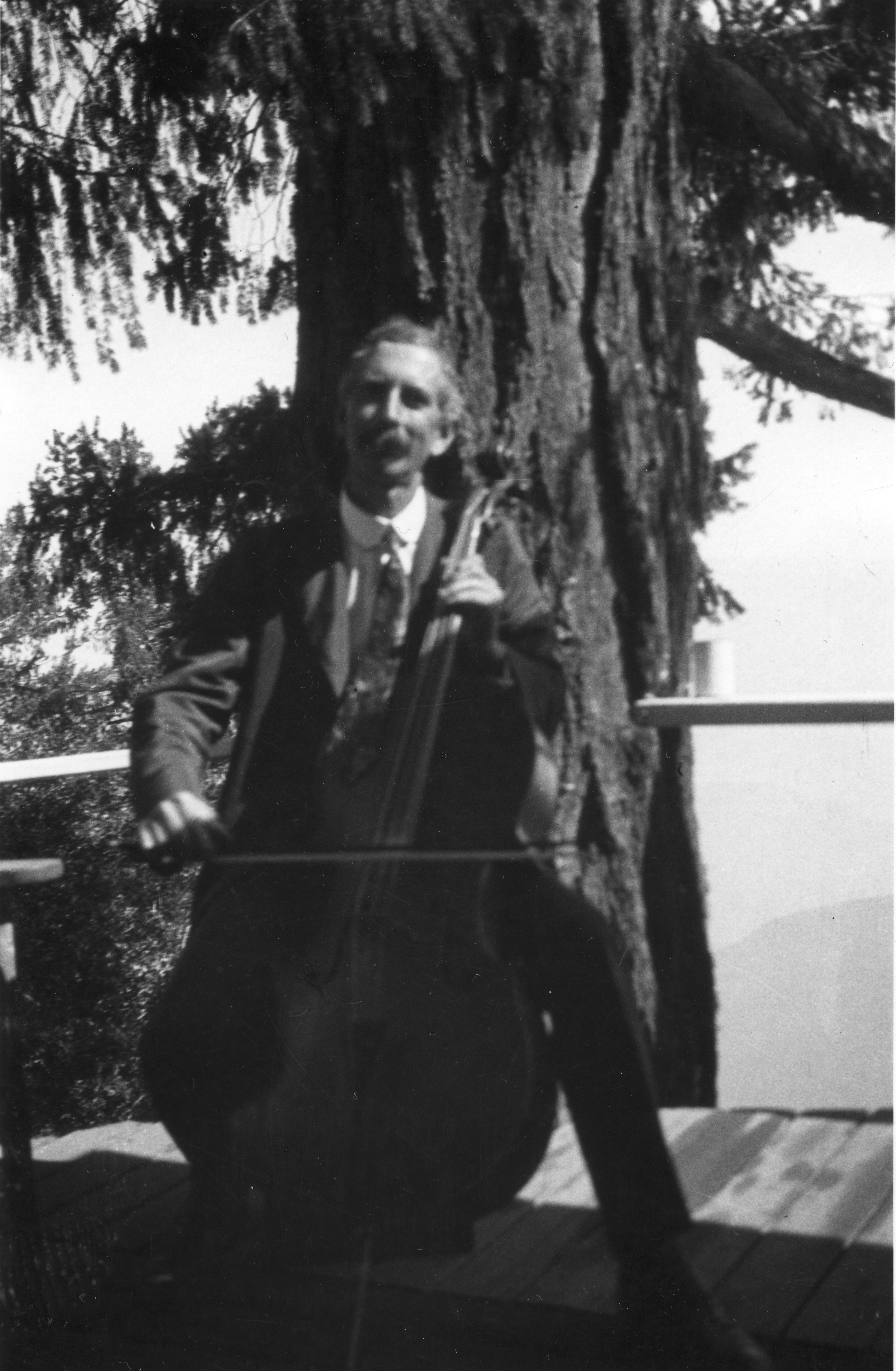
Charles G. Abbot relaxing with his cello on Mount Wilson, 1915. For many years Abbot spent the summer on the mountain studying the solar constant.
Abbot Charles B1 Credit Line: Photograph by Margaret Harwood, courtesy AIP Emilio Segrè Visual Archives
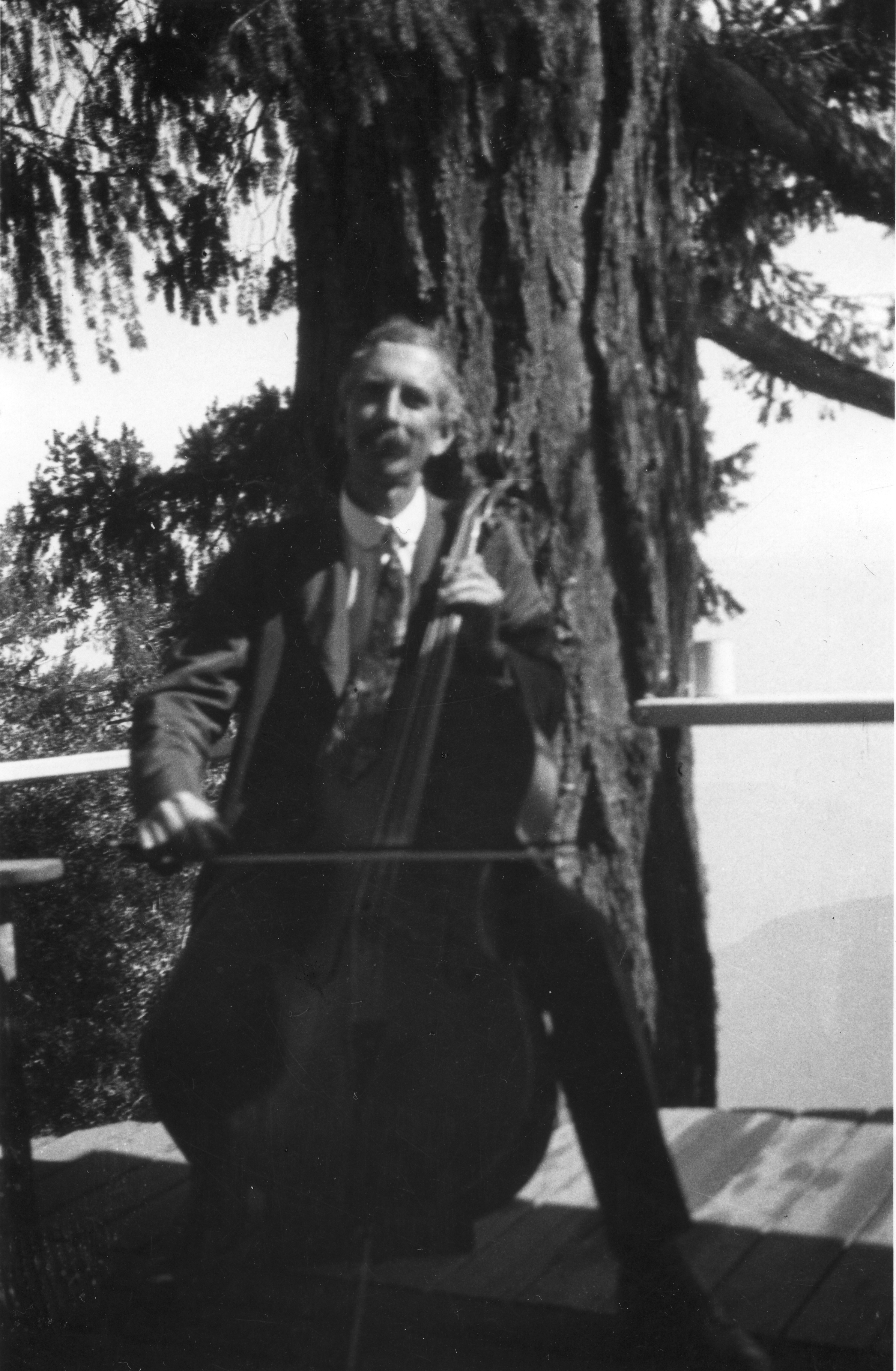
Perhaps the most adventurous photo of a musician in the ESVA is the one above of Abbot “relaxing” with his cello on Mount Wilson in California. Abbot spent many summers there making observations of the solar constant at the observatory’s 5,715 ft elevation. Whilst a foggy day, you can still make out the stunning vista behind him as Abbot plays outdoors. The observatory was still pretty remote in 1915, with only a small toll road for the transport of equipment. Astronomers were forced to hike to the station or go by stage coach, which makes you wonder how nerve-wracking it would be to trek up a mountain with a cello!
Abbot was a self-taught musician and had a deep love of classical music. In his unpublished autobiography, held at AIP, he described his training:
“Although I have never had lessons, I have tried to play the violincello [sic] since I was 10 years old. Fortunately the master composers of olden times wrote parts not too difficult for me, while quite complex enough to interest good violinists and pianists. For 30 years, with two friends, we played the piano trios of Beethoven, Hadyn, and other masters nearly every Saturday evening.”
He also fondly recalled singing as a student at MIT in the chorus of the Handel and Haydn Society of Boston, accompanied by the Boston Symphony Orchestra. Abbot loved attending music, opera, and theater performances throughout his life. He once got the opportunity to play with famed violinist Mischa Elman while on a trip returning from Australia and he played the cello at the Smithsonian Institution’s very first holiday party in 1955 (alongside his SAO successor Loyal Aldrich on piano).
This photograph of Abbot was taken by fellow astronomer Margaret Harwood , who was working at nearby Lick Observatory towards a master’s in astronomy at UC Berkeley. Just a year later, she was named the first director of the Maria Mitchell Observatory in Connecticut. It is important to note that when this photograph was taken in 1915, Harwood would have been prohibited from accessing the telescopes at Mount Wilson Observatory. It was not until 1923 that she became the first woman to be allowed access to the mountaintop observatory on Mount Wilson and 1924 before she was allowed to use the 60-inch telescope.
Martin Kamen
Chemist | Violist

Martin Kamen playing his viola, circa 1950.
Kamen Martin B1 Credit Line: AIP Emilio Segrè Visual Archives, Segrè Collection
Martin Kamen (1913-2002) was a pioneering chemist who revolutionized biochemistry with the co-discovery of the synthesis of carbon-14. His love of music, however, goes back much further than his scientific career. Kamen began violin lessons at the age of seven in Chicago and was considered a child prodigy, featured frequently in the local newspaper. Uncomfortable with the limelight however, he switched to the viola at age thirteen. He continued his music studies at the Girvin Conservatory of Music in parallel with a degree at the University of Chicago. After the formation of the University of Chicago’s music department, he earned a scholarship to play first viola in the university orchestra and earned extra funds by playing “jazz fiddle” at speakeasies in the Chicago area. He was initially an English major but changed to Physical Chemistry for financial reasons his junior year of college.
Kamen continued to play viola at a high professional level for the rest of his life, including playing chamber music with violinist Isaac Stern. In 1944, after a chamber concert, he was overheard talking to some members of the Russian consulate who had admired his playing and was falsely accused by the FBI of being a suspected spy for the Soviets. It took him nearly 10 years to clear his name and win a libel suit against the press. In the early 1950s, when this photo was taken, Kamen was running the cyclotron program at the Washington University of St. Louis medical school, using radioactive tracers in research.
Martin Kamen’s autobiography “Radiant Science, Dark Politics ” goes further into his remarkable life, including his scientific and musical career.
Clinton B. Ford
Astronomer | Violinist | Violist

Clinton Ford plays his viola at a rehearsal of the Stamford Connecticut Symphony Orchestra, 1973.
Ford Clinton B1 . Credit Line: AAVSO, courtesy AIP Emilio Segrè Visual Archives
Clinton B. Ford (1913-1992) was an amateur variable star astronomer whose self-described interests were “the AAVSO, his music, and the stock market.” He joined the American Association of Variable Star Observers (AAVSO) at the age of 15 in 1927, the youngest member at the time, and over the course of his life made over 62,000 variable star observations. His father was a mathematics professor who nurtured his youthful interest in science. Ford pursued both a bachelor’s and master’s degree in astronomy from the University of Michigan. However, enlisting in the navy during World War II interrupted his studies and prevented the completion of his dissertation. He spent the next several decades working in industry before taking an early retirement in 1960 with money he had gotten through strategic investing in the stock market. He spent his later years devoted to variable star astronomy and philanthropy; he joined several amateur observing groups and was honored for his work by the Astronomical Society of the Pacific. He donated much of his estate to the AAVSO and the Ford Observatory is named in his honor.
Ford described his musical pursuits in his 1986 memoir: “Some Stars, Some Music: The Memoirs of Clinton B. Ford. ” The “some music” refers to Ford’s training as a violinist and violist -- he is seen above playing viola with the Stamford Connecticut Symphony Orchestra in the 1970s. Ford would bring his violin with him on his travels and would hold impromptu chamber music sessions with local players around the world. His first wife, Alice Guernsey, was also a musician and they would often give performances together and play in the same groups. Ford was known to perform at AAVSO meetings and was an active member of the Associated Chamber Music Players, to which he bequeathed money to establish a fund for chamber music education.
Albert Einstein and Paul Ehrenfest
Physicists | Violinist (Einstein) | Pianist (Ehrenfest)

Painting of Einstein with violin and Ehrenfest at piano. From original watercolor by Marijke Kamerlingh-Onnes.
Einstein Albert C19. Credit Line: Original watercolor by Marijke Kamerlingh-Onnes, courtesy AIP Emilio Segrè Visual Archives
What post on physicist musicians would be complete without Albert Einstein? In this contemporary watercolor painting by Marijke Kamerlingh Onnes, Albert Einstein is seen playing chamber music with physicist and pianist Paul Ehrenfest. Ehrenfest and Einstein were close friends, and Einstein visited Ehrenfest’s family in Leiden several times in the 1910s and 1920s, when this painting was presumably made.
The artist, Elisabeth Maria “Marijke” Kamerlingh Onnes (1897-1955), was the daughter of Dutch artist Menso Kamerlingh Onnes and niece of Nobel Prize-winning physicist Heike Kamerlingh Onnes, who also resided in Leiden. Marijke’s brother Harm was also a painter and did portraits of Einstein and Ehrenfest.
This painting was featured on the cover issue of Physics Today in April 2006 for its article “Albert Einstein in Leiden” by Dirk van Delft. In the article, Delft describes how Einstein introduced Ehrenfest to the music of Johann Sebastian Bach and they would “interrupt their intense discussions on subjects like the ergodic principle or gravitation to play Brahms sonatas, with Einstein on the violin and Ehrenfest at the piano.”
Several AIP oral histories attest to the scientific music making of the Ehrenfest household in Leiden, including Jan Burgers , who recalled Ehrenfest enjoying duets with physicist-cellist Hans Kramers, and physicist Hendrik Casimir who recalls Ehrenfest frequenting his home as a child:“One of the things was that he [Ehrenfest] would always drop in unexpectedly and if there was no one at home he would collect my sisters and myself around the piano and start playing children’s songs and would have all the children singing with him. This I remember very distinctly: Ehrenfest hammering away on the piano, Dutch children’s songs and all of us singing with him.”
- Oral History Interview with Hendrik Casimir on 1963 July 5 and 6. Session I
John Coltman
Physicist | Flutist

John Coltman plays a flute in his office.
Coltman John B1 . Credit Line: AIP Emilio Segrè Visual Archives, Physics Today Collection
John W. Coltman (1915-2010) was a physicist at the Westinghouse Electric Corporation whose amateur musical activities sparked a long research career in musical acoustics, particularly on the behavior of flute and organ pipes. Coltman began studying the flute in school, playing while in college and beyond, including serving as the associate director of the Wilkinsburg Symphony Orchestra and playing in the Pittsburgh Woodwind Quintet.
It was during his time as an undergraduate at Case Western Reserve University, however, that he became interested in the science behind the acoustics of the instrument and its history. In the 1950s he started collecting flutes, eventually amassing over 200 instruments, and created a home laboratory (“with home-made equipment and a very modest budget”) to test the sound production of the instruments. This “hobby” soon turned into nearly 40 published scientific papers on musical acoustics, making him a recognized authority on the acoustics of the flute. Stanford University holds the John W. Coltman Archive dedicated to his work on musical acoustics, which includes a list of his publications on the flute and other resonant wind instruments along with computer programs he wrote that simulate resonances.
In his professional life, Coltman was the head of Mathematics and Radiation at Westinghouse Electric. While he did work on some acoustics there, particularly sound propagation underwater, he is best known for his work in the development of an x-ray image amplifier that is used in modern medical fluoroscopy. By the time he retired in 1980, he held 22 patents and had written 66 non-flute related technical articles on topics such as information theory, nuclear physics, and semiconductor devices.
In 1968 he authored a Physics Today article on the “Acoustics of the Flute” in which a cropped version of this photograph was first featured.
Arthur Roberts
Physicist | Composer

Arthur Roberts, a physicist at Argonne National Laboratory, at a recording session for music he composed for a film on the 1964 Atoms for Peace Conference. The musician is from the Chicago Symphony.
Roberts Arthur C5 Credit: AIP Emilio Segre Visual Archives, George Tressel Collection
Another physicist with a significant musical career, this time as a composer, is Arthur Roberts (1912-2004). While Robert’s music deserves its own blog post (see this Physics Today article for just a sampling of his physics songs), the photo above is from one of the more serious compositions he wrote for a film score that was performed by the Chicago Symphony Orchestra.
Roberts held a master’s degree from the Manhattan School of Music along with a PhD in Physics from New York University. He spent most of his professional career as a physicist working on high energy physics and cyclotrons, including time at the Argonne National Laboratories and FermiLab. Starting in the 1930s, he began composing songs, mainly satirical or humorous songs involving physics (many of which can be found on Haverford College’s Physics Songs Database ), but also more traditional compositions. His best-known symphonic work is the Overture for the Dedication of a Nuclear Reactor (1952) which was performed by the Oak Ridge Symphony and Rochester Philharmonic and is considered one of the first serious musical compositions inspired by the atomic age. (A 2024 recording by the Oak Ridge Civic Music Association is available on YouTube ) Roberts also was an early experimenter with electronic music: he used Fortran in the 1960s to make computer-generated music and adopted MIDI in the 1990s.
When asked in a 1993 interview with Earl Dumor for the Computer Music Journal how his colleagues at Argonne viewed his musical work, Roberts replied:
“Usually you’ll find among scientists a great number of people who are very fond of classical music. I had lots of sympathy and admiration. The man who was in charge of scientific films at Argonne, George Tressel, asked me to write computer music for his films. So I did that. I wrote the title music for a short film called Link that had to do with the analysis of bubble chamber photographs. He then asked me to write the music for the full-length feature film they were doing called The Many Faces of Argonne, which I wrote for conventional instruments; it was recorded by members of the Chicago Symphony Orchestra. That film won an award later that year at a film festival in Belgium.”
The photo above is likely from the recording session for The Many Faces of Argonne (1963), a film produced during the time of the Atoms for Peace Conference (the film recording is held at the National Archives). and comes from a collection of photographs donated to AIP by George Tressel.
For more on Arthur Roberts’ scientific career, see his obiturary in Physics Today.
Victor Weisskopf
Physicist | Pianist

(L-R): Volney Rasmussen, W.A. Fowler, V.F. Weisskopf (at piano) and Thomas Lauritsen
Resmussen Volney D1 . Credit Line: AIP Emilio Segrè Visual Archives, Gift of W.A. Fowler
To close out this post, I’ll end with a photograph that is representative of many musical moments in oral history accounts: physicists singing around a piano. Here we see physicist Victor “Viki” Weisskopf at the piano playing a tune with fellow scientists joining in raucous song. While we do not know what song they are playing or what event this is from, the photograph was likely taken in the late 1940s or early 1950s at Caltech.
On the left is Volney K. Rasmussen, who earned his PhD in 1950 from Caltech in Physics and Mathematics focused on gamma radiation, and was the student of nuclear physicist Thomas Lauritsen (far right). Astrophysicist William A. Fowler (1911-1995), who later won the Nobel Prize in Physics, is in the center. While not an instrumentalist, Fowler was known to be a lover of classical music, particularly that of Robert Schumann.
References
1 Measures for Progress: A History of the National Bureau of Standards. Rexmond C. Cochrane, NBS Miscellaneous Publication 275, (1966). p. 658.