NBLA acquires offprints of three papers by Kathleen Yardley Lonsdale

Portrait of Dame Kathleen Lonsdale.
AIP Emilio Segrè Visual Archives. Catalog ID: Lonsdale Kathleen A2
The AIP Niels Bohr Library & Archives recently acquired three rare offprints of early papers by the crystallographer Kathleen Yardley Lonsdale (1903-71), one of the first two women inducted into the Royal Society of London. These offprints, which are separate printings of individual articles from a journal, give scholars a window into the kind of careful crystallographic work that Lonsdale would later become renowned for, and into her career trajectory as a young scientist in pre-World War II Britain.
Kathleen Yardley was born in Newbridge, Ireland, and was the youngest of ten children. When Yardley was five, her mother, Jessie Yardley, moved her family to England to escape Irish political unrest. According to her fellow crystallographer Dorothy Hodgkin, who wrote her obituary for Biographical Memoirs of Fellows of the Royal Society, Yardley was a standout student as a teenager and attended most of her courses at the County High School for Boys because the girls’ school did not offer physics, chemistry, or higher mathematics. At sixteen she enrolled in Bedford College for Women, an institution in the University of London system, and at the age of nineteen she earned the highest mark of any University of London student on the honors physics exam.
That score caught the attention of one of the examiners, the Nobel Prize-winning crystallographer William Henry Bragg, who offered Yardley a place in his lab at University College London (UCL). In 1923 Bragg was offered the opportunity to move to London’s famed Royal Institution, the former home of Michael Faraday. He accepted and brought Yardley with him to the new laboratory.
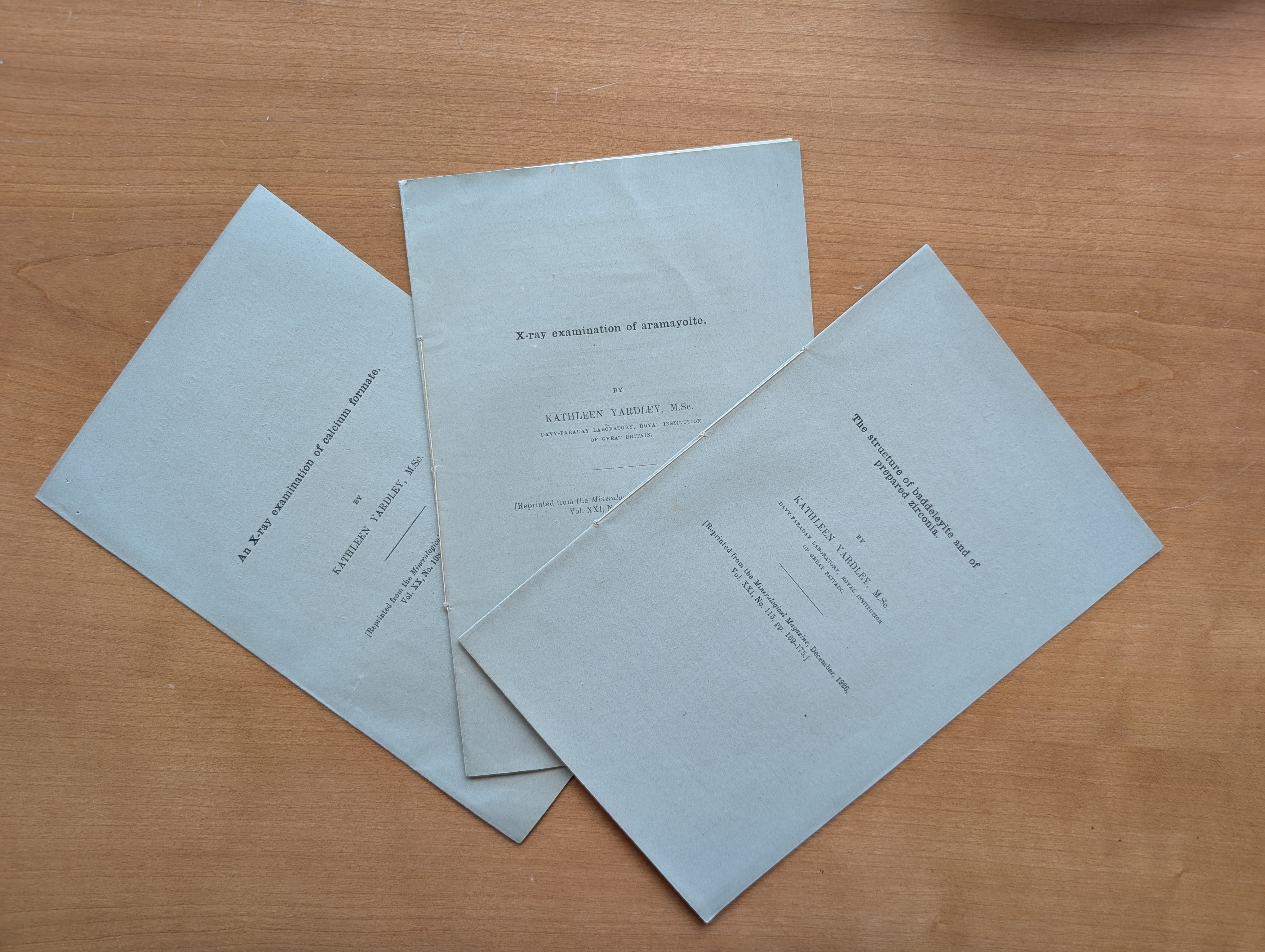
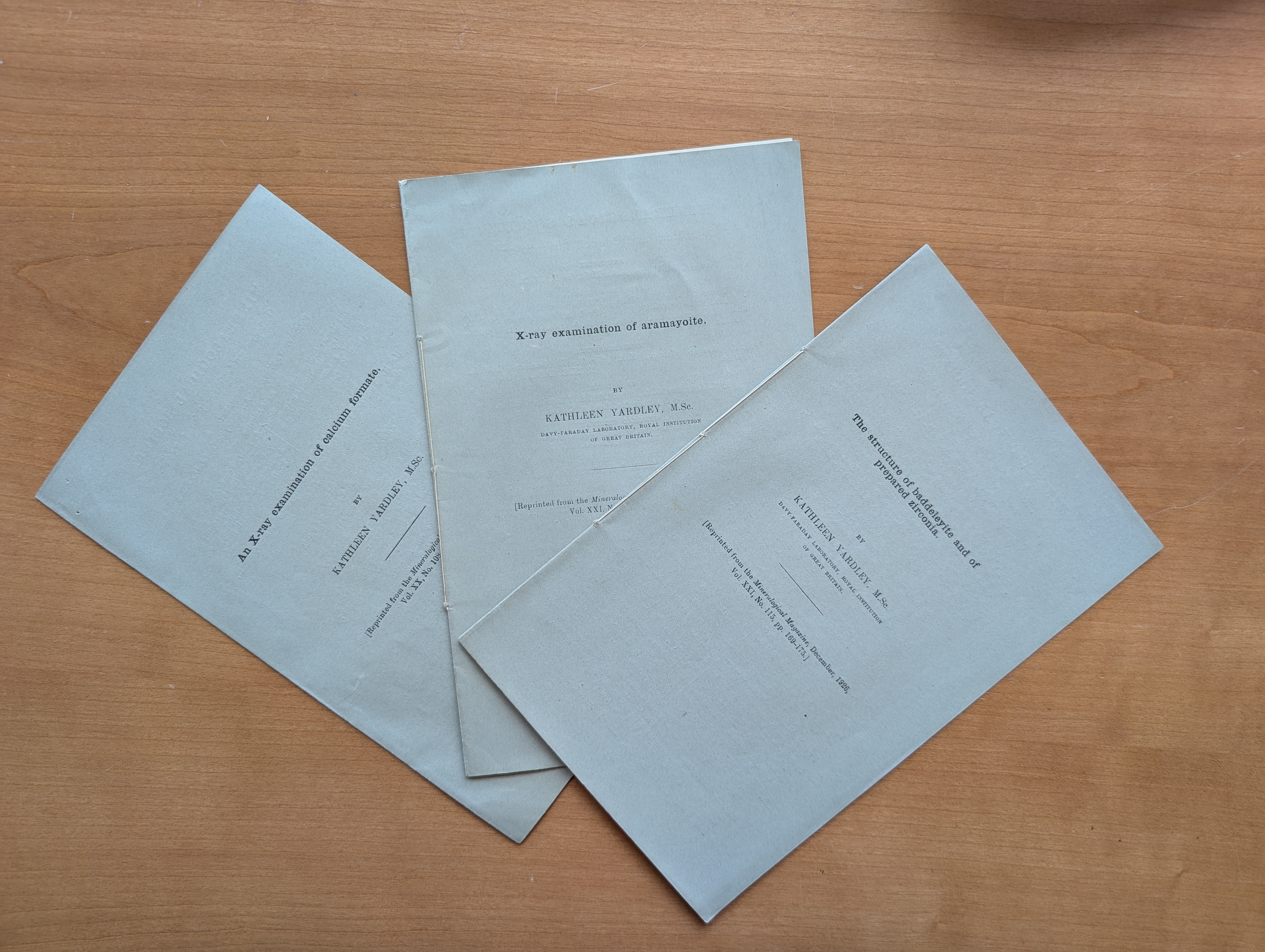
These three offprints from the Mineralogical Magazine all date from Yardley’s years at the Royal Institution. “An X-ray examination of calcium formate” was printed in March 1925; “The structure of baddeleyite and of prepared zirconia” and “X-ray examination of aramayoite” were published in December 1926. Mineralogical Magazine was a specialized scientific publication focusing on the mineral sciences. Like most papers in Mineralogical Magazine, Yardley’s articles were short, averaging six pages each. In each paper she used Bragg’s signature technique, x-ray crystallography, to draw conclusions about the structure of minerals based on a mathematical analysis of their x-ray diffraction patterns.
The minerals Yardley focused on in these papers were rare ones. Baddeleyite, for example, is a zirconium oxide with formula ZrO2 found only in igneous rocks; the sample Yardley analyzed was on loan from the British Museum. Aramayoite, a mineral made from silver, antimony, bismuth, and sulfur, is mostly found in Bolivia. All three papers are early examples of the kind of work Yardley would later become distinguished for: careful reconstructions of molecular and mineral structures via x-ray crystallography.

Three offprints by Kathleen Lonsdale.
Melinda Baldwin
The fact that these papers were published solely under her own name, with Bragg thanked for his mentorship in the acknowledgements but not listed as a co-author, speaks to Yardley’s independence as a young researcher—she would have been 22 and 23 at the time these papers were published. They also reinforce Bragg’s reputation as a supportive mentor who actively worked to launch the careers of the young scientists in his lab by making certain they established publication records early. Notably, all three papers indicated that Bragg had them read aloud at meetings of the Mineralogical Society. At the time it was common to require that a paper be read out loud by a member at a scientific society meeting before it could be published in one of that society’s journals. Bragg’s participation paved the way for these three papers to reach print.
These versions of the papers are also an example of offprints, a form of printing that has fallen out of use as more and more journals are published digitally. Unlike later offprints, which were often simply reprints of a paper with a single staple at the top left corner, these Mineralogical Magazine offprints were bound with a light blue cover that bore both the paper’s title and, on the back, the table of contents for that issue of the journal. Authors like Yardley would have been given a set number of these bound offprints to send to colleagues who had supported their work, or to correspondents who wrote in to ask for a copy of the paper.


The year after the last of these papers was published, Yardley married Thomas Lonsdale, whom she had met in Bragg’s group at UCL. Like most married women of the age she changed her last name to her husband’s, and when she began publishing as Kathleen Lonsdale, it was not necessarily a given that her fellow scientists would remember her previous work as Kathleen Yardley. Lonsdale took pains to ensure that her reputation would be linked to her new name. When she published a letter in Nature announcing that she would soon publish a comprehensive study of the structure of benzene, for example, she signed it “K. Lonsdale (née Yardley).”
In 1927 the Lonsdales moved to the University of Leeds. It was there that Lonsdale did the experimental work that she was arguably best known for: a calculation of the structure of the benzene ring that used the kind of mathematical analysis she had employed in her earlier mineralogical work. At the time, there was an active debate among crystallographers over whether the benzene ring was planar or whether it had a zig-zag structure similar to that of diamonds. Lonsdale’s paper on the structure of the benzene ring in hexamethyl benzene, the first x-ray diffraction analysis of a benzene derivative, demonstrated that the x-ray data was only consistent with a planar benzene ring.
Lonsdale went on to a distinguished career after that landmark paper. She published an enormously popular set of reference tables for crystallographers, became known as an expert on diamond structures, and in 1949 became head of the Department of Crystallography at University College London, the first such department anywhere in Britain. In 1945, she and the biologist Marjory Stephenson became the first two women inducted into the Royal Society of London , and Lonsdale frequently wrote about the obstacles facing her fellow female scientists , including unequal domestic expectations. A Quaker, she was also known for her passionate anti-war activism, and even spent ninety days in jail during World War II for her activities as a conscientious objector. These three offprints highlight the beginning of a long and illustrious life in science, one that advanced the field of crystallography and helped open doors for other women in science.
Melinda Baldwin is an associate professor of history and the AIP Endowed Professor in History of Natural Sciences. Her research focuses on the history of science in the 19th and 20th centuries, with particular interest in scientific publishing, grant-making, and peer review. She is a former senior editor at the magazine Physics Today, a member of the John Tyndall Correspondence Project editorial team, and a former postdoctoral fellow of the American Academy of Arts and Sciences.