
How Scientific Knowledge Moves: Oral Histories, Soviet Lasers, & Innovation Research


Jungkyu Suh, an Assistant Professor of Management and Organizations at New York University’s Stern School of Business.
New York University’s Stern School of Business
Earlier this year, while exploring how graduate students have used the collections of AIP’s Niels Bohr Library & Archives in theses and dissertations , I came across a particularly intriguing study that I wanted to learn more about. In his doctoral dissertation, Essays on Science and Innovation , Jungkyu Suh drew on AIP oral histories as part of a broader investigation into the relationship between science and innovation. What caught my attention was the way the project brought together research traditions that are not often combined. Quantitative metascience studies of innovation frequently rely on large-scale analyses of publications, patents, and other quantitative data, while oral histories are more commonly associated with the qualitative traditions of history and sociology of science. Seeing our oral histories cited in a computational science-of-science study made me curious to learn more about both the research and the researcher behind it.
Jungkyu Suh is an Assistant Professor of Management and Organizations at New York University’s Stern School of Business. His research examines how firms translate scientific knowledge into technological innovation and how the structure of the innovation ecosystem shapes that process. In the interview that follows, we discuss his research, his use of AIP’s oral histories, and what their combination can reveal about how scientific knowledge moves through the world.
Trevor Owens: Unlike many of the scholars we feature on this blog, you approach science as a researcher working at the intersection of business, economics, and organizational studies. What are the central questions that motivate your research, and how did you become interested in studying the relationship between science and innovation?
Jungkyu Suh: My research asks how firms can hasten the commercialization of science into innovations. Going back, I’ve always been interested in what determines the wealth and poverty of nations. So I read international political economy as an undergrad, but found the theories missed a central factor: the role of science and technology in accelerating development and the critical role of companies in them.
As I progressed through my PhD, I became convinced that scientific breakthroughs do not magically translate themselves into useful products and services. And plumbing this innovation “supply chain” became a challenge I decided to dedicate myself to. Translation of science requires the cooperation of scientists that came up with the breakthrough, the inventors that exploit breakthroughs to produce prototypes, and the innovators that will go to market by betting on nascent demand and investing in complementary assets. No one person can master all three parts: due to differences in taste, skills and resources, the best scientists seldom make the best inventors, and the best inventors often fail at innovating.
The organizational upshot is that we have divided the innovation supply chain amongst universities (science), startups (invention) and incumbent firms (innovation) to maximize the gains from specialization. The tricky part is that this division of innovative labor must contend with coordination costs: selling knowledge runs into a Catch-22 where the seller needs to reveal the “secret sauce” for the buyer to verify its contents. Better contracts and stricter patents can be written, but these remedies are incomplete, especially in “deep-tech” areas of science.
These tensions have led me to study several interrelated questions in my PhD dissertation: Why do firms conduct scientific research with their own money (Ch 2)? What happens when large corporations retreat from science and universities and startups assume more translational tasks (Chs 1 & 5)? How can markets for technology function more efficiently (Ch 3)? Under which conditions are startup innovations more novel than incumbents’ (Ch 4)?

TO: In your dissertation, Essays on Science and Innovation , you cite oral history interviews with Amnon Yariv and Martin Stickley from AIP’s Niels Bohr Library & Archives. How did you first discover AIP’s oral history collection, and what led you to see these interviews as relevant sources for your research?
JS: A bit of serendipity and some triangulation. I’ve been an admirer of historians of science and technology and wanted to emulate the deep contextual details they brought to their work. In the third year of my PhD, I had the chance to work on a book chapter on the history of American innovation, and that led me to explore the commercialization trajectories of some of the most important science-based products of the past century: DuPont’s Nylon, Xerox PARC’s Alto Computer, Merck’s Ivermectin, and the laser.
The most interesting of these to me was the laser, because compared to the three others, there was a far finer division of innovative labor when it came to its commercialization. For instance, the idea for the laser came from a 1958 paper on masers written by Arthur Schawlow (at AT&T) and Charles Townes (at Columbia). But the first working prototype was invented by Ted Maiman at Hughes, who was working on a U.S. Army Signal Corps project. Firms large (AT&T, IBM, GE, American Optical, GTE and RCA) and small (TRG, Korad, Trion) joined the R&D race by inventing lasers in various crystals, dyes, semiconductor diodes, and excimers. In diode lasers in particular, process innovations elsewhere became instrumental to diffusing the technology. While teams at AT&T, RCA, and MIT Lincoln Labs introduced product innovations in continuous wave, room temperature-operable heterojunction diodes with longer lifespans, diode lasers would still not have been economically viable had the semiconductor industry not invented the planar process which dramatically improved the unit economics of chip manufacturing.
As I absorbed this information from prior work by Jeff Hecht’s Beam and Joan Lisa Bromberg’s The Laser in America, 1950-1970, it had become clear that the AIP’s oral histories (cited copiously in both works) served a vital role in clarifying the exact turn of events as these commercialization efforts unfolded (in fact, many of these interviews were conducted by Bromberg herself!). I received more help from industry insiders who were intimate with the interviewees to navigate the collection. Then, I “snowballed” the next interviews based on cross references to converge on a few that seemed most relevant to me.
TO: What role did these oral histories, and other historical research, play in the project? More specifically, what did they help you understand that would have been difficult to learn from publications, patents, or the other sources that informed your analysis?
JS: The laser chapter in my dissertation argues that what drives startups to try novel types of lasers is not necessarily their superior “upstream” scientific capability relative to incumbents, but a need to make up for inferior “downstream” capabilities in sales, manufacturing and distribution. The “upstream” argument, drawn from evidence from the biotech industry, was well received in the innovation literature, so I needed a setting where access to upstream scientific opportunities would be more or less equal for startups and incumbents. The sudden influx of Soviet science to the West after the Cold War seemed an ideal setting for this reason, but I wanted more assurance that the fall of the iron curtain had closed a meaningful knowledge gap.
The oral histories were important in establishing this stylized fact, as they showed how accessing Soviet knowledge was difficult and expensive. Yariv’s interview for example talks about how he’d written a paper about phase conjugation only to discover later parallel work by Zeldovich. To be clear, seminal findings such as the invention of the laser itself (by Prokhorov and Basov), the introduction of heterojunction diodes (by Alferov) and innovations in excimers reached Western audiences, but we know from past work by economic historians of World War I such as Moser & Voena (2012) and Iaria, Schwarz and Waldinger (2018) that meaningful knowledge transfer requires more than publications codifying results – it requires active cooperation that fills in tacit elements of a discovery. Cyrus Mody , for example, reminds us that shortly after Gerd Binnig and Heinrich Rohrer invented the scanning tunneling microscope in IBM’s Zurich lab, their American counterparts at Almaden and Yorktown Heights struggled to reach atomic resolution because the instrument’s specifications could not be clearly communicated. The AIP oral histories helped validate this for the transfer of Soviet laser science.
TO: Looking back on the project, do you think your findings or interpretation of the case would have been different if those oral histories had not been available?
JS: Without the oral histories, I would have needed to qualify my claims more carefully, as I would have primarily relied on citations from U.S. publications and patents to show an uptick in citations to Soviet articles after the fall of the Berlin Wall. The oral histories added much needed context to the data I could not find elsewhere.
TO: For readers who have not encountered the dissertation, could you walk us through the broader study? What were the central questions you were trying to answer, and why did the history of Soviet laser science provide a particularly useful case for investigating them?
JS: I think I ended up answering this question in my response to the previous questions. What I would add is that the Soviet Union in general offers a fascinating parallel where world-class science would be commercialized differently when innovators are subject to different incentives from those in the West. Studies of Soviet science often focus on how ideology can directly distort the scientific process – the abject failure of Lysenkoism being a prominent example. But even in areas where Soviet science excelled, the commercialization of these discoveries lagged the West. This, among other reasons, I believe was the biggest contributor to why the Soviet Union was a net technology importer , often relying on industrial espionage to build Western knock-offs.
The “flowering” of a general purpose technology such as lasers is an American success story, where a division of innovative labor allowed for different firms to specialize in applications as wide as rangefinders, missile seekers, barcode scanners, optical communication, photolithography, LASIK surgery, and even nuclear fusion. As the oral histories hint, the Soviet system, while generous in its funding of upstream research, could not emulate the diversity of approaches that the U.S.’s divided innovation ecosystem supported.

Product Novelty and Firm Type before and after Soviet Collapse
Jungkyu Suh
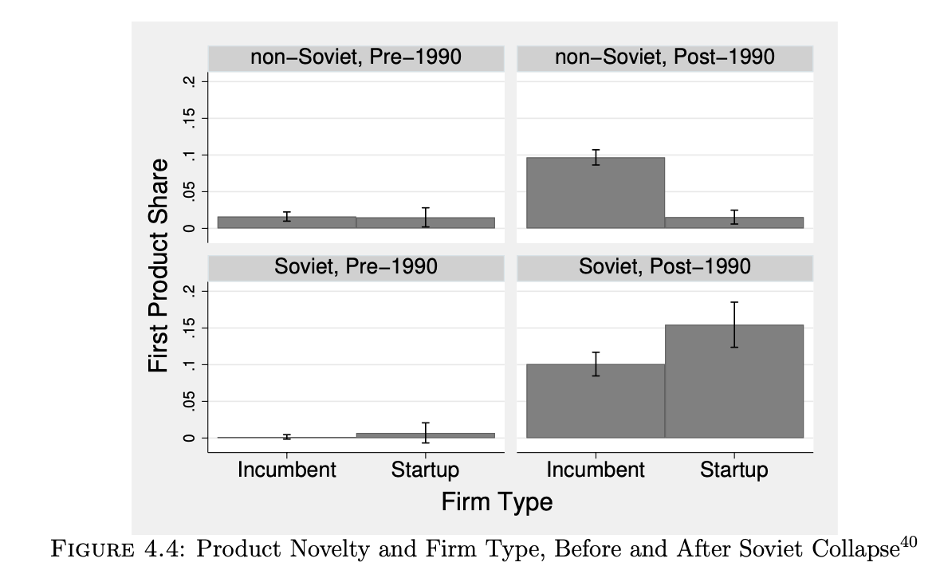
TO: Figure 4.4 in the dissertation, which I’ve included below, compares product novelty among startups and incumbent firms before and after the collapse of the Soviet Union. Could you walk us through what readers are seeing in this figure? How does it connect to your broader argument, and what kinds of data and sources were required to build it?
JS: The key comparison in this figure is in the bottom row, which compares product innovations for “Soviet type” lasers. I classified “Soviet type” lasers as those where the USSR had a commanding share of inventions in the 1980s according to Marvin Weber’s Handbook of Lasers. Concretely speaking, these are rare-earth doped solid state lasers (e.g., Ytterbium, Erbium, Holmium and others that were also later used in fiber lasers). Product introductions were scraped from the buyer’s guide of an industry publication, Laser Focus World, which lists the gain medium of the products. Prior to the end of the Cold War, there is no meaningful difference in the introduction of Soviet-type laser products between firms (bottom left). Afterwards, however, we find a distinct increase in Soviet-type laser product introductions, especially driven by startups (defined as firms at or younger than 5 years). The rest of the paper tests the hypothesis that this discrepancy owes to gaps in downstream commercialization capabilities between startups and incumbents.
TO: Your dissertation struck me as an example of productive engagement between research traditions that I do not often see interacting with one another. Researchers in the history and sociology of science often work with rich qualitative evidence, while researchers in economics, innovation studies, and the science of science often focus on large-scale quantitative patterns. Do you see opportunities for greater exchange between these communities? If so, what might help foster more of that dialogue?
JS: Yes, I do. As we specialize more deeply within our own disciplines, it becomes harder to learn from another because of the sheer effort it takes to catch up to the knowledge frontier. Yet, breakthroughs often come from the application of one disciplinary insight to another: Nate Rosenberg , for instance, recounts how tools of physics (spectroscopy, electron microscopy, x-ray crystallography and nuclear resonance) were repurposed by the life sciences over time to deliver leapfrog discoveries.
I believe a similar cross-pollination is possible between historians, sociologists and economists of innovation. Just last month (August 2026), I had the opportunity to co-organize a Symposium on research technologies at the Academy of Management that did just this (more on this in my response to your next question). We were able to showcase ethnographic studies of technicians at university core facilities on the one hand, and applied microeconomics work on the effects of automated liquid handling robots on scientific labor at universities on the other. I felt that the diversity of approaches complemented each other well, and plan on repeating this symposium next year.
TO: Since completing the dissertation, what research questions have you become most interested in pursuing? How do your current projects build on or depart from the themes you explored in this work?
JS: The book chapter I’d mentioned earlier has been expanded into a full-fledged scholarly volume, which has just been published . It asks why some fields of science (e.g., nuclear fusion, materials science) are harder to commercialize than others (e.g., software, chips and drugs). Our argument is that scientists and inventors in “deep tech” areas of science have trouble capturing the value they create for society. We document that large American firms in the past century addressed this problem by erecting consolidated industrial research laboratories that housed discovery, invention, and innovation under the same roof. But for a variety of reasons, this model has given way to a division of labor between university Technology Transfer Offices and Venture Capital backed startups that focus on upstream inventions while incumbents focus primarily on scaling.
My current projects try to answer how this division of labor can function better. In recent work, I show that one of the reasons why university science is less commercializable than corporate science is because the former relies less on costly scientific instruments . Using a comprehensive dataset of research equipment scraped from federal grants, I show that capital intensity in science has roughly doubled across the past four decades, and that universities have consistently lagged corporations in their use of such equipment. Yet, papers that use expensive equipment are more likely to get cited in patents (i.e., used downstream). Echoing the book’s finding, I show that academics’ lower equipment adoption is partly driven by their poor economic value capture from pursuing applied work: for instance, I also find that academics that have experience selling patents were more likely to adopt equipment.
A separate project , co-authored with Dror Shvadron at the University of Toronto, uses historical data to answer how firms make disclosure decisions about their internal research. The question is urgent, because the extent to which firms disclose results in cutting edge areas such as AI and Quantum Computing will have follow-on consequences for the growth of public science. Data for prior work on corporate innovation are limited to publications or patents, which are themselves selected out of an urn of internal research results that we rarely have access to. To solve this selection problem, we accessed internal research writeups at a large corporate lab (the David Sarnoff Research Center at RCA) to digitize around 7,000 internal reports across three decades (1947-1974). Interestingly, we found that around half of all internal results were kept secret while the other half were published in journals or patented. Contrary to prior work, we also found evidence that pairing publications with patents when disclosing results destroyed value for the firm (i.e., the two disclosure choices were strategic substitutes). This “compound leakage” threat may explain why patent-paper pairs from corporations are remarkably rare.
TO: Looking ahead, what areas of research on science, innovation, and organizations do you think deserve more attention?
JS: Echoing your point, I think we can learn from collaborations between science of science and the economics of innovation literatures. My understanding is that science of science studies how the rate and direction of scientific progress can be altered through norms and resource allocation decisions for scientists. The economics of innovation, on the other hand, has primarily studied firms’ decisions to develop and monetize science downstream. I find it fascinating to read works that link the two realms.
Second, social science in general can benefit from the use of artificial intelligence. In my own research, the digitization of scanned archival materials that would have taken months of contractor time could be compressed to a fraction using AI tools; the parsing of millions of federal grant documents also was helped by an AI screener. Both methods of course require human validation, but there is no question machines can augment social science research and accelerate discoveries.


