
Nancy Grace Roman Papers now online


Dr. Nancy Grace Roman in the AIP Niels Bohr Library & Archives reading room looking through her donated papers, September 18, 2012.
Roman Nancy B25 . AIP Emilio Segrè Visual Archives
The AIP Niels Bohr Library & Archives is excited to announce that the archival papers of Dr. Nancy Grace Roman, first chief of astronomy at NASA and namesake of the new Roman Telescope, are now available online . These archives have been fully digitized and made freely available with the generous support of a grant from the Henry Luce Foundation . The digitized archive is viewable alongside our existing digital materials related to Nancy Grace Roman at the link below.
On August 30, 2026, NASA is set to launch the Nancy Grace Roman Space Telescope. With a field of view 100x greater than that of the Hubble Space Telescope (HST), this Wide-Field Infrared Survey Telescope is designed to explore the mysteries of dark matter, dark energy, and exoplanets, ushering a new era of discovery about the universe. The telescope honors the legacy of Nancy Grace Roman, who developed the very first space telescope program at NASA and was instrumental in making the Hubble Space Telescope a reality.

Nancy Grace Roman
Roman Nancy B14 . AIP Emilio Segrè Visual Archives, Roman Collection
Nancy Grace Roman (1925-2018) was the first Chief of Astronomy and first woman executive at NASA. She joined in 1959, when the nascent National Aeronautics and Space Administration (NASA) was only six months old. Roman quickly rose the ranks to become Chief of Astronomy and Solar Physics in NASA’s Office of Space Science, doing what she sometimes described as “liaising between scientists, engineers, and the government.” In her 20-year tenure at NASA she built the program of astronomical research in space — working to secure budgets, convene expertise, set research priorities, and oversee the creation of dozens of science missions including the Orbiting Solar Observatory (OSO), Orbiting Astronomical Observatory (OAO), the International Ultraviolet Explorer (IUE), and the first great space observatory, the Hubble Space Telescope (HST). Roman was given the nickname “Mother of the Hubble” by her successor Ed Weiler for her contributions towards HST’s development. In addition to her work with NASA, Nancy Roman was an accomplished observational astronomer, making strides in stellar spectroscopy and radio astronomy in her early research career at the University of Chicago Yerkes Observatory and Naval Research Laboratory, and was a champion of women’s education in astronomy and science.

In her memoir , Roman considered the 1962 Federal Woman’s Award, one of her greatest honors as it led to her meeting with then President Kennedy. It was given to Nancy Grace Roman “in recognition of her high ability and strong leadership in developing a progressive national space program in astronomy and astrophysics. Her efforts are resulting in a comprehensive array of scientific experiments which will be flown in satellites over the next several years. She has played a key role in the selection of experiments and the development of concepts for these satellites. In a new and undefined area of national effort she has effectively organized and coordinated a complex program of research and development on astronomical observations from satellites and space probes, utilizing the capabilities of universities, nonprofit institutions, industry, and government facilities.”
Box 9, Folder 1, Nancy Grace Roman Papers, 1931-1993 (bulk 1950-1980) [AR 347], Niels Bohr Library & Archives, American Institute of Physics

Childhood arithmetic homework from June 1935, showing Nancy Grace Roman’s (age 10) aptitude for mathematics at a young age.
Box 2, Folder 10, Addition, Nancy Grace Roman Papers, 1934-2006 [AR 2007;696; AR 2007-744], Niels Bohr Library & Archives, American Institute of Physics

One of many annual Christmas Letters written by Nancy Grace Roman in her papers detailing her personal and professional accomplishments for the year and sent to friends and family. In the beginning of this one from 1962 we see that she attends musical concerts and is starting to design her own clothes, all while winning the Federal Woman’s Award, launching the Orbiting Solar Observatory, and doing outreach at women’s colleges to encourage women to go into science.
Box 2, Folder 20, Nancy Grace Roman Papers, 1931-1993 (bulk 1950-1980) [AR 347], Niels Bohr Library & Archives, American Institute of Physics
The Nancy Grace Roman papers provide a unique window into who Roman was as a person, bringing the name behind the telescope to life. They contain primary source documents such as correspondence, memorabilia, and meaningful ephemera from throughout her life and career, ranging from childhood schoolwork and letters to her parents to her scientific research and awards from her time at NASA. The AIP Niels Bohr Library & Archives is home not only to her archive, but also her photographs , books from her personal library , and oral histories from 1980 and 2014 that help us continue to tell her story in her own words. We encourage you to explore her newly digitized papers and NBLA’s other online Roman collections in our digital repository ! Stay tuned for more from us about the collection in the coming months.
Note: The Nancy Grace Roman Papers consists of three separate archival accessions that have been digitized. The first, and largest, of these archival collections (Nancy Grace Roman Papers, 1931-1993 (bulk 1950-1980) ) is being released August 28, 2026 and can be explored using its finding aid . The additional collections will be added to our digital archival Roman Collections page soon, so please stay tuned for updates.
To see some examples from the collection and learn more about Roman’s role in developing early space telescopes, see our 2024 blog “Nancy Grace Roman and Early Space Telescopes”.
For more on Nancy Grace Roman and our other collections on women in science, see the Women in STEM Collections at NBLA research guide.
Handwritten copy (in Roman’s own hand) of the certificate awarding her the NASA Medal for Outstanding Leadership in 1978 for her work on several missions including the International Ultraviolet Explorer. The original certificate does not survive in her papers.
Box 1, Folder 11, Nancy Grace Roman Papers, 1931-1993 (bulk 1950-1980) [AR 347], AIP Niels Bohr Library & Archives
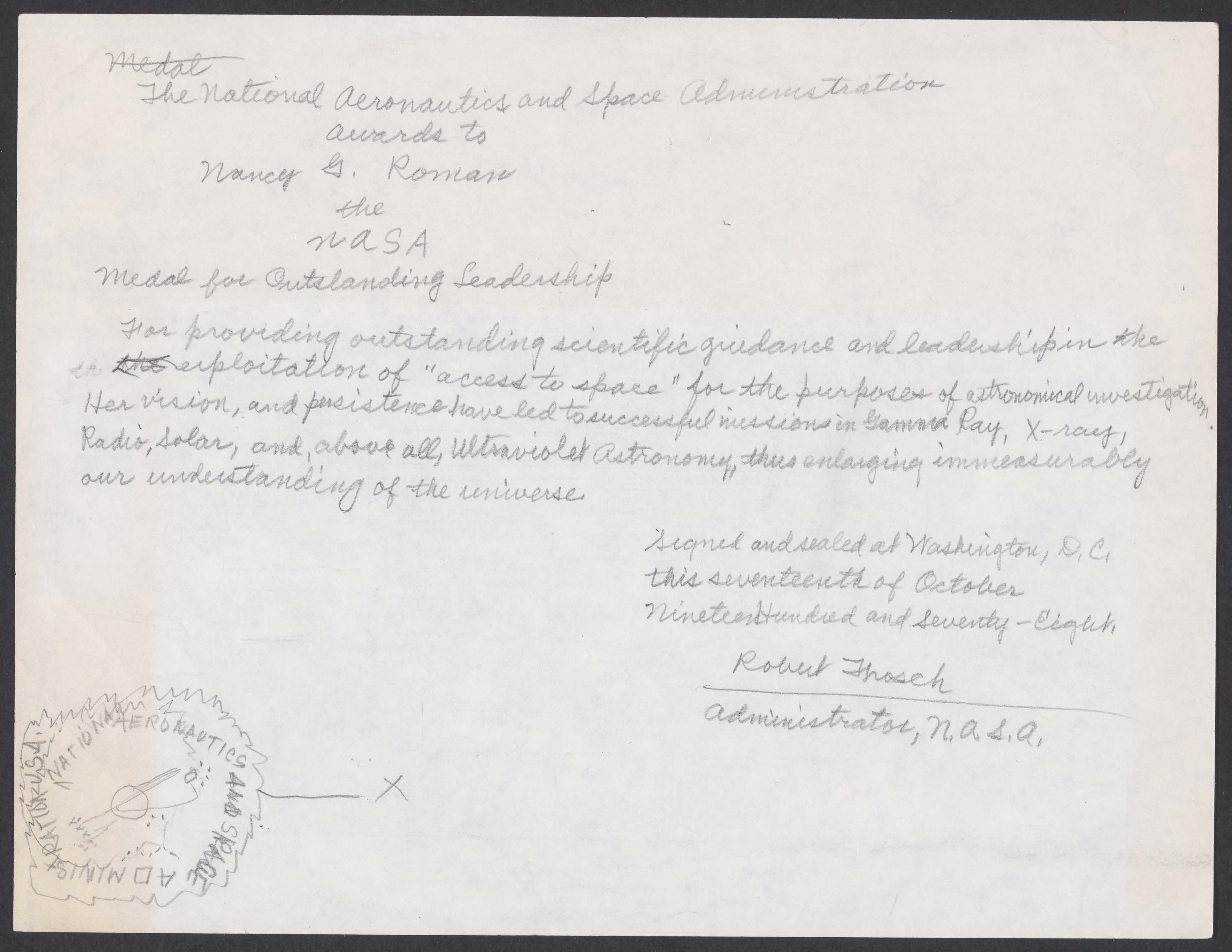
The National Aeronautics and Space Administrationawards toNancy G. Romanthe NASAMedal for Outstanding LeadershipFor providing outstanding scientific guidance and leadership in the exploitation of ‘access to space’ for the purpose of astronomical investigation. Her vision, and persistence have lead to successful missions in the Gamma Ray, X-ray, Radio, Solar, and, above all, Ultraviolet Astronomy, thus enlarging immeasurably our understanding of the universe.Signed and sealed at Washington, D.C., this seventeenth of October Nineteen-Hundred and Seventy-EightRobert FroschAdministrator, NASA

Nancy Grace Roman with a model of the Orbiting Solar Observatory (OSO), circa 1963.
Roman Nancy B10 . NASA, courtesy of AIP Emilio Segrè Visual Archives, Roman Collection


