The Life and Legacy of Hertha Sponer

On March 20, 2026, Dr. Elise Crull gave the AIP Lyne Starling Trimble lecture “Hertha Sponer and the Path from Electron Diffraction to Wave/Particle Duality,” which focused on the contributions of physicist Hertha Sponer to early quantum experimentation. The recording of the lecture can also be found on our YouTube channel . At the lecture, the AIP Niels Bohr Library & Archives hosted a display of rare books and archival materials related to Hertha Sponer from our collections. This blog will give you a behind-the-scenes look at these items and explore the life and work of Hertha Sponer.

Hertha Sponer materials on display at the March 20, 2026 Trimble Lecture.
Karina Cooper/AIP
One of the items on display, a lecture transcript from 1960, was discovered in the process of preparing for this event and has now been made available to researchers in our catalog for the first time. More on that lecture and the story behind its identification below.
Who was Hertha Sponer?

Hertha Sponer-Franck working with equipment in a laboratory, circa 1920s.
Catalog ID: Sponer Hertha F3 Credit: AIP Emilio Segre Visual Archives, Lisa Lisco, Gift of Jost Lemmerich
Hertha Sponer (1895-1968) was a German physicist and quantum chemist, best known for her work in spectroscopy and her decades-long career at Duke University physics department, as well as her distinction of being one of only three women to earn Habilitation (the right to teach and hold a professorship) in physics in Germany before World War II.
She grew up in Neisse and Zittau (now modern-day Poland) and began her university studies in 1917 at the University of Tübingen, one of first universities in Germany to allow women and where Sponer was first introduced to spectroscopy under the mentorship of Friederich Paschen . After one year, she transferred to the University of Göttingen, where she specialized in molecular spectroscopy and earned her PhD in 1920. She was hired as the Assistentin (PhD-level research staff position) to James Franck , director of the newly formed Second Institute for Experimental Physics at Göttingen. In that role, she ran the day-to-day operations of the spectroscopy laboratory, managed staff, and taught lab courses while conducting molecular spectroscopy experimental research. In 1925 she passed the qualifications for Habilitation, making her just one of three women (along with Lise Meitner and Hedwig Kohn ) to earn this distinction in physics before WWII. She was soon awarded the prestigious Rockefeller Foundation Fellowship to spend a year at Berkeley where she became one of the first scientists to introduce quantum mechanics to Americans on the West Coast. During her time there she collaborated with Raymond T. Birge, resulting in the Birge-Sponer method for determining disassociation energies. Back at the University of Göttingen, she soon took on greater responsibilities: she was recognized with the position of Chief Assistant in 1929 and finally Associate Professor in 1932. For more on her scientific work and early contributions to quantum mechanics at this time, see Elise Crull’s talk .

Group picture, taken at the Farewell of James Franck from the Kaiser Wilhelm Institute in Berlin, now called Fritz Haber Institute, before leaving for the University of Gottingen. L-R: (Seated) Hertha Sponer, Ingrid Franck (wife of James Franck), James Franck, Lise Meitner, Fritz Haber, Otto Hahn. L-R: (Standing) Albert Einstein, Hugo Grotrian, Wilhelm Westphal, Otto von Bayer, Peter Pringsheim, Gustav Hertz.
Catalog ID: Einstein Albert E36 . Credit Line: Credit Line: AIP Emilio Segrè Visual Archives, Aristid V. Grosse Collection
In 1934, Sponer lost her position at Göttingen due to Nazi restrictions on women in academia. Unable to find work in Germany, she emigrated first to Norway, where she taught at the University of Oslo for two years, before coming to the United States to accept an offer from Duke University in 1936. She was the first woman hired on the physics faculty at Duke and started the spectroscopy lab there. During her 30 years at Duke, she mentored dozens of master and doctoral students, including several women. She also gave research opportunities to fellow women physicists and émigrées, including Gertrud Pöschl Nordheim (theoretical physicist and wife of Duke physics professor Lothar Nordheim) and Hedwig Kohn (who similarly fled from the Nazis and taught physics at Wellesley, before working with Sponer after her retirement). Sponer was a well-regarded expert in the spectroscopy of diatomic molecules, and she published over 80 scientific papers over the course of her career under the name “H. Sponer.” She also maintained a close friendship with James Franck, who had emigrated to the US around the same time and taken a position at the University of Chicago. In 1946, several years after his first wife died, Sponer and Franck married and maintained a long-distance relationship to preserve both of their scientific careers.
At the time of writing, only one full biography has been written about Sponer (by Marie-Ann Maushart, first published in German in 1997 and in English in 2011 ). Her story, however, has been gaining prominence in scholarship and online, thanks to those recognizing her contributions to science and her role in the early days of quantum mechanics. Dr. Elise Crull authored a chapter on Hertha Sponer in the 2025 book Women in the History of Quantum Physics: Beyond Knabenphysik. Sponer was also prominently featured in the popular 2025 book by Olivia Campbell, Sisters in Science : How Four Women Physicists Escaped Nazi Germany and Made Scientific History (see our Q&A with the author and look behind the photos used in the book on our blog). Despite her increased recognition, her English Wikipedia page (at the time this blog was written) remains woefully short.
Hertha Sponer at AIP
The display at the Trimble lecture featured rare and archival items by and about Hertha Sponer in the NBLA collections, including an early influential scientific text by Sponer, a newly discovered transcript of an outreach lecture she gave in 1960, an oral history interview with her and her husband James Franck, and a photo album from her time in Göttingen.

First editions of Volumes I and II of Hertha Sponer’s scientific textbook on molecular spectroscopy on display at the Trimble Lecture.
Karina Cooper/AIP
Sponer H. Molekülspektren und ihre Anwendung auf chemische Probleme (Vol. 1: Tabellen & Vol. 2: Text). Springer, Berlin: 1935-1936. N8 SPO (bb)
This two-volume set was one of the first books to provide a comprehensive overview of the field of molecular spectroscopy. Hertha Sponer began working on it at the University of Göttingen in 1929, originally intending to publish in 1930. However, a series of delays meant it was not completed until 1935, after Sponer had emigrated to Norway. In Maushart’s biography of Sponer, she details the long journey that writing and publishing this book took. She quotes frequent letters Sponer wrote to James Franck, complaining about various stages of the writing and proofreading process and the difficulty of balancing writing with keeping up with her experimental research. It was finally published in Max Born and James Franck’s series Struktur und Eigenschaften der Materie in 1935 and 1936, presenting new and updated tables of results of spectra emitted by complex polyatomic and diatomic molecules, accompanied by an explanatory volume. The text was quite popular and regarded as a valued scientific and technical reference at the time (see this contemporary review in Nature) .

Hertha Sponer’s vacuum-spectograph. Circa 1932.
Sponer Hertha F2 Credit Line: AIP Emilio Segrè Visual Archives, Franck Collection
Unfortunately, due to the rapid advancements of the field, the tables of spectra became out of date quickly, and while the text was relevant for a while, by the 1950s subsequent publications by others on molecular spectroscopy soon eclipsed her text. It was also never translated into English, which limited its reach, but was still commonly found in many university libraries thanks to a pirated edition circulated by the US Government during the war.

Bookplate of donor Victor Rabinowitch, son of Eugene Rabinowitch, in NBLA’s copy of the Sponer’s text.
Karina Cooper/AIP
NBLA has a copy of the original German edition, which was presented to AIP by Victor Rabinowitch, son of biophysicist and co-founder of the Bulletin for Atomic Scientists, Eugene Rabinowitch . The volume very likely came from Eugene Rabinowitch’s personal library, who was a long-time collaborator and friend of James Franck and knew Hertha Sponer personally.

Group photograph taken at the Göttingen Institute circa 1933. Photograph is from Hertha Sponer’s Göttingen album. Eugene Rabinowitch is in the back row, 3rd from the right, while Hertha Sponer is at the far right.
Catalog ID: Gottingen Institute E2 Credit Line: AIP Emilio Segrè Visual Archives, Franck Collection

NBLA’s copy of Hertha Sponer’s lecture, “Early History of Natural and Artificial Radioactivity”
Niels Bohr Library & Archives, AIP
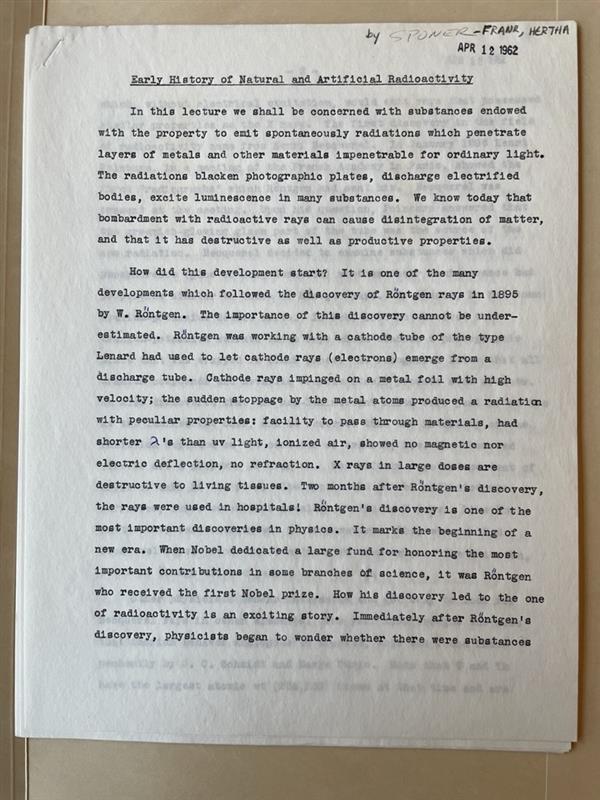
“Early History of Natural and Artificial Radioactivity” [typescript] MP 2026-2980
Also on display was a newly rediscovered transcript of a lecture given by Hertha Sponer on the history of radioactivity. In the lecture, Sponer recounts the history of the development of radioactivity from Röntgen rays abd the discovery of new radioactive elements to the discovery of fission and its use in atomic weapons and energy, along with the stories of the scientists who facilitated those discoveries along the way.
The provenance of NBLA’s typescript is unknown, beyond that it was acquired in April 1962, likely during the Center for History of Physics’s early documentation efforts. The transcript was found in an uncatalogued biographical file on Hertha Sponer with no identifying context beyond the title and “By Sponer-Franck, Hertha” written in pencil by a former archivist at the top.
I was, however, able to match the lecture to one listed in the appendix of Maushart’s biography of Sponer:
H. Sponer, “Early History of Natural and Artificial Radioactivity,” Marie Curie Lecture, Phillipsburg, PA, May 18, [1960].
Interested to learn more about the context of why and where the lecture was given, I consulted an archival letter Maushart used as a source, which is now held in the Hertha Sponer papers at the Duke University Rubenstein Rare Book & Manuscript Library. I was able to determine that the lecture was given at Penn State University (nearby to Philipsburg, PA) as part of the Marie Curie Lecture series run by their chapter of the national women’s chemistry honor society, Iota Signma Pi. Penn State’s digital student newspaper archive gave greater information about the series: it was founded by the Penn State “Palladium” chapter of Iota Sigma Pi in 1941 to invite a woman chemist to speak on a semi-popular topic of research. In May 1960, Hertha Sponer was invited by one of the members, Janet I. Newman, to give the 19th Annual Marie Curie Lecture and to become an honorary member of their society.
NBLA’s copy of the transcript appears to be an original typescript, complete with handwritten special characters and typo corrections. The only other known copy of the transcript is a carbon copy in the James Franck Papers at the University of Chicago , although it is not attributed to Hertha Sponer. We are excited to announce our copy is now available to researchers, with a digital copy available by request.

Portraits of James Franck and Hertha Sponer.
Franck James A3 Credit Line: AIP Emilio Segrè Visual Archives, Mayer Collection. Sponer Hertha A1 Credit Line: AIP Emilio Segrè Visual Archives, Lisa Lisco, Gift of Jost Lemmerich
Oral History Interview with James Franck and Hertha Sponer-Franck, 1962 July 9-14 (OH 4609)
A series of six oral history interviews with James Franck and Hertha Sponer were conducted for the Archive for the History of Quantum Physics (AHQP) in July 1962 by historian Thomas Kuhn and physicist Maria Goeppert Mayer (who knew both Franck and Sponer from their time in Germany before the war). This interview began as an interview of James Franck, however Hertha Sponer was present for many of the sessions and it soon became a joint interview. Hertha Sponer’s participation, however, has not always been credited in full. For example, in the 1967 Sources for the History of Quantum Physics, while Hertha Sponer’s presence is credited for most of her joint sessions, Session I, where Sponer speaks as well, is listed solely as an interview of James Franck in the list of tapes.
Over the course of the interview, Hetha Sponer briefly speaks in Session I . She enters as a more focused subject halfway through Session IV and contributes somewhat in Session V before becoming the main focus of the final Session VI interview on July 14, 1962. These interview transcripts have been used heavily by biographers and researchers (including in all the books already mentioned in this blog). The transcripts for these interviews are freely available online on AIP’s digital repository and the audio can be requested from the American Philosophical Society .
Photographs from the Franck Collection : Hertha Sponer’s Göttingen Photo Album

Group of Physicists. Pictured are: Gunther Cario, Kornicke, Holland, Herbert Arthur Stuart, Wilhelm Hanle, Ramsauer, Philipp Heinrich Emil Rupp, Otto Oldenberg, Schmidt, Reinhold Mannkopf, Hertha Sponer, James Franck, Hans Kopfermann, Donat. Photograph is from Hertha Sponer’s Göttingen album. https://repository.aip.org/node/116354
Catalog ID: Cario Gunther E1 Credit Line: AIP Emilio Segrè Visual Archives, Franck Collection

The Way Home: typical life of small university town. Left to right: Spiro Kyropuolos, Gunther Cario, James Franck, Hertha Sponer-Franck, Max Born, and Otto Oldenberg riding bicycles.
Catalof ID: Franck James D11 Credit Line: AIP Emilio Segrè Visual Archives, Franck Collection

Students and their instructor at the Gottingen Institute feigning frustration or boredom. (Left to right): possibly Friedrich Kirchstein, possibly Paul Emil Flechsig, Reinhold Mannkopf, Dr. Hertha Sponer, Heinrich Gerhard Kuhn. Photograph is from Hertha Sponer’s Göttingen album
Catalog ID: Gottingen Institute D2 Credit Line: AIP Emilio Segrè Visual Archives, Franck Collection

Mechanics Laboratory Course room at the Göttingen Institute. Circa 1931. Photograph is from Hertha Sponer’s Göttingen album.
Catalog ID: Gottingen Institute H5 Credit Line: AIP Emilio Segrè Visual Archives, Franck Collection
During her years at the University of Göttingen in the 1920s, Hertha Sponer kept a photo album documenting her life and work with fellow physicists. It contains many informal portraits of physicists such as Max Born, Carl Runge, and Arnold Sommerfeld, photos of life teaching and working at the Göttingen Physics Institute, and a behind-the-scenes look at the group outings and social gatherings of the physics department during this time. A set of the photos from this album were donated by the Franck family in the 1970s and are available on our repository in the Emilo Segrè Visual Archives. Stay tuned for a future blog post on this photograph collection!
References and Resources for Further Reading on Hertha Sponer:
- Crull, Elise. “Hertha Sponer, Maven of Quantum Spectroscopy.” In Women in the History of Quantum Physics: Beyond Knabenphysik, edited by Patrick Charbonneau, Michelle Frank, Margriet Van Der Heijden, and Daniela Monaldi. Cambridge University Press, 2025. https://doi.org/10.1017/9781009535816.005 .
- Maushart, Marie-Ann, Annette Vogt, Raph Morris (trans.), Brenda P. Winnewisser (ed.). Hertha Sponer: A Woman’s Life as a Physicist in the 20th Century ‘So You Won’t Forget Me.’ Dept. of Physics, Duke University, Durham: 2011. [Print]
- Campbell, Olivia.Sisters in Science: How Four Women Physicists Escaped Nazi Germany and Made Scientific History. Park Row Books, Toronto: 2024. [Print]
- Hertha Sponer Papers, 1917-1967. Duke University, Rubenstein Rare Book & Manuscript Library. https://archives.lib.duke.edu/catalog/uasponerhertha
- “Historical Faculty: Hertha Sponer,” Department of Physics, Duke University. https://physics.duke.edu/about/history/historical-faculty/HerthaSponer .
- “Hertha Sponer.” Duke Centennial,2024. https://100.duke.edu/story/hertha-sponer-explorer/ .
- Box 4, Letter from Sponer to Mrs. Newman, 1960. Hertha Sponer papers, 1917-1967. David M. Rubenstein Rare Book & Manuscript Library, Duke University [digital copy provided by their reference librarians]
- “Spectroscopist to speak” The daily collegian. (University Park,Pa.)1940-current, May 18, 1960, Image 5. Image provided by Penn State University Libraries; University Park, PA Persistent link:https://panewsarchive.psu.edu/lccn/sn85054904/1960-05-18/ed-1/seq-5/print/image_518x817_from_0,0_to_3294,5191/
- “Marie Curie Lecture Given” The daily collegian. (University Park,Pa.)1940-current, April 26, 1968, Image 3.Image provided by Penn State University Libraries; University Park, PA. Persistent link:https://panewsarchive.psu.edu/lccn/sn85054904/1968-04-26/ed-1/seq-3/print/image_514x817_from_0,0_to_4470,7101/