Size of Undergraduate Physics and Astronomy Programs, 2024


This report and interactive tool benchmarks physics and astronomy programs nationwide by faculty size and the number of bachelor’s degrees awarded. This allows departments and administrators to see where they fit in the national landscape of undergraduate physics and astronomy programs.
This report and interactive tool are, in part, a response to requests AIP has received from students, faculty, and administrators looking for data and resources that would enable them to see the relationship between the number of undergraduate degrees conferred by the number of faculty at individual physics and astronomy programs across the country.
Key highlights visible in the interactive tool:
- Physics departments that offer a bachelor’s as their highest degree typically award fewer degrees on average than departments that also offer a master’s or PhD in physics.
- Physics departments that award a PhD housed at research‑intensive (R1) institutions generally have larger faculties and, on average, award a greater number of bachelor’s degrees than PhD-granting departments not classified as R1.
- Physics departments at public institutions that offer a bachelor’s as their highest degree, on average, award a greater number of bachelor’s degrees than those at private institutions.
- Physics departments at private institutions that offer a bachelor’s as their highest degree, typically award more bachelor’s degrees per full-time equivalent (FTE) faculty member than the undergraduate physics programs at public institutions.
There were 723 physics degree-granting departments and 33 separate astronomy degree-granting departments that offered a bachelor’s degree in 2024. The interactive tool below presents data for 543 of these departments. Only departments that responded to the 2024 Academic Workforce survey and all three of the 2022, 2023, and 2024 Enrollments and Degrees surveys are displayed in the Physics and Astronomy Department Undergraduate Program Size Tool.
Department’s missions are not homogeneous, so the relationship between the number of degrees awarded and the number of full-time equivalent (FTE) faculty should not be used as a direct measure of productivity. FTE faculty counts do not consider teaching loads. Most departments with physics graduate programs will have non-teaching faculty included in their total FTE counts.
Physics and Astronomy Department Undergraduate Program Size Tool
The tool below displays departments by the average number of bachelor’s degrees granted by the number of full-time equivalent (FTE) faculty members at the department. For combined physics and astronomy departments, the number of astronomy bachelor’s degrees awarded, and their astronomy faculty, are presented with the physics department data for that institution.
Several filters are available, allowing users to customize the types of departments displayed. Hovering over the points on the plots will display various characteristics of the department the point represents.
Physics Departments
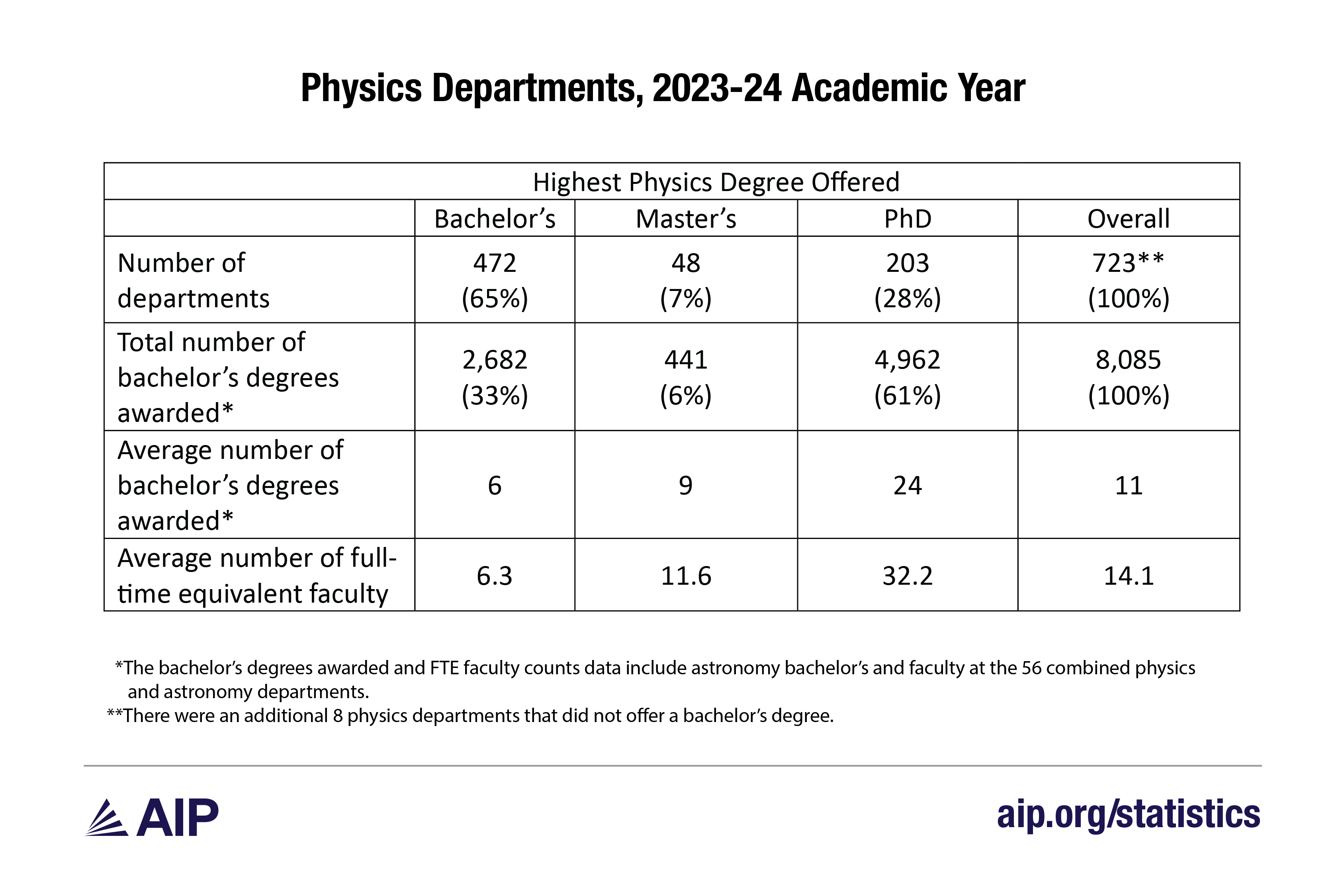
Of the 723 physics departments, the majority (65%) of these departments award a bachelor’s as their highest degree and awarded 33% of the physics bachelor’s conferred in the 2023-24 academic year. The majority (61%) of physics bachelor’s degrees were awarded by departments that also offered a PhD in physics. As shown in Table 1, PhD-granting departments, on average, awarded a greater number of bachelor’s degrees and had more full-time equivalent faculty than departments that offered a master’s or bachelor’s as their highest degree.
Table 1

Separate Astronomy Departments
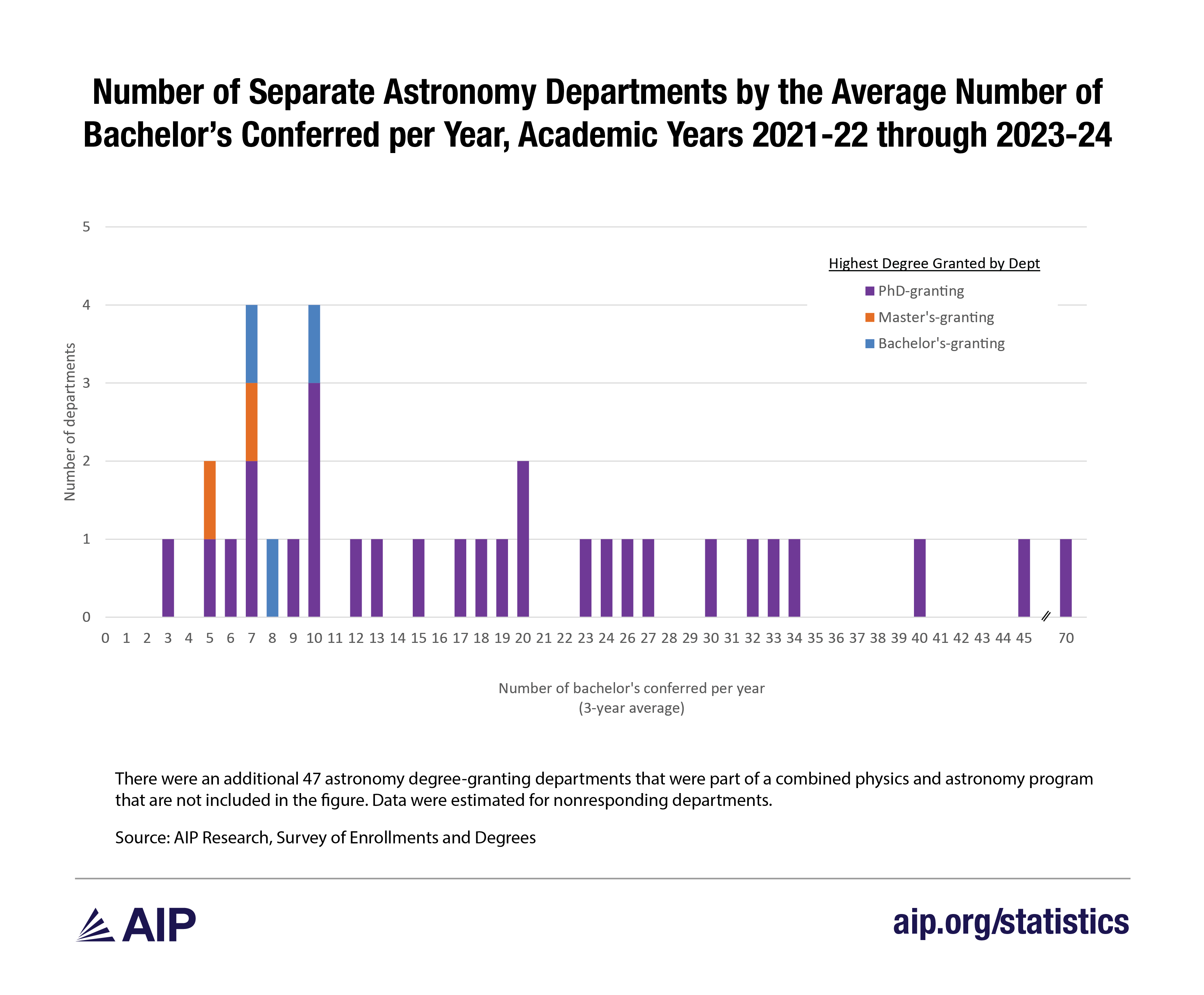
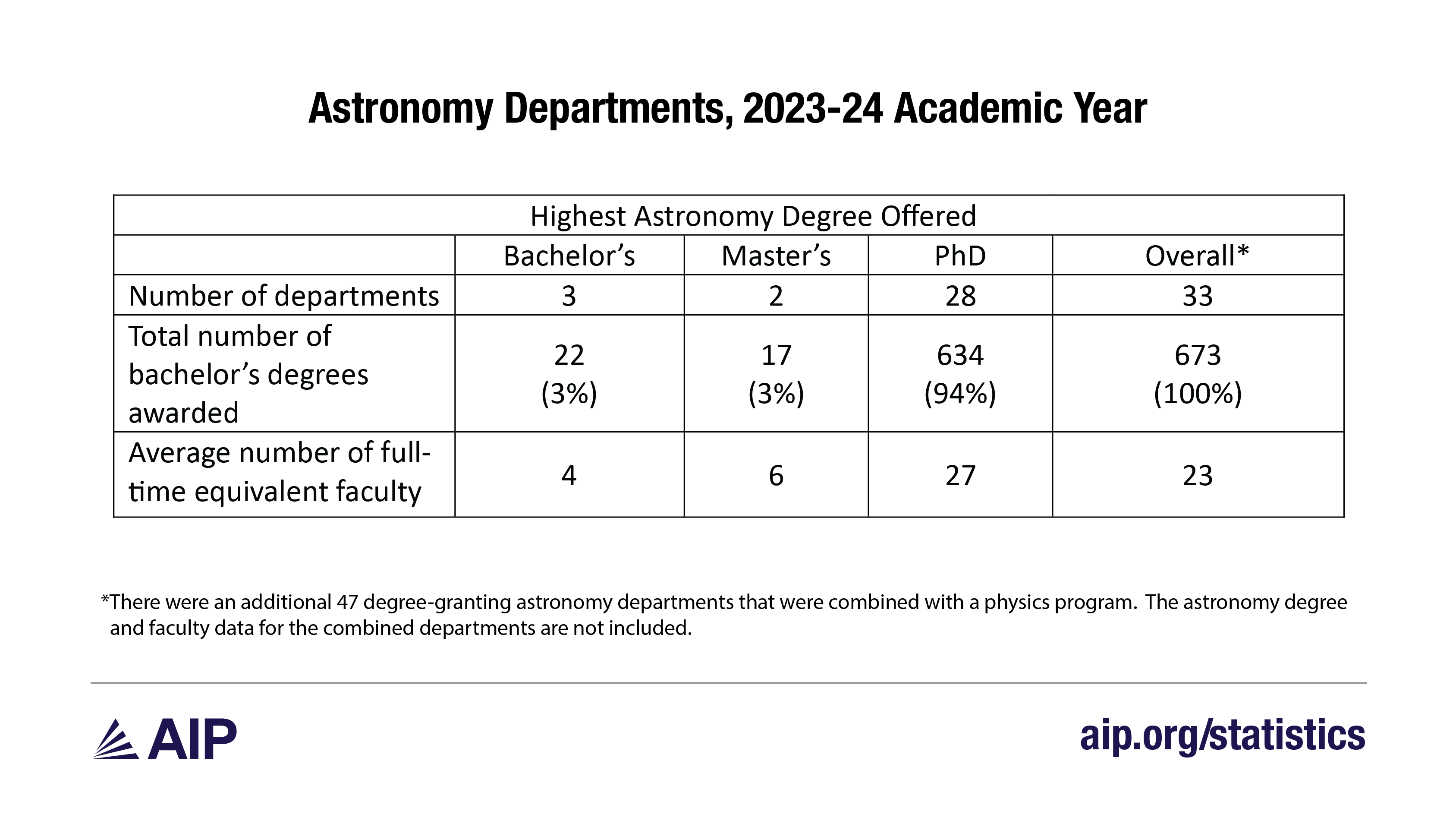
In the 2023-24 academic year, a total of 80 departments had an undergraduate astronomy program. Of these, there were 33 separate (stand-alone) astronomy departments, with the remaining 47 departments being part of a combined physics and astronomy department. Table 2 disaggregates the separate bachelors-granting astronomy departments by the highest astronomy degree offered by the department. The majority (85%) of the separate astronomy departments that offered an undergraduate degree also offered an astronomy PhD. The astronomy degree and faculty data for the combined physics and astronomy departments are included in the physics department data above.
Table 2

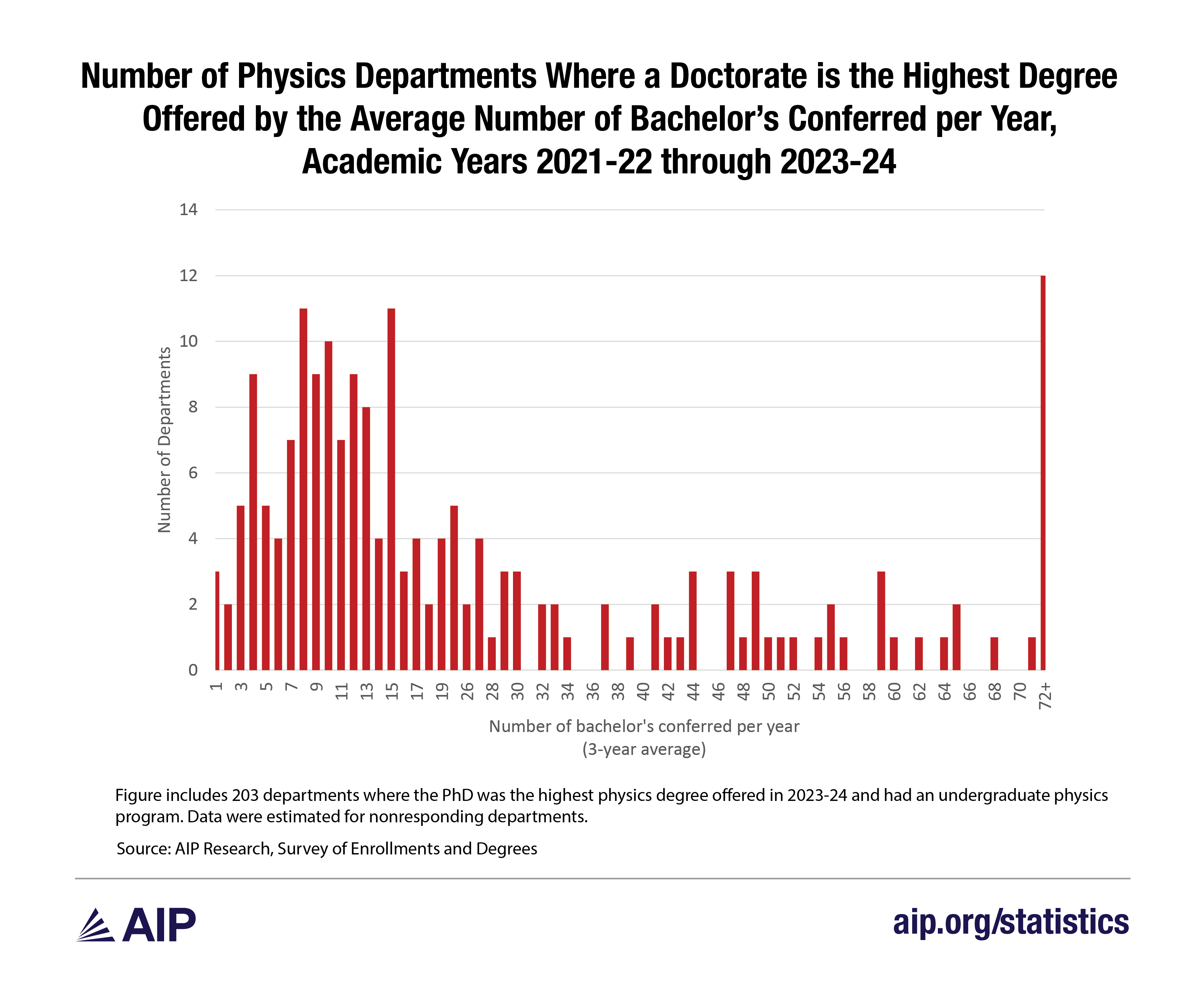
The four figures in Appendix A display the distribution of departments by how many bachelor’s degrees they confer on average.
Methodology
This report utilizes data from two AIP departmental surveys: the Academic Workforce Survey and the Survey of Enrollments and Degrees. The Academic Workforce Survey is conducted every two years, most recently in 2024. Departments were asked to provide the number of full-time equivalent (FTE) faculty members in their department for the 2023-24 academic year. Those FTE faculty counts include all faculty regardless of rank and their teaching load. The Survey of Enrollments and Degrees is conducted annually and collects the number of bachelor’s degrees awarded at each department. The degree data in this report comes from the academic years 2021-22, 2022-23, and 2023-24. Departments needed to provide the number of bachelor’s degrees they awarded each year to be included in the data displayed in the interactive tool. FTE faculty data were estimated for select nonresponding departments. Both the physics and astronomy bachelor’s degree data for combined physics and astronomy departments are included with the physics department data.
The interactive tool uses data from the National Center for Education Statistics (NCES) Institutional Characteristics Survey (A) and The Carnegie Classification of Institutions of Higher Education (B)
Data on FTE faculty and bachelor’s degrees conferred for earlier academic years can be found:
Size of Undergraduate Physics and Astronomy Programs (2022) https://www.aip.org/statistics/size-of-undergraduate-physics-and-astronomy-programs
and
Size of Undergraduate Physics and Astronomy Programs (2020) https://www.aip.org/statistics/size-of-undergraduate-physics-and-astronomy-programs-1706196923693
References
A) The Carnegie Classification of Institutions of Higher Education (n.d.). About Carnegie Classification. Retrieved (date optional) from http://carnegieclassifications.acenet.edu/ .
B) National Center for Education Statistics. (2025). Integrated Postsecondary Education Data System (IPEDS) (Institutional Characteristics). U.S. Department of Education, National Center for Education Statistics
Appendix A
Disaggregated by highest physics degree offered, the graphics in this appendix provide a visualization of the distribution of departments by the average number of bachelor’s degrees they confer.
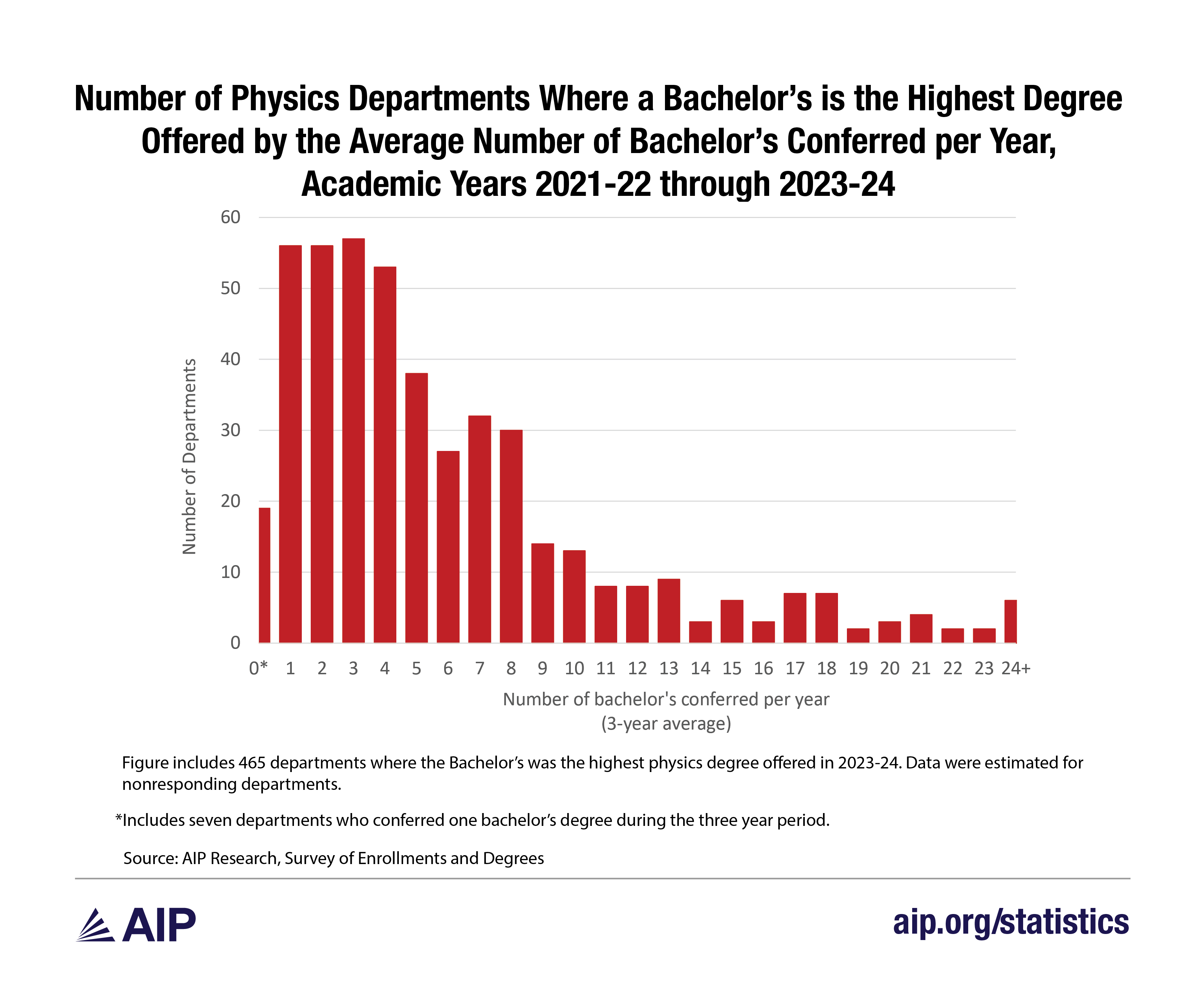
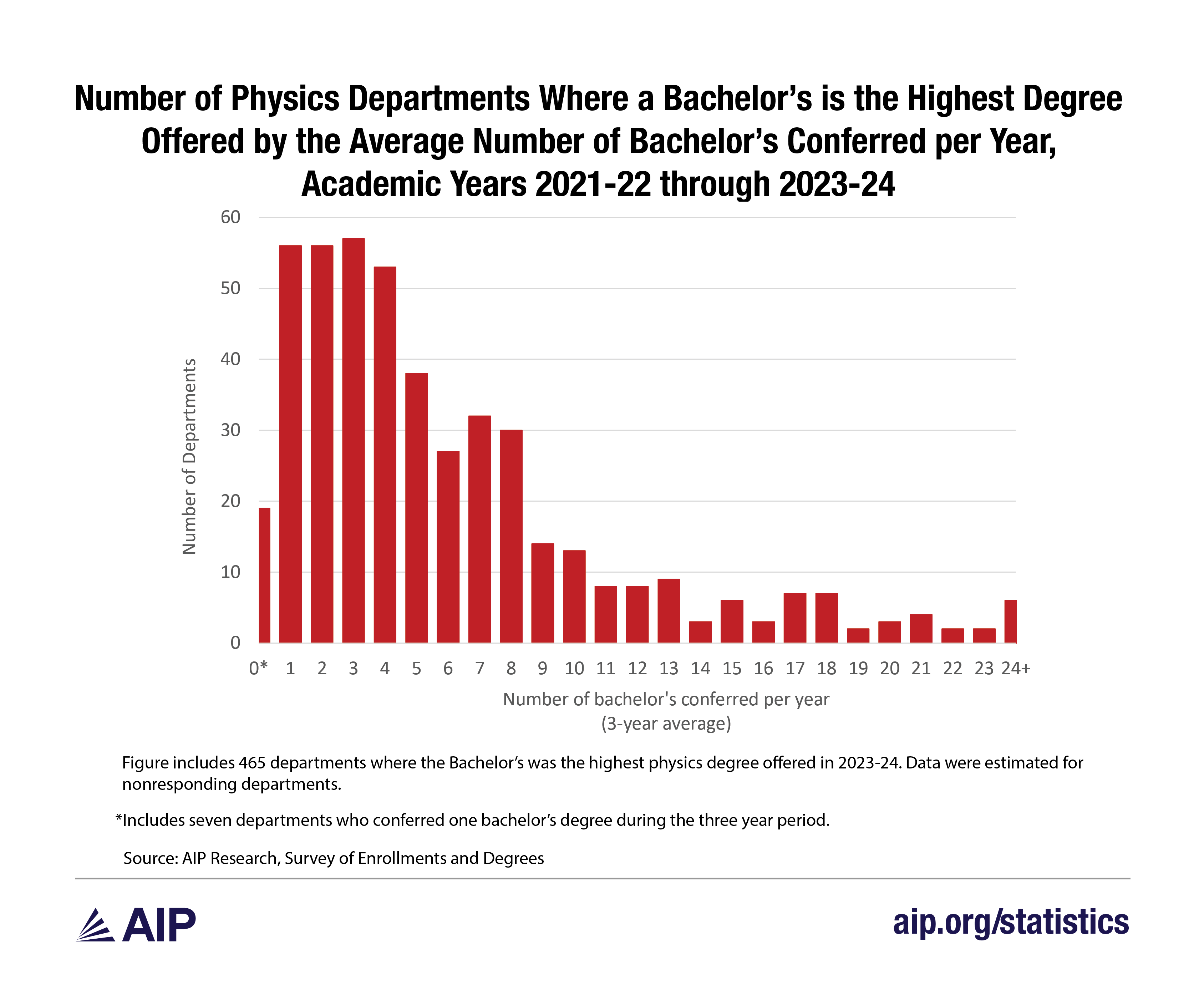
A1) Half of the physics departments that offer the bachelor’s as their highest degree averaged fewer than 5 physics bachelor’s degrees a year.
Figure A1

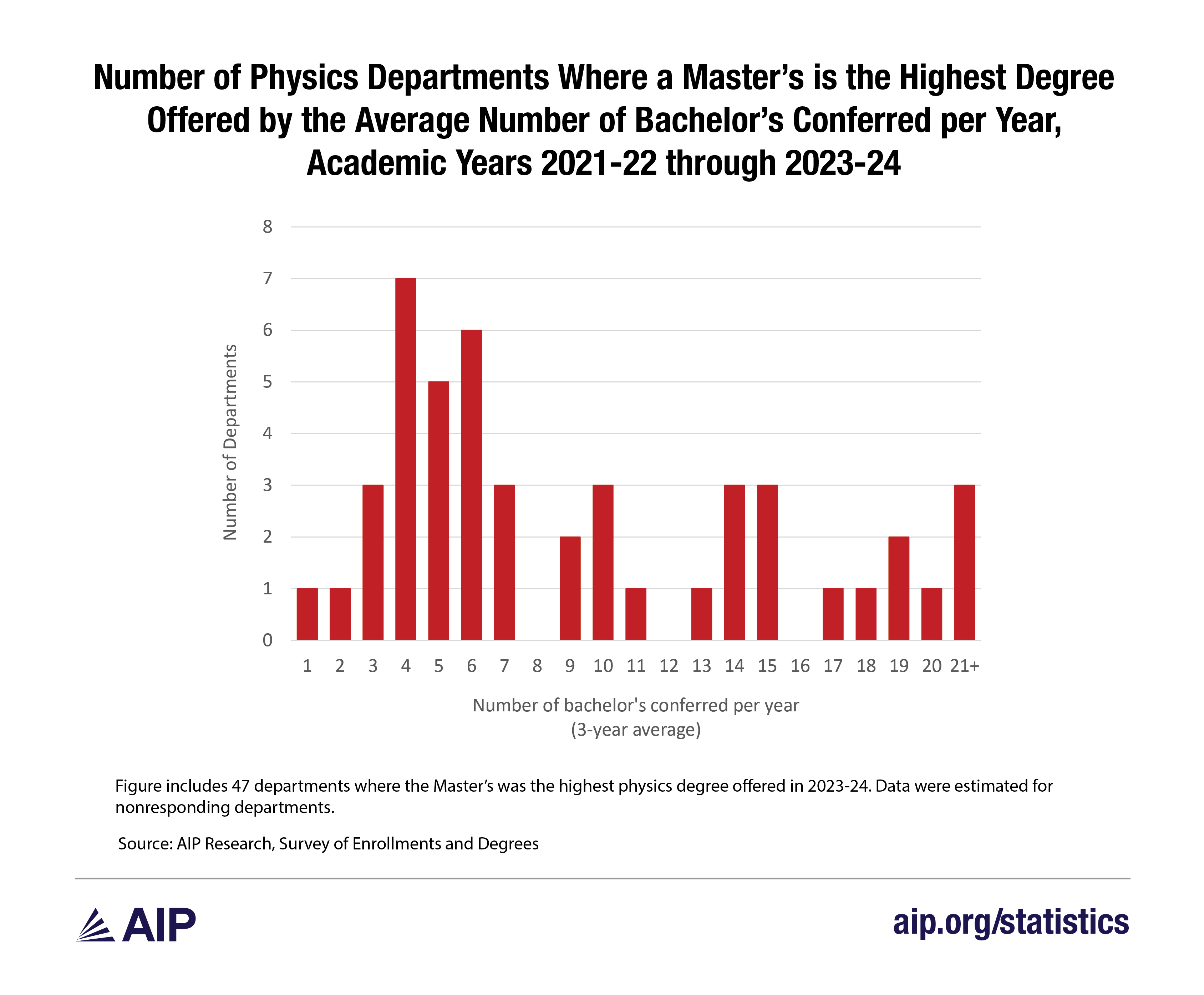
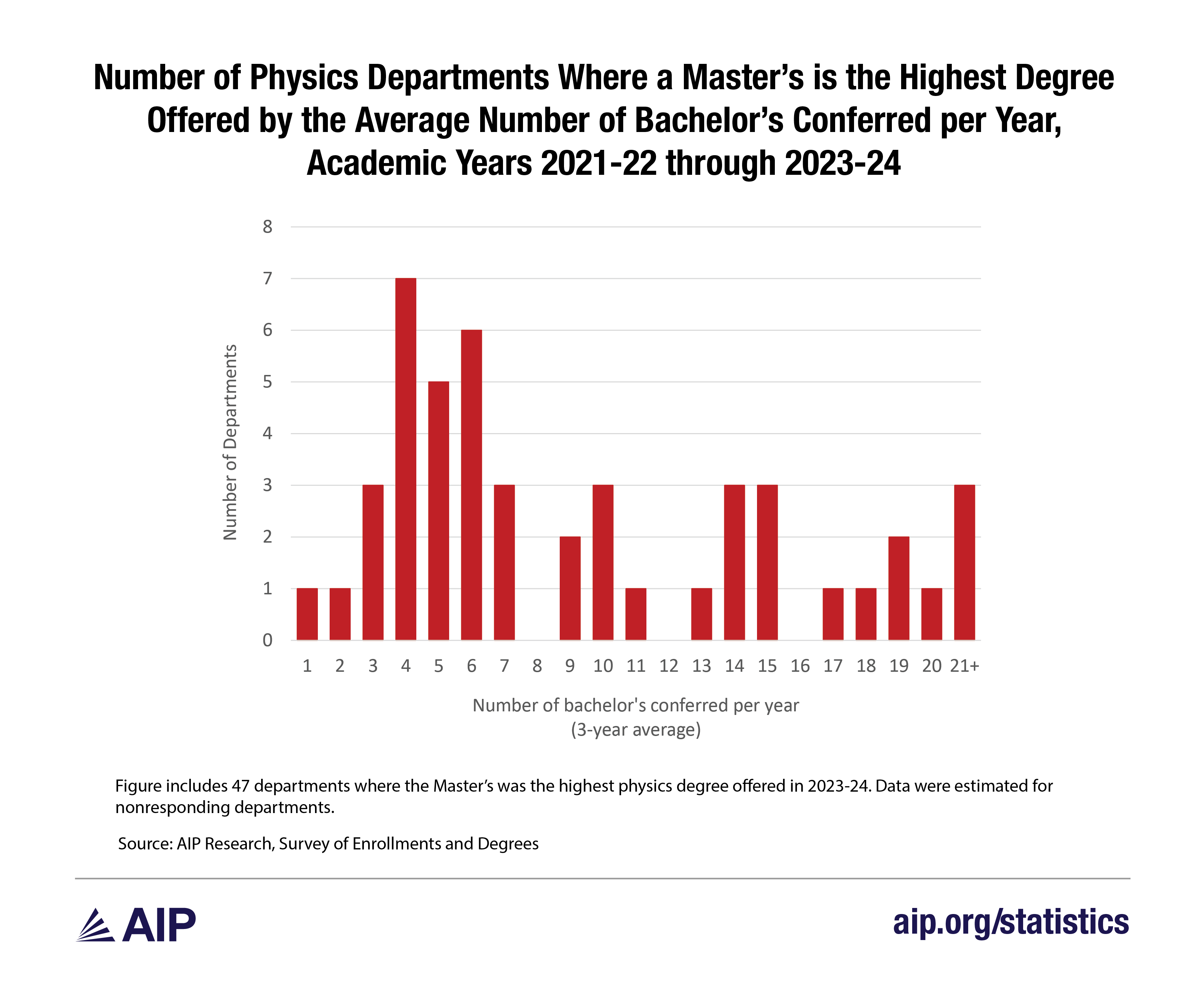
A2) Half of the of the physics departments that offer the master’s as their highest physics degree had undergraduate programs that average fewer than 7 physics bachelor’s degrees a year.
Figure A2

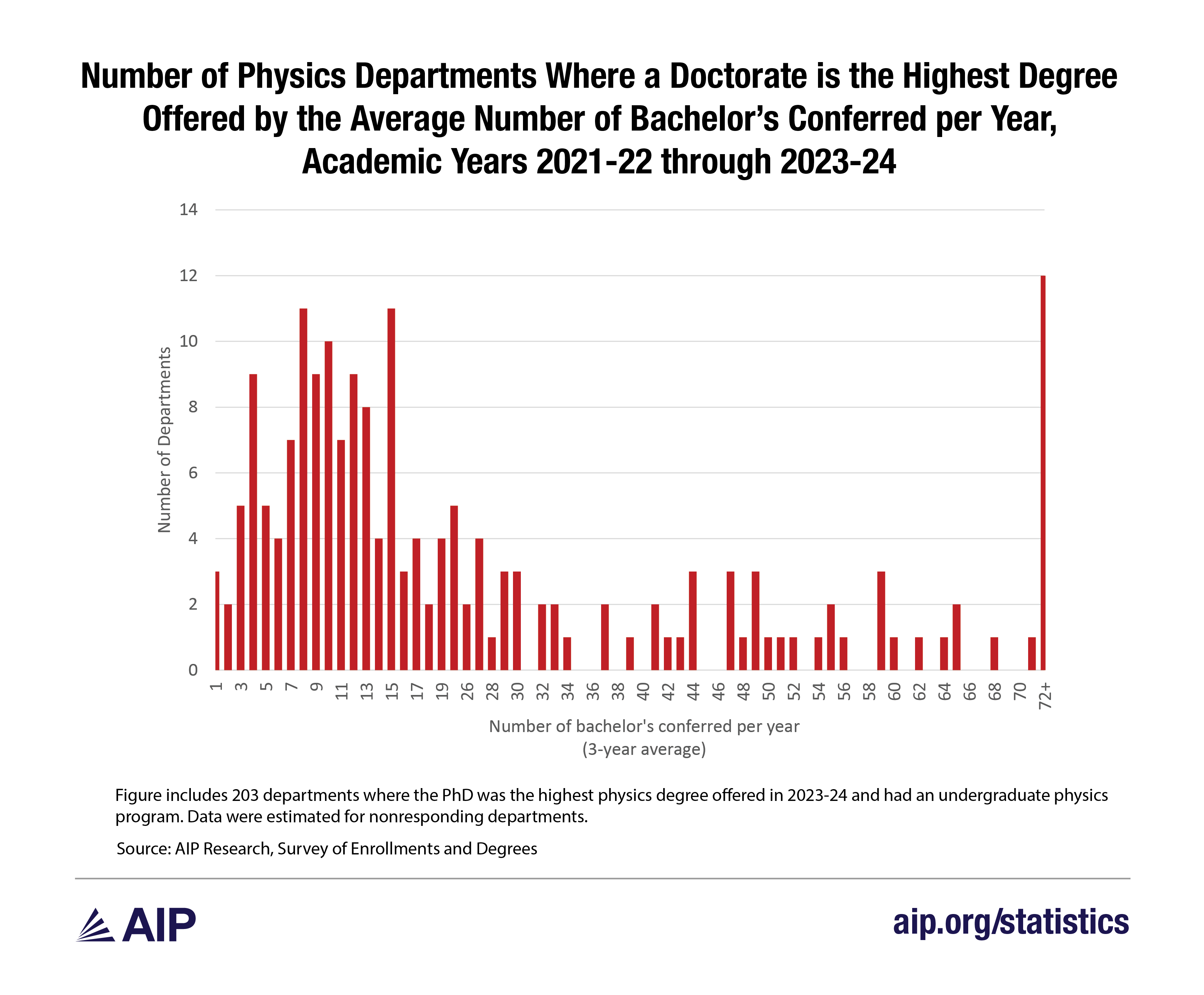
A3) Half of the physics departments that offer a PhD as their highest physics degree had undergraduate programs that average fewer than 16 physics bachelor’s degrees a year. Some PhD-granting departments have very large undergraduate programs, with 14% of the programs averaging 50 or more physics bachelor’s degrees a year, with 5 departments averaging over 100 degrees.
Figure A3

A4) The relatively small number of separate undergraduate astronomy programs are mostly departments that also award astronomy PhDs.
Figure A4