
How to Support Transfer Students in Physics

Report Highlights
• More than one-third of transfer students do not complete their bachelor’s degree within six years of transferring to a four-year institution, underscoring the need to understand the barriers that delay or prevent degree completion.
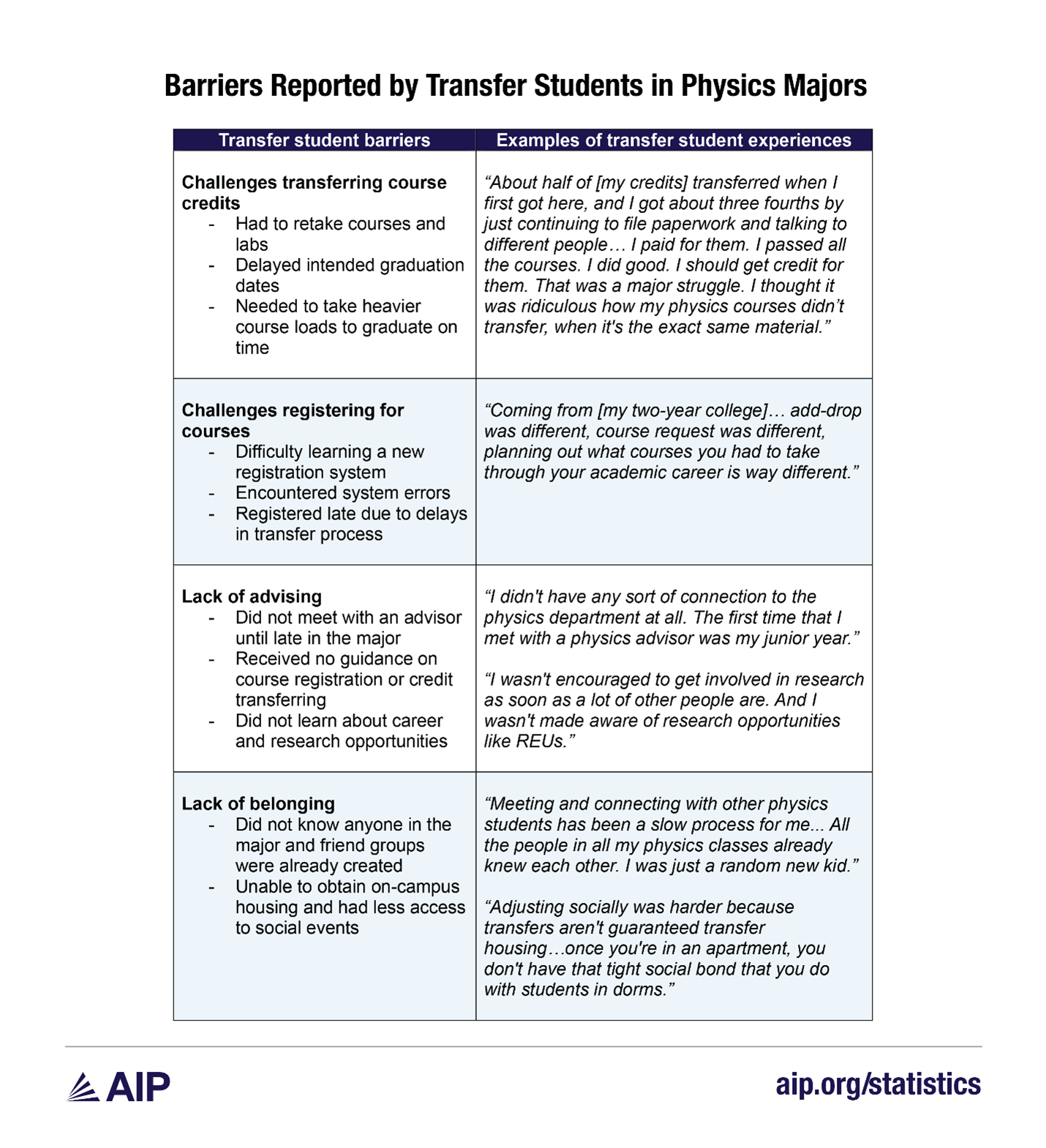
• Transfer students in physics reported experiencing challenges in transferring course credits, registering for courses, getting access to advising, and forming a sense of belonging at their new department.
• Physics departments can support transfer students in several ways, such as creating transfer programs with local two-year colleges and ensuring transfer students meet with an advisor during their first semester. A full list of recommendations is at the end of this report.
Introduction
About 13% of physics bachelor’s degree earners begin their studies at a two-year college (Pold & Mulvey, 2025), and recent trends show that the number of transfer students is growing in undergraduate education. In the fall of 2024, there were 1.2 million transfer students, making up 13% of all undergraduate students and increasing by 4% from the previous year (Velasco et al., 2024). Transferring from a small school to larger university gives students more access to opportunities in career development, research, and community building in their field.
The number of transfer students earning degrees could be much higher. Within six years after transferring, only 65% of transfer students completed their bachelor’s degree (National Student Clearinghouse Research Center, 2025). Over 1/3 of transfer students do not complete their bachelor’s degree within six years, and for those that do finish a degree within 4-6 years, the cost of tuition is expensive and completing a degree sooner would reduce transfer students’ overall financial burden. It is important to understand what barriers transfer students experience that lead them to delay or drop out of their degree program.
Using data from interviews with 17 transfer students in physics majors at four-year universities, this report discusses the barriers transfer students faced and how physics departments helped their transfer students navigate these issues. Of the 17 transfer students, 11 were graduating with a physics bachelor’s degree that semester, and 6 switched out of physics major and remained at the university.
Transfer students discussed challenges in four areas: transferring course credit, registering for courses, getting access to advising, and building a sense of belonging.
Table 1

Supportive strategies used by physics department to help transfer students
As our transfer students told us in interviews, transferring was a great opportunity for them. Compared to smaller colleges, four-year institutions gave them more access to funding, equipment, research opportunities, and a community of like-minded peers and professors.
Just being around other people doing physics was a big difference for me, because I transferred from a branch campus where I was the only physics major. And it was certainly very helpful to be around other people taking the same classes and thinking about things the same way.
If we want more students to succeed in physics, helping transfer students is an important part of the process. As discussed in The Transfer Playbook, transfer students are more likely to succeed when transfer programs are prioritized by department and university leadership (LaViolet et al., 2025). The transfer students we interviewed talked about how their physics departments helped them succeed. The following strategies gave transfer students a stronger sense of belonging in their new department, and guided them through the practical aspects of the transfer process.
Build partnership programs with local two-year colleges. Transfer students who had a more successful transfer process went to a university that formally partnered with local two-year colleges. Having an official program made it smoother to transfer course credits and get enrolled in the physics department.
I had help from a program through [my university] and [my two-year college] where… if you get your associate’s degree in two years and you have over a 3.0 GPA; you can just transfer really easily… it’s guaranteed.
Add potential transfers to department email listservs in advance. Transfer students found it helpful when physics departments added them to their department’s email listerv before they transferred. By receiving these emails, transfer students knew who to contact with questions, and got early access to department announcements and opportunities.
The main campus changed their policy. They would allow people who listed physics as their intended major be added to the email list, so that you [have] correspondence between people who want to major in physics and transfer in, and the actual physics department.
Ensure transfer students meet with an advisor during their first semester. Transfer students who reported successful experiences all discussed positive relationships with their physics advisors, and met with them early in their transfer process. Advisors were welcoming, responsive, and approachable. Good advisors helped them complete transfer paperwork, suggested courses to take, resolved course registration errors, and gave them advice on research opportunities, career paths, and graduate school applications. Some advisors even wrote letters of recommendation.
[My advisor] helped me figure out what physics classes I would take so I could get my major and graduate on time.
My general physics advisor was always really supportive. And especially coming in being older. I felt like I didn’t necessarily fit the mold for the average physics student, and he really welcomed me.
Enroll transfer students in department seminar courses. Transfer students found it helpful to attend seminar courses, where they were introduced to department research opportunities and potential physics career paths.
Our freshman year we have a physics seminar just for freshmen or transfer students, where every week, a different member in the department or someone from the [university] alumni community who is in physics comes in to talk about their research or talk about their job.
Introduce transfer students to social spaces and events. Since transfer students often don’t know anyone in the department, public spaces like physics longues or other social events were positive opportunities to connect with other students. Joining study groups helped transfer students build their sense of belonging.
I managed to make a pretty good study group, and we all encouraged each other. We would meet on the weekends in our physics lounge and just go through the homework problems either new or old, at least for a few hours, both days on the weekend. So, working together with a good group of friends/peers. So that was my biggest support. I came in as a transfer, but I ended up doing pretty well.
Waive course prerequisites (with caution). When transfer credits were not accepted or didn’t align with the department’s course schedule, some transfer students kept to their graduation timeline by getting prerequisite waivers. This can be a double-edged sword. In one case, a transfer student reported feeling left behind in the course material because they hadn’t taken a previous course.
It seems sometimes difficult, because I would get outperformed by people that, for example, have already taken differential equations… There’s not much I can do if... the moment I take the class, I’m a step back a semester from other people, because they already have that class under their belt and I don’t.
In another case, a transfer student was supported because the course professor personally met with them and ensured they could address their knowledge gaps in the class. Combining prerequisite waivers with professor support led to better transfer student outcomes.
The professor was really good about working with me to make sure that if there was something from a semester of intro physics that I didn’t know that I would be able to learn it for the class.
Conclusion
Although transfer students at four-year institutions face barriers with course transfers, course registration, department advising, and belonging, there are many actions physics departments can take to support transfer students and make them feel welcome. Implementing the recommendations provided above can give transfer students a better social and academic experience, and encourage them to persist in their physics degree.
Methodology
This report contains data from our Attrition and Persistence in Undergraduate Physics Programs project (Porter, Chu, & Ivie, 2024). Over five years from 2018 to 2023, we surveyed 3,917 introductory physics students and 285 graduating physics bachelors at four universities. At the end of our surveys and in email messages, we invited graduating physics students and students who were no longer interested in a physics major to participate in one-on-one interviews. 17 of those students were transfer students and discussed their experiences. 11 were graduating with a physics bachelor’s degree and 6 switched to another major outside of physics. We did not interview any transfer students who dropped out of their institution. It is possible that they experienced similar barriers without getting the support they needed from their department and advisors.
References
LaViolet, T., Masterson, K., Anacki, A., Wyner, J., Fink, J., Tulloch, A.G., Steiger, J., & Jenkins, D. (2025). The transfer playbook (second edition): A practical guide for achieving excellence in transfer and bachelor’s attainment for community college students. Community College Research Center and College Excellence Program. Available at https://ccrc.tc.columbia.edu/publications/transfer-playbook-second-edition.html.
Velasco, T., Fink, J., Bedoya-Guevara, M., Jenkins, D., & LaViolet, T. (2024). Tracking transfer: Community college and four-year institutional effectiveness in broadening bachelor’s degree attainment. Community College Research Center, College Excellence Program, and National Student Clearinghouse Research Center. Available at https://ccrc.tc.columbia.edu/publications/tracking-transfer-community-college-and-four-year-institutional-effectiveness-in-broadening-bachelors-degree-attainment.html .
National Student Clearinghouse Research Center (2025). Tracking transfer: Entering four-year college cohort dashboard. Available at https://nscresearchcenter.org/tracking-transfer/
Pold, J. & Mulvey, P. (2025). Physics bachelors: Two-year colleges as a starting point. AIP. Available at https://www.aip.org/statistics/physics-bachelors-two-year-colleges-as-a-starting-point
Porter, A.M., Chu, R., & Ivie, R. (2024). Attrition and persistence in undergraduate physics programs: A five-year longitudinal study. AIP. Available at https://www.aip.org/statistics/attrition-and-persistence-in-undergraduate-physics-programs


