Building Up the Next Generation of Scientific Society Leaders


Report Highlights
- Early-career society leaders in volunteer positions primarily learned about their scientific societies during undergraduate or graduate education through faculty mentors and advisors.
- First-time society conferences were important formative positive experiences that encouraged further society engagement. When early-career society leaders felt anxious about attending their first society conference, their mentors and the conference community made them feel welcome and included.
- Early-career leaders learned about their first society volunteer opportunity from their colleagues and mentors, society emails, and society conference sessions.
- Community and networking were the most important benefits of society membership for early-career society leaders.
- Early-career leaders wanted to volunteer to give back and make a difference in their field, and did so by piloting new society programming, building society communities, performing society outreach, supporting conference operations, and participating in federal advocacy.
- To engage early-career members in volunteering and leadership, we provide several recommendations, such as prioritizing outreach to student mentors, investing in local or regional chapters and events, creating open and approachable committee environments, and continuing conference programming that welcomes early-career attendees.
Introduction
Scientific societies play an essential role in advancing the scientific enterprise. Over the next decade, we will witness a generational shift, as leadership responsibilities are passed from one generation to the next. However, research shows that only 2% of leadership positions in scientific societies are held by early-career researchers (Bankston et al., 2020 ), and many early-career members are disengaging from societies because their continuing education and professional development needs are not being met (The Wiley Network, 2024 ).
To better understand how to engage and support early-career society leadership, we interviewed 22 early-career scientists and engineers from across ten scientific societies in the American Institute of Physics (AIP) federation. We defined early-career leaders as anyone who earned their highest degree within the last seven years (2018 or later) and was highly engaged in volunteer leadership work within their society. We selected early-career leaders based on recommendations from society CEOs and staff, as well as listings of early-career members on committee websites. All interviewees gave permission to be mentioned by name in the report and had the opportunity to review their interview transcripts before publication.
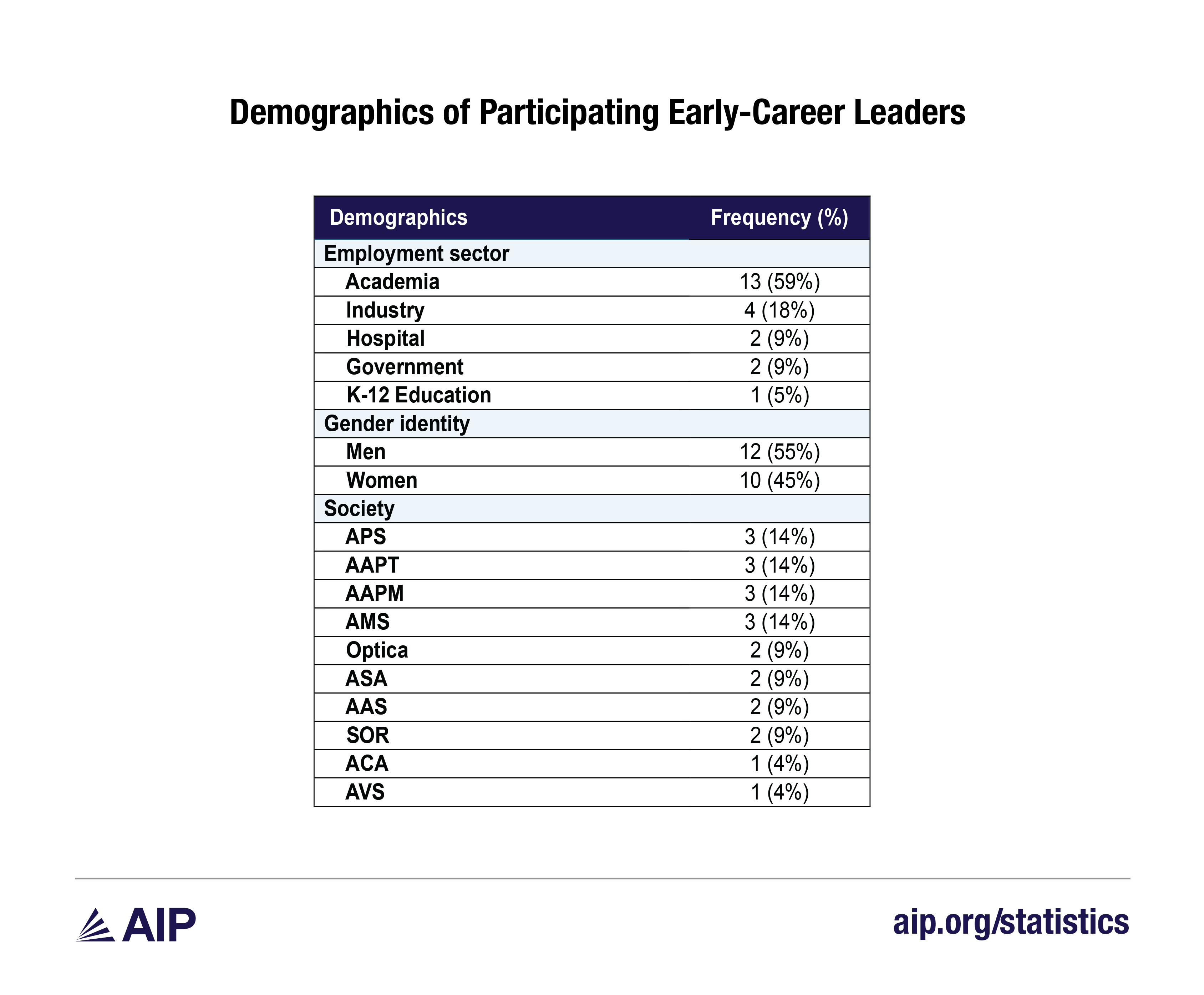
Of the 22 early-career leaders we interviewed, 55% identified as men and 45% as women. Fifty-nine percent of interviewees worked in academia, while the remaining 41% were employed in various sectors, including industry, government, hospitals, and high schools. Tables with lists of early-career leader names and demographics can be found in the Appendix, as well as a PDF attachment with early-career leader photos, biographies, and LinkedIn profile addresses at the bottom of this webpage.
In what follows, we describe the journeys of early-career leaders in scientific societies. We begin by documenting how they became aware of their societies and initially joined. Next, we document how they moved into active volunteering and society leadership roles. From there, we describe the impact that these early-career leaders are having within their communities and why societies should prioritize engagement with early-career professionals. We conclude with a series of recommendations for stakeholders in the scientific community on how to further encourage early-career leadership in scientific society volunteering.
How early-career leaders became aware of societies
Most of the early-career society leaders we interviewed learned about their society during undergraduate education and began engaging with their societies while they were undergraduate students (Table 1). By engaging with societies and encountering volunteer opportunities as students, they were able to enter society leadership relatively early in their careers.
Table 1


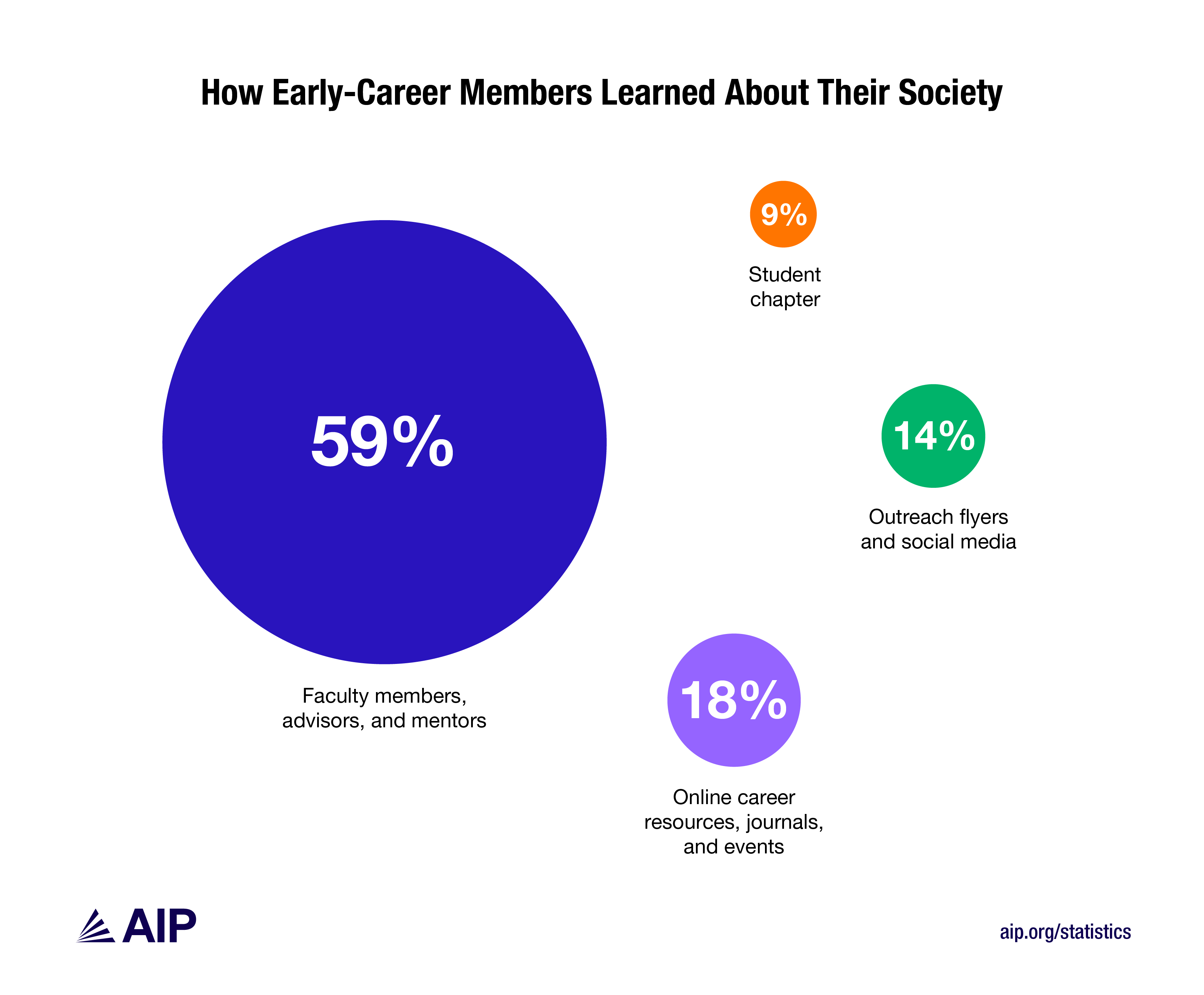
Our early-career leaders learned about their society from a variety of sources, but one clear trend emerged. Most participants in our study learned about their society’s existence from mentors, including graduate advisors, undergraduate advisors, society student chapter advisors, and SPS (Society of Physics Students) members (Figure 1). As such, helping students connect with mentors who champion the importance of volunteering in scientific societies is likely one of the most effective ways societies can engage early-career members.
Figure 1

Mentor relationships are not the only way our interview participants became aware of their societies. Early-career leaders also learned about their societies while doing other professional development and educational activities, such as:
- attending other conferences in related fields
- finding online society resources to help with coursework
- reading society journal articles
- encountering society posts on social media
- seeing society posters hung up in academic departments
How early-career leaders became society members
The social environment at an institution has the most influence in joining a society. A society is a social community, and social connections provide entrance into that community. Most of the early-career leaders we interviewed joined their societies because of encouragement from their mentors and advisors. Mentors informed them about the benefits of membership, helped them obtain funding for conference attendance, and gave advice on how to navigate their first conference.
Having a supportive workplace that grants permission and funding to attend conferences helps early-career professionals maintain their membership. In our interviews, we learned that institutions in all sectors can provide this support. In cases where institutions are unable to afford funding for conference attendance, early-career leaders described how society programs and travel grants can help early-career members attend those conferences.
Below we describe four examples of early-career journeys into society membership that are broadly illustrative of trends from across all 22 of our interviews.
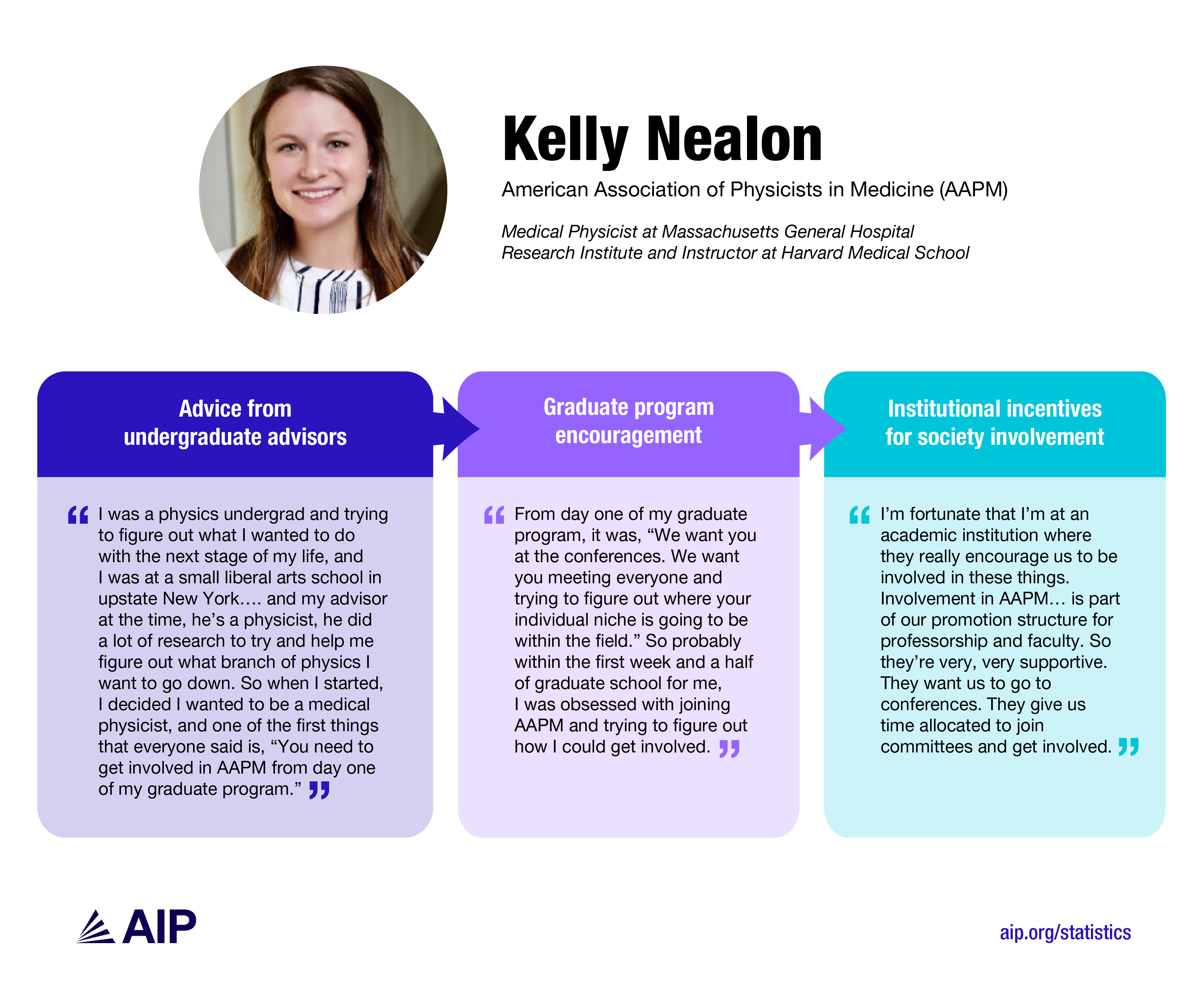
Learning about societies from undergraduate advising. As a physics major, Kelly Nealon worked with her undergraduate physics advisor to figure out what field of physics she wanted to pursue (Figure 2). When she decided on medical physics, her advisor and mentors told her about the American Association of Physicists in Medicine (AAPM). From there, her medical physics graduate school program encouraged students to join AAPM, and she became part of the AAPM Mentorship program. Now, her institution continues to support her involvement in the member society.
Figure 2

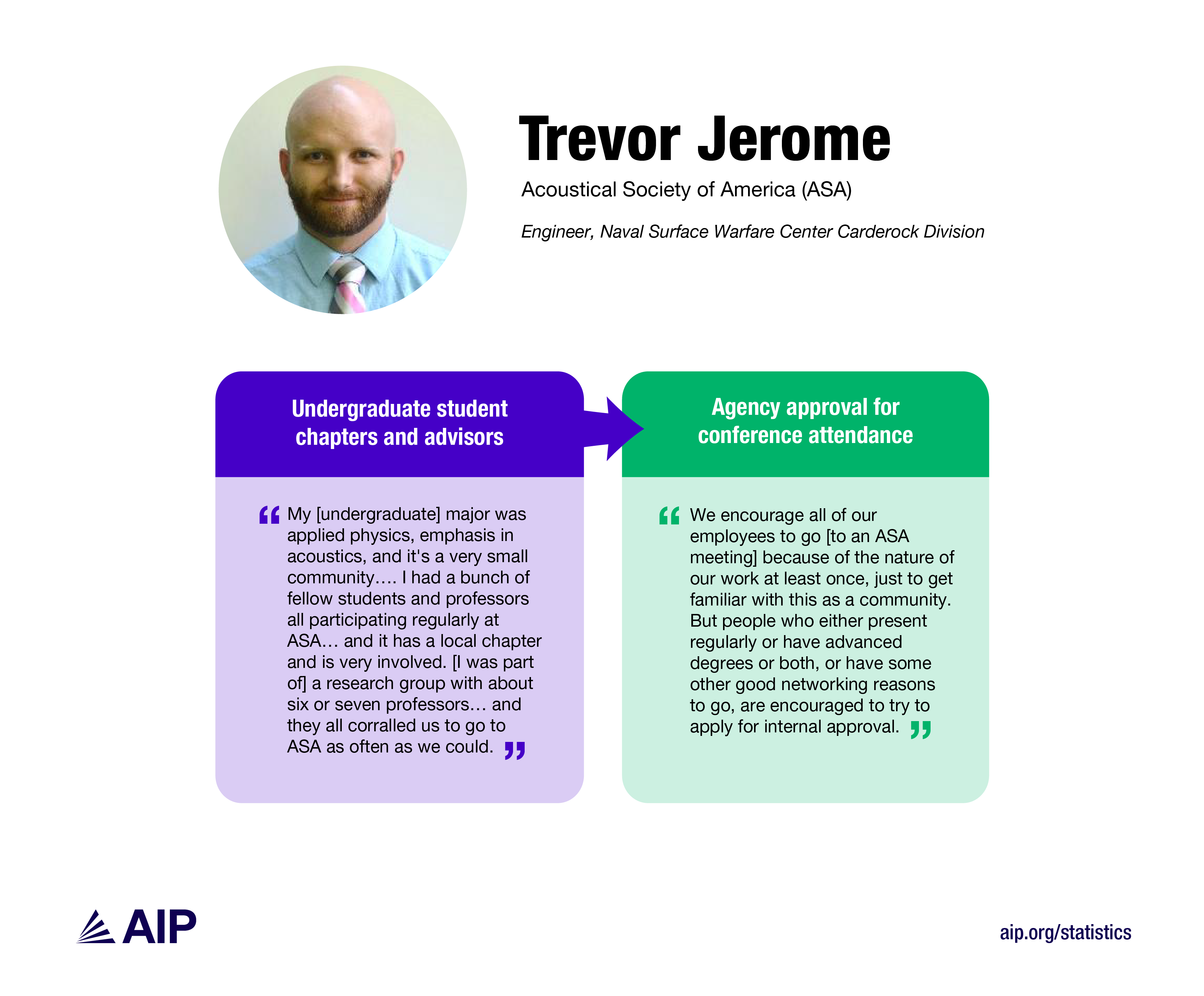
Participating in undergraduate student chapters. Trevor Jerome was pursuing acoustics as an undergraduate physics major and joined the university’s Acoustical Society of America (ASA) student chapter (Figure 3). That student chapter supported students’ engagement in the society and helped them attend conferences. Working at a government agency, he found support to continue attending ASA conferences and inform their engineering work.
Figure 3

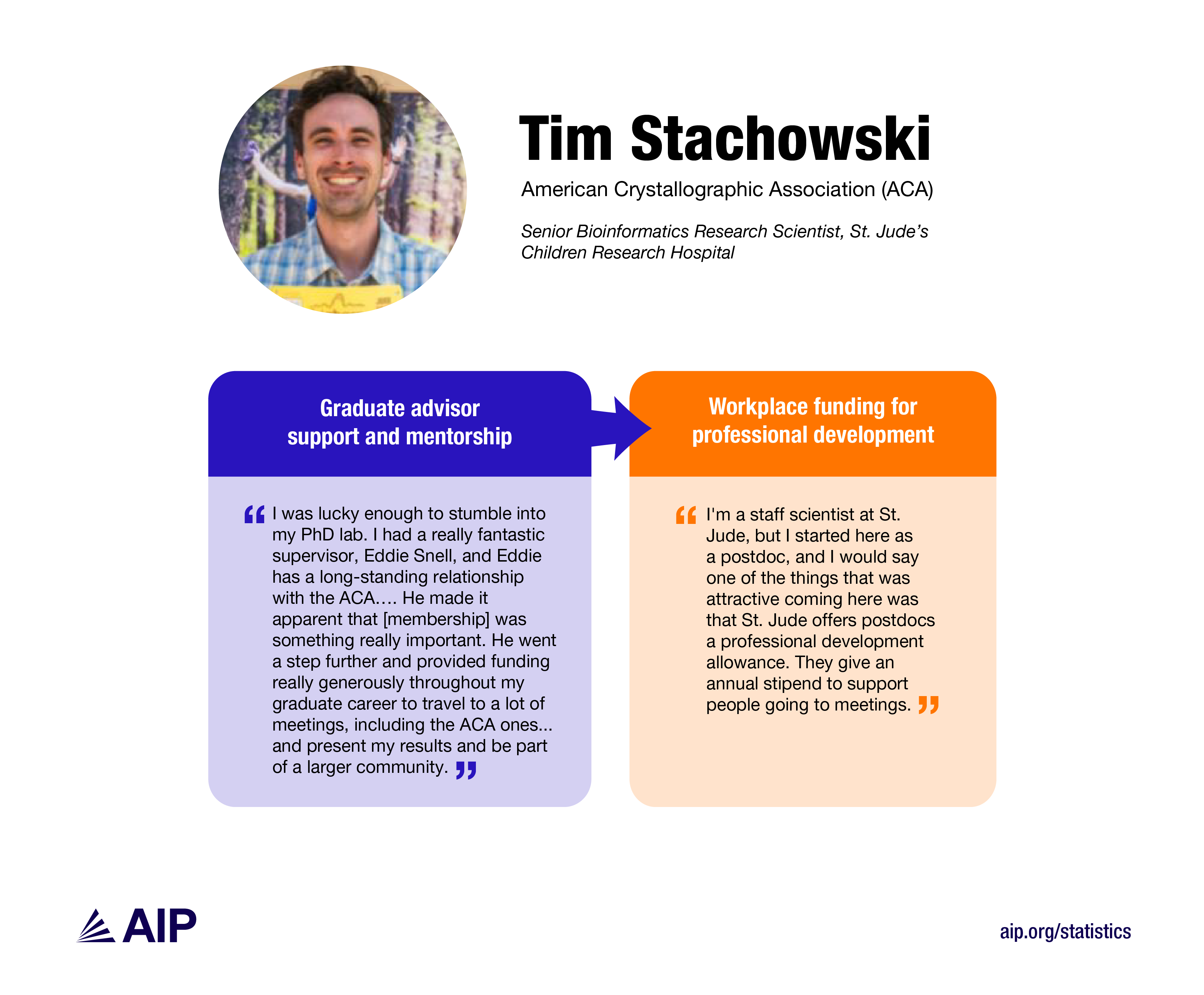
Joining after graduate advisor encouragement. Tim Stachowski learned about the American Crystallographic Association (ACA) when he joined his research lab in graduate school (Figure 4). His graduate advisor, Dr. Eddie Snell, highly encouraged ACA membership and conference attendance, and wanted his students to become part of the ACA community. Tim looked for workplaces that would support his continued ACA involvement, and now works at St. Jude’s Children Research Hospital, where they provide professional development allowances for society memberships.
Figure 4

Getting support from professional programs and society funding. Meghan DiBacco was completing her education to become a high school physics teacher when she discovered the American Association of Physics Teachers (AAPT) and joined to connect with other physics teachers (Figure 5). By becoming involved in programs like STEP-UP, she was able to get funding to attend the AAPT national conference and now works on society committees to help others obtain the funding they need to attend.
Figure 5


First-time conference experiences for early-career members
The early-career leaders we interviewed all reported very positive conference experiences, which encouraged them to become engaged society members. Societies only have one opportunity to make a good first impression, and it is clear from how our interview participants described their experiences that their first-time conferences had an important impact on their future engagement. Here is an example about how our early-career leaders felt at their first conference:
It was great. It was wonderful to meet so many people that had both similar but unique interests at the same time. All which were super interesting. And it really was a great experience, because it made me feel included in this community.
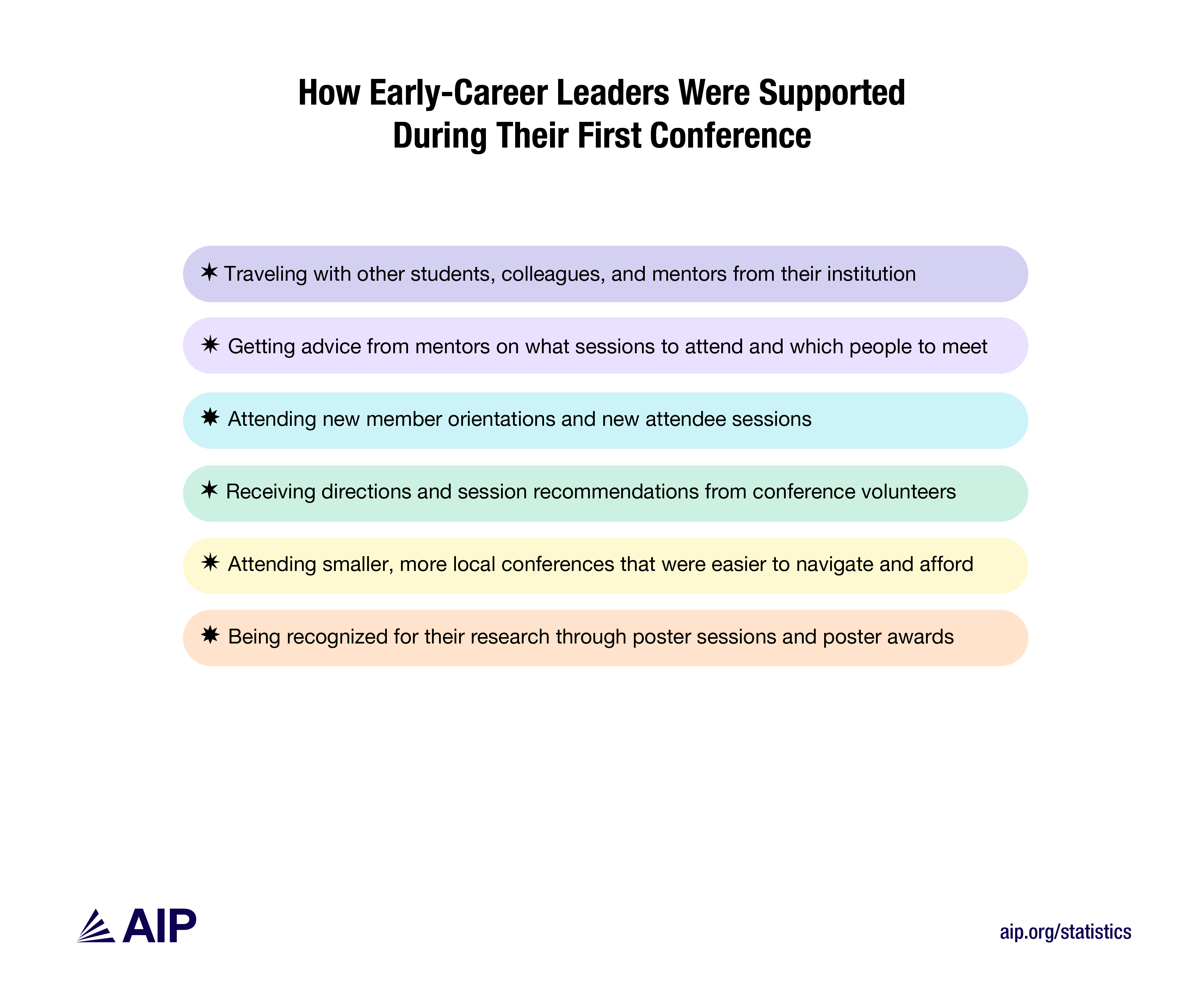
While several early-career leaders said they were initially overwhelmed at their first conference, there were many things that helped them overcome their worries and feel supported (Figure 6).
Figure 6

Why early-career leaders value society membership
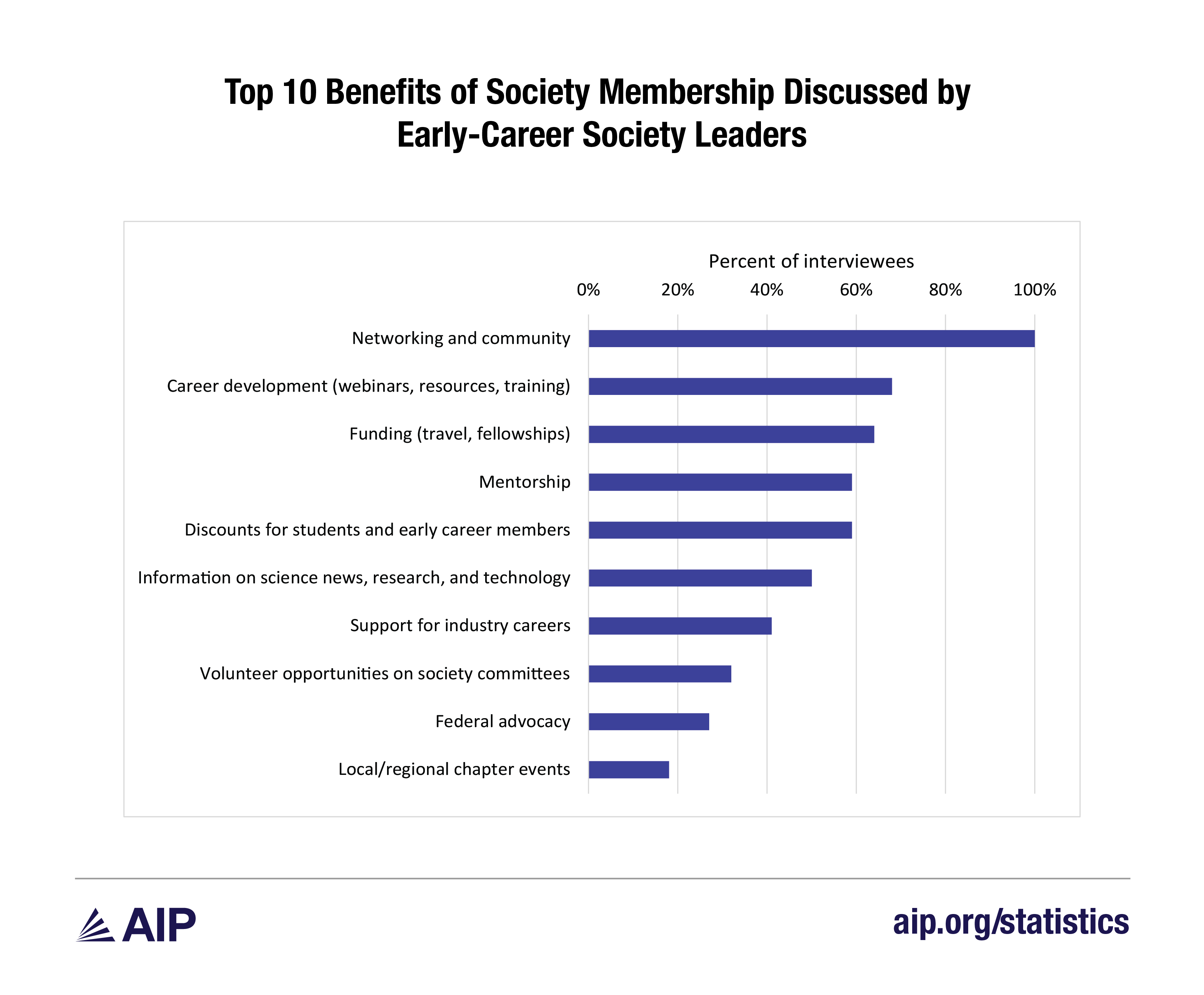
A report by McKinley Advisors (2024) found that members initially joined societies for tangible benefits, such as discounts; however, they remained in societies for intangible benefits, including community and career development. Our interviews with early-career leaders showed the same pattern (Figure 7). Community and networking were by far the most discussed and valuable benefits. Indeed, the term “benefit” is likely too limiting and transactional a word to describe the value that many early-career scientists and engineers find in their society work. A society acts as a professional “home,” a term that many of those we interviewed used without our prompting, for early-career members to create and build long-term relationships that will support them throughout their careers.
I think it’s really important to have that network outside of your home organization, to help understand the different pathways that are open to you… other perspectives, other industries, other jobs… your home base, no matter who’s signing that paycheck.
This was especially important for early-career members in smaller fields, like medical physics or high school physics teaching, where members may feel isolated because there are fewer peers in their local geographical area.
Figure 7

The second most important benefit of society membership was career development, which includes building career skills, receiving continuing education, and accessing career opportunities. Here’s an example of how a society provides career resources to its early-career members:
I know the Careers Team at APS really well. There are so many resources… finding a job in general, how to sell yourselves. There’s a whole mentoring program where they pair you up with a professional. At the Global Physics Summit, there was probably 10 different workshops they put on in various capacities… how to expand your network, give an elevator pitch…and career panels where we expose you to people of various backgrounds.
How early-career leaders became volunteers
Early-career leaders learned about their first society volunteer opportunity in different ways (Figure 8). Once again, relationships were important. For many early-career members, their colleagues and mentors told them about a volunteer opportunity and directly encouraged them to explore it. Having mentors and peers who encourage volunteer work is critical for cultivating early-career volunteer leaders. Other ways they learned about volunteering include receiving emails from the society asking for volunteers, hearing about volunteer opportunities while attending society conference sessions, being nominated for a society volunteer position, and encountering volunteer opportunities while participating in society student chapters.
Figure 8

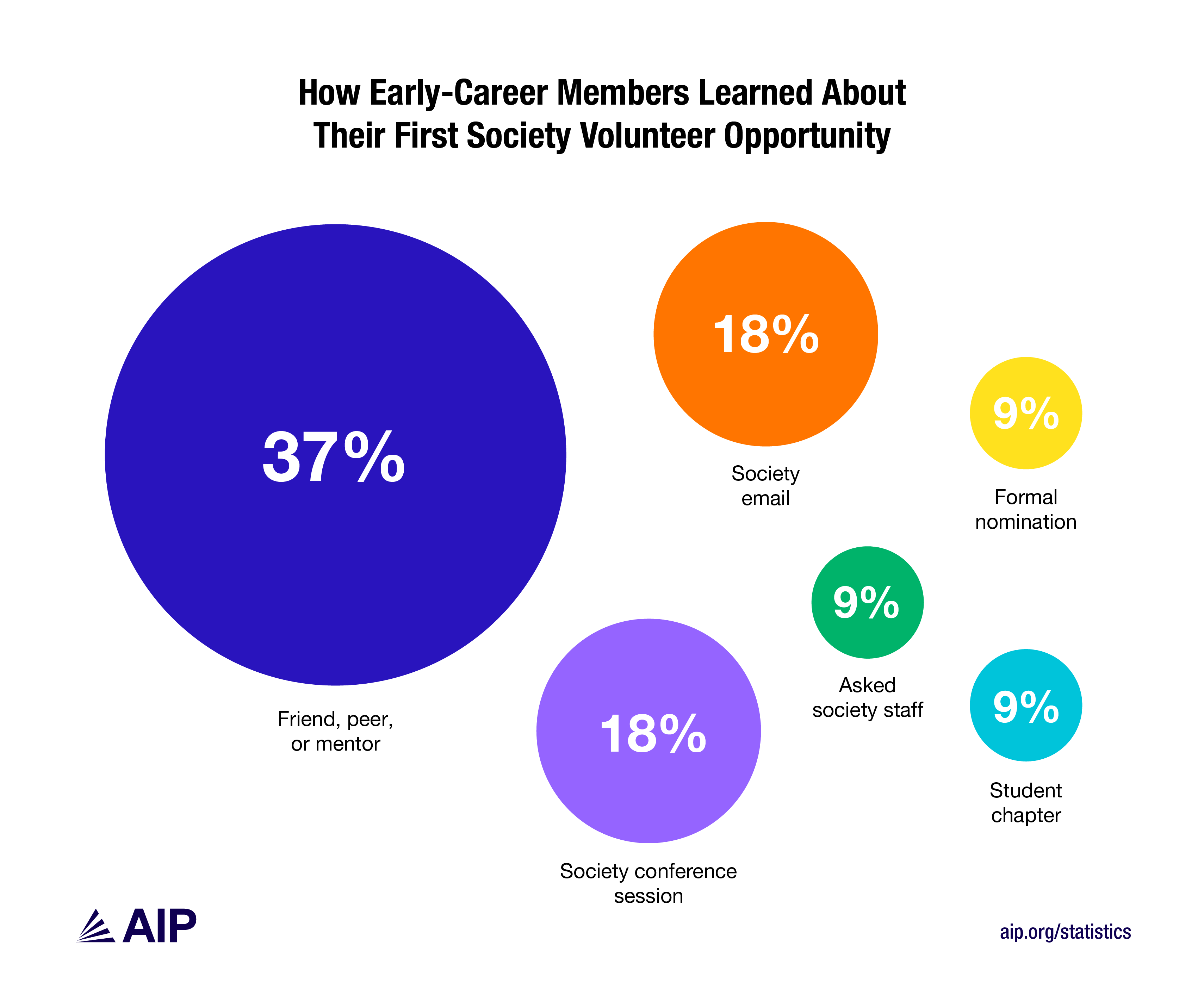
The early-career society leaders we interviewed started volunteering on committees or working groups, and joined these groups in three different ways, depending on the structure of their society:
- Formal nominations – a person self-nominated or someone else nominated them. This was more commonly the case for executive level committees.
- Informal invitations – a person on the existing committee invited them to join, and they accepted and became a committee member.
- Guest attendance policies – a committee allowed them to attend the meetings as a guest and learn how the committee worked. When they asked to join the committee, they became a formal committee member once a spot opened.
Here are some example stories showing how early-career leaders became member society volunteers:
Finding volunteer opportunities through friends and colleagues. Encouragement from friends and colleagues is one of the primary ways to become a society volunteer. Xuan Chen was already doing work to support postdoctoral employees at her workplace, when her friend, an existing staff member at the American Physical Society (APS), asked her if she would join the APS Forum on Graduate Student Affairs.
I was on the Fermilab Postdoc Student Association. It is basically a group that helps student postdocs who are based at Fermilab, which is a national lab outside Chicago. My friend, who was also elected as an officer at the same time, she ended up becoming APS staffer. One day she told me, “They want to have an ex-official member for the Grad Student Forum… since you have done so many stuff at Fermilab, would you be interested in taking on that role?” I said, “Yeah, that sounds really exciting.”
Ria Corder was working with a research collaborator, the chair of a Society of Rheology (SOR) committee, who asked Ria to join her on the committee. From there, her collaborator recommended her to the SOR President, and she was formally nominated as a committee member.
I had professionally connected with the person who chairs the committee and gotten to know her in a collaborative research context, and she said, “You seem like you really care about the activities that this committee puts on. Would you like to join this committee?” And so, she recommended that the President of the society nominate me to this committee.
Learning about opportunities at society conferences. Society conference sessions are another great place to advertise volunteer opportunities. Mason was attending an American Astronomical Society (AAS) meeting and while attending a session on congressional advocacy, he learned about the existence of the new Working Group for International Scholars and was invited to join.
The Working Group for International Scholars… it’s a relatively recent working group that was spurred out of the AAS meeting last year. I went to the special session. My expertise is on congressional advocacy... and met with a few folks who are from the Public Policy Committee, and then they mentioned that they’re thinking of setting up the committee or working group. And then from there, I was invited to join the working group, and now we meet monthly to talk about... what challenges international students are facing, and what sort of solutions people have come up with.
Hearing about opportunities from staff members. Having approachable and responsive staff members can help encourage early-career members to get involved. When Emma Louden reached out to Joel Parriot at the American Astronomical Society (AAS) and asked how to get involved in policy work, she learned they needed a student member on their Public Policy Committee. After applying to the position through the AAS President, she joined the committee.
I was really interested in public policy and science policy at the time, so I reached out to Joel Parriot of AAS and said, “I’m a grad student, but I really want to do this.” And he said, “Well, we’ve been looking for a student member to have on the Committee on Astronomy and Public Policy. Would you be interested in that?” And I said, “Absolutely.” So I sent over a CV and talked to the President of the AAS at the time, and ended up joining CAP as their student representative, which is a role I’ve maintained all the way through graduate school.
Becoming a volunteer through guest membership. Eric Welch wanted to get involved at the American Association of Physicists in Medicine (AAPM), and he first started attending working group meetings as a guest member. This enabled him to get accustomed to society group work before committing himself to being a full member. Once he started one volunteer opportunity, it became easier to join others.
By getting [a working group] to let you be a guest on a meeting and actively participate in it, you get more comfortable in what AAPM is doing, and more comfortable in actually doing the work. So I became a guest, and after that guest year, I rotated on as a full member... after you get onto one committee, it’s somewhat easier to get access to other committees. But I would say that getting that first foot in the door is important.
Why early-career leaders became volunteers
To understand more about what motivates and keeps dedicated early-career leaders engaging with their societies, we asked our interviewees why they became society volunteers. They told us that they were motivated to give back and make a difference and were inspired by the other volunteers they worked with.
Giving back. Throughout our discussions with early-career leaders, we heard time and again that these volunteers wanted to give back to their scientific community and help others the same way that they were helped in the past.
What do I owe my field? Because I got all that value up front, I feel like I owe something to some degree. I want that for the people that come after me, and I want them to be able to have the same building blocks for their careers as I did for mine.
Making a difference. Early-career leaders wanted to improve the lives of students and professionals in their field and make a positive impact on the world.
I come from a somewhat non-traditional background. I didn’t really know that you could major in physics or even have a career in physics until I was already an undergraduate myself. I think I would like to remedy that for future students… so people can make a better decision for themselves in their own life and their own career choices and have the most information to do so efficiently and effectively.
Working with others who care. When our early-career leaders started working with other volunteers and saw their passion for the community, they became more inspired and engaged themselves.
I was very interested in [volunteering] because I got to see these conferences. They seem to be organized very smoothly… and it’s really nice to learn the machinery that is behind all these activities we engage in. I get to know the people who are running these activities. None of us is paid to do this… people do it totally just out of their love for the community.
How early-career society leaders are making an impact
We consistently heard that giving back and making a difference were the things that motivated and drove the engagement of early-career leaders. Here we briefly describe some of the wide ranges of ways that these leaders are making an impact (Figure 9).
Figure 9


Here are some examples of what early-career society leaders accomplished within their societies.
Pilot new society programming and content. Carlos Martinez proposed, developed, and chaired a new committee for the American Meteorological Society (AMS).
I developed and now lead a committee on multifaith and environmentalism (COSMOS)… to have dialogue, build community and fellowship. So, for example, disaster preparedness. Knowing that many houses of worship can be spaces for volunteerism, crisis management and safety, before, during, after, high-impact weather and climate events, we’ve partnered with Interfaith Power and Light, Green Faith and Creation Justice Ministries.
Build society communities. Katie Burzynski led the establishment of a local chapter of AVS (a society for the Science and Technology of Materials, Interfaces, and Processing), hosting local career events and growing the local AVS community.
I became the Chair of the Ohio chapter at AVS and just started organizing local symposiums... tried to grab other early-career people to give invited talks, people that we know were contributing very largely to the scientific community, but maybe weren’t quite on everyone’s radar. Our first event, I think we had 20… and now I think we’re at 50 people. So we’re just slowly growing organically in the chapter.
Perform society outreach. Atrouli Chatterjee served as an Optica Ambassador in 2023, where she disseminated information about pursuing an optics career by hosting webinars and writing online articles. She advertised Optica events and resources through social media and local networks. Sadly, Atrouli passed away earlier this year, but she left a legacy of support and encouragement for others in her community.
When I initially started as an ambassador, there were two ways that I was interacting with people. One was through my webinars, which were focused on scientific development and the speakers’ career journey. And I was writing short articles for Optics and Photonics News on career development. All of the ambassadors... we have our own social media specifically for our ambassador-related activities. LinkedIn, Instagram, those are the two main ones that I use… other than that, I go through my local schools and networks here.
Support conference operations. Cassandra Shivers-Williams sought out feedback from members about conference experiences at the American Meteorological Society (AMS) and made improvements to conference scheduling and other aspects of conference operations.
I am the co-chair of the AMS Annual Meeting Oversight Committee. We help evaluate how the conference went and what places exist for improvement. One very concrete example is lunch breaks. Lunch breaks were an hour, and it was impossible to get a table anywhere…. fast forward to the 2024 conference in Baltimore, lunch break was 90 minutes. So that’s a tangible example of some of the things that our committee has done.
Perform federal advocacy. Ari Jain partnered with the Governmental Affairs Team at the American Physical Society (APS) to advocate for fairer compensation for graduate students and postdoctoral researchers and communicated with U.S. congressional representatives.
We partnered with the Governmental Affairs Team because there was a piece of federal legislation called the RESEARCHER Act, which calls for the White House Office of Science and Technology Policy to develop robust guidelines for graduate student and post doc pay. We organized a grassroots campaign. Overall, 800 letters were sent to congressmen across the country... and six teams met with the offices of their congressmen or senators. As a result, three congressmen signed on to co-sponsor the bill.
Why societies should engage early-career members in leadership
Engaging early-career members is an essential mission for any organization. To that end, we asked early-career leaders why they thought this was an important area to focus on. Early-career members in volunteering positions bring new life, new ideas, and new energy to society operations. Their fresh perspectives can help solve existing challenges and build new communities.
Newer people have different ideas than the people who’ve been in the field for a long time.
If we don’t focus on the long game of involving early-career people… then we’re going to slowly die. It’s like a siphon. If you don’t keep water going in, then it’s just going to dry up.
They’re the next generation… they have the energy and the drive I feel that inspires many to lift voices and to create spaces that bring everyone together to tackle these global and grand challenges. If there aren’t opportunities for them to see their worth and their value, we lose that.
Recommendations for cultivating early-career society leadership
To conclude this report, we offer a consolidated set of recommendations for societies to cultivate, engage, and support early-career leadership. We recognize that many societies are already engaging in these kinds of activities, and we share them here to reinforce their importance.
How societies can reach students and early-career professionals
- Help undergraduate and graduate mentors/advisors show the value of society membership to their mentees
- Invest in student/local chapters and society ambassadors, who can advertise society events and resources
- Use social media platforms to communicate with students
How societies can engage early-career members in volunteering
- Foster open and approachable committee environments
- Set committee term limits to create more opportunities for new voices
- Give early-career members equal voting responsibilities
- Have open committee structures and invite guests
- Discuss volunteer opportunities at student and early-career conference sessions
- Send early-career members tailored email messages with volunteer opportunities
- Involve existing early-career members in outreach efforts and have them encourage other early-career professionals to get engaged
How societies can support students and early-career professionals
- Create opportunities to develop a sense of community
- Organize community events outside of annual meetings, such as seminars and coffee chats
- Support and develop society mentorship programs and events
- Build cohort programs, where small groups of new students or early-career members meet for events and reunions
- Continue to make conferences a welcoming place for students and early-career members
- Provide travel funding and conference discounts for students and early-career professionals
- Host first-time attendee sessions at conferences, and hand out brochures that list society resources
- Offer research awards and invited talks to recognize student and early-career work
- Organize mentorship events, where new members can talk with experienced society mentors
- Provide resources focused on the current needs of early-career professionals
- Prioritize industry career development, such as industry expos, industry workshops, industry mentors, and industry job listings
- Advocate for student and early-career needs at the federal policy level, such as fair graduate student and postdoctoral pay and international student visas
Methodology
We interviewed 22 early-career members from ten scientific societies in the American Institute of Physics (AIP) federation. Interviewed members were selected via a nomination form sent to the society CEOs, where we asked for the nominees’ names and contact information. Interviewees were also selected via web searches on society websites. We looked up early-career members listed on society committees, particularly committees focused on student or early-career engagement. Someone was considered in their early-career if they earned their highest degree within the past seven years (2018 or later). Interviews were conducted over Zoom. Transcripts were made from Zoom recordings. Participants were given the opportunity to review their own interview transcripts and make redactions or changes. Participants were each compensated with a $50 Amazon gift card for their participation.
References
Bankston, A., Davis, S.M., Moore, E., Niziolek, C.A., & Boudreau, V. (2020). Why scientific societies should involve more early-career-researchers. eLife, 9, e60829. DOI: https://doi.org/10.7554/eLife.60829
McKinley Advisors (2024). Membership reset: Delivering on the promise of membership. Retrieved at https://www.mckinley-advisors.com/resource/membership-reset
The Wiley Network (2024). The future for societies starts with early-career researchers. Retrieved at https://www.wiley.com/en-us/network/publishing/societies/member-engagement/the-future-for-societies-starts-with-early-career-researchers .
Appendix
Below is a list of all 22 early-career leaders who participated in our interviews by name, scientific society, and position. Table 2 shows the demographic percentages of the early-career leaders by employment sector, gender identity, and scientific society. The PDF attachment at the bottom of the page has expanded biographies, including photos, LinkedIn profile addresses, and quotes describing what each person was most proud of during their society work.
- Ari Jain, American Physical Society (APS)
Current PhD Student in Aerospace, Aeronautical, and Astronomical Engineering, Georgia Institute of Technology - Aryeh Drager, American Meteorological Society (AMS)
Postdoctoral Research Associate, Brookhaven National Laboratory - Atrouli Chatterjee (passed away August 2025), Optica
Postdoctoral Associate, Yale University School of Medicine - Benjamin Cromey, Optica
Principal Optical Engineer, BAE Systems - Cassandra Shivers-Williams, American Meteorological Society (AMS)
Social Science Deputy Program Manager, NOAA - Carlos Martinez, American Meteorological Society (AMS)
Senior Climate Scientist, Union of Concerned Scientists - Chuqiao (Elise) Chen, Society of Rheology (SOR)
Postdoctoral Researcher, UC Santa Barbara - Emma Louden, American Astronomical Society (AAS)
President of Slooh, Bringing Space Directly into Classrooms - Eric Welch, American Association of Physicists in Medicine (AAPM)
Proton Clinical Medical Physicist, Mayo Clinic - Katherine Burzynski, Science and Technology of Materials, Interfaces, and Processing (AVS)
Materials Engineer, Air Force Research Laboratory - Kelly Nealon, American Association of Physicists in Medicine (AAPM)
Faculty Medical Physicist, Massachussetts General Hospital - Martin Lawless, Acoustical Society of America (ASA)
Assistant Professor, The Cooper Union - Mason Ng, American Astronomical Society (AAS)
Postdoctoral Researcher, McGill University and Trottier Space Institute at McGill - Meghan DiBacco, American Association of Physics Teachers (AAPT)
AP/GT Physics Teacher, Cinco Ranch High School - Pankaj Patel, American Association of Physicists in Medicine (AAPM)
Senior Imaging Physicist, Houston Methodist - Rachael Merritt, American Association of Physics Teachers (AAPT)
Postdoctoral Associate, University of Colorado-Boulder - Ria Corder, Society of Rheology (SOR)
Assistant Professor of Chemical Engineering, University of Tennessee-Knoxville - Spencer Perry, American Association of Physics Teachers (AAPT)
Current PhD Student in Science Education, Indiana University-Bloomington - Tim Stachowski, American Chystallographic Association (ACA)
Senior Bioinformatics Research Scientist, St. Judes Children’s Hospital - Trevor Jerome, Acoustical Society of American (ASA)
Engineer, Naval Surface Warfare Center Carderock Division - William Munizzi, American Physical Society (APS)
Postdoctoral Scholar, UCLA - Xuan Chen, American Physical Society (APS)
Postdoctoral Research Associate, Cornell University
Table 2