Trends in Physics Bachelor’s Degrees: Decline and Signs of Stabilization

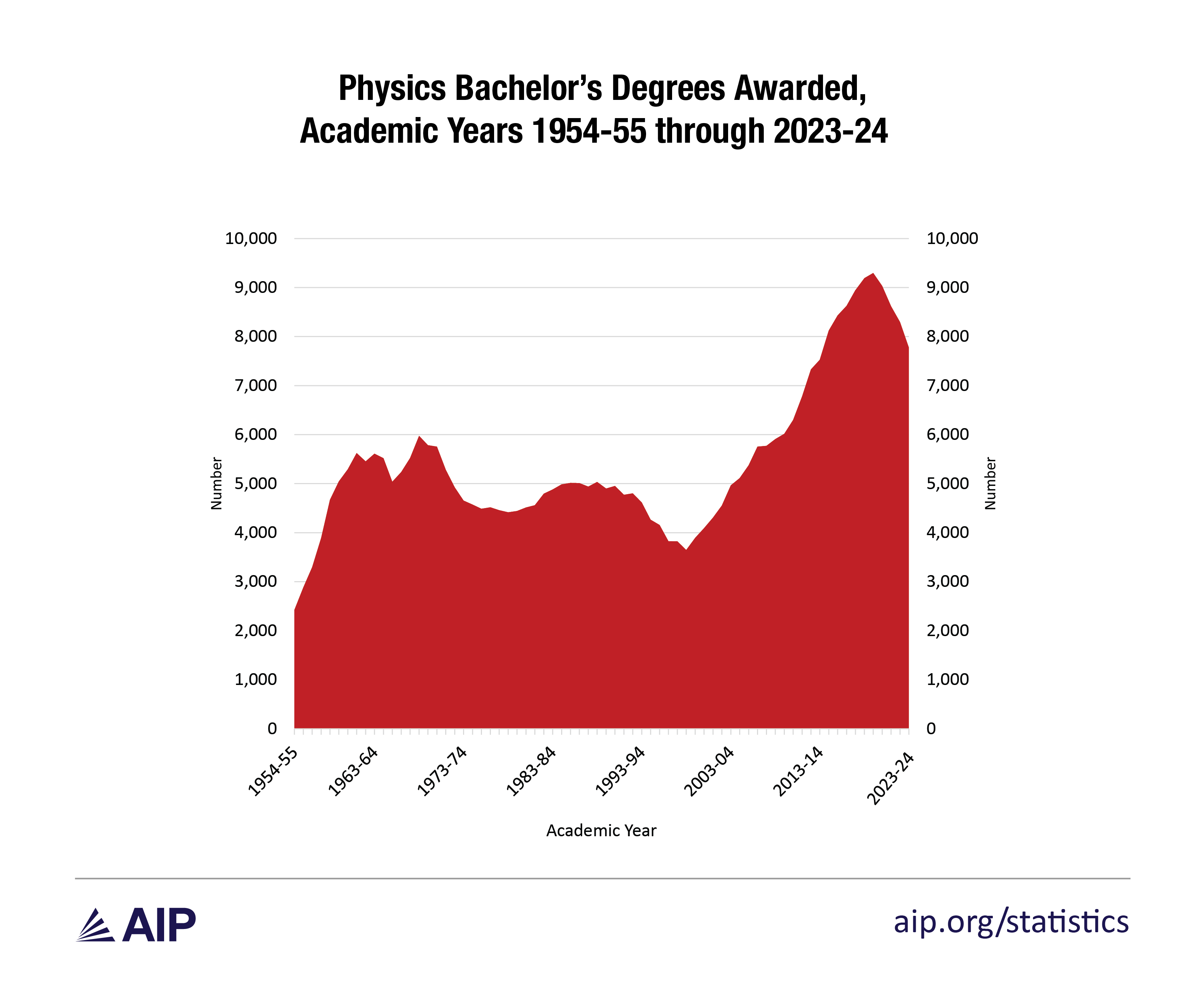
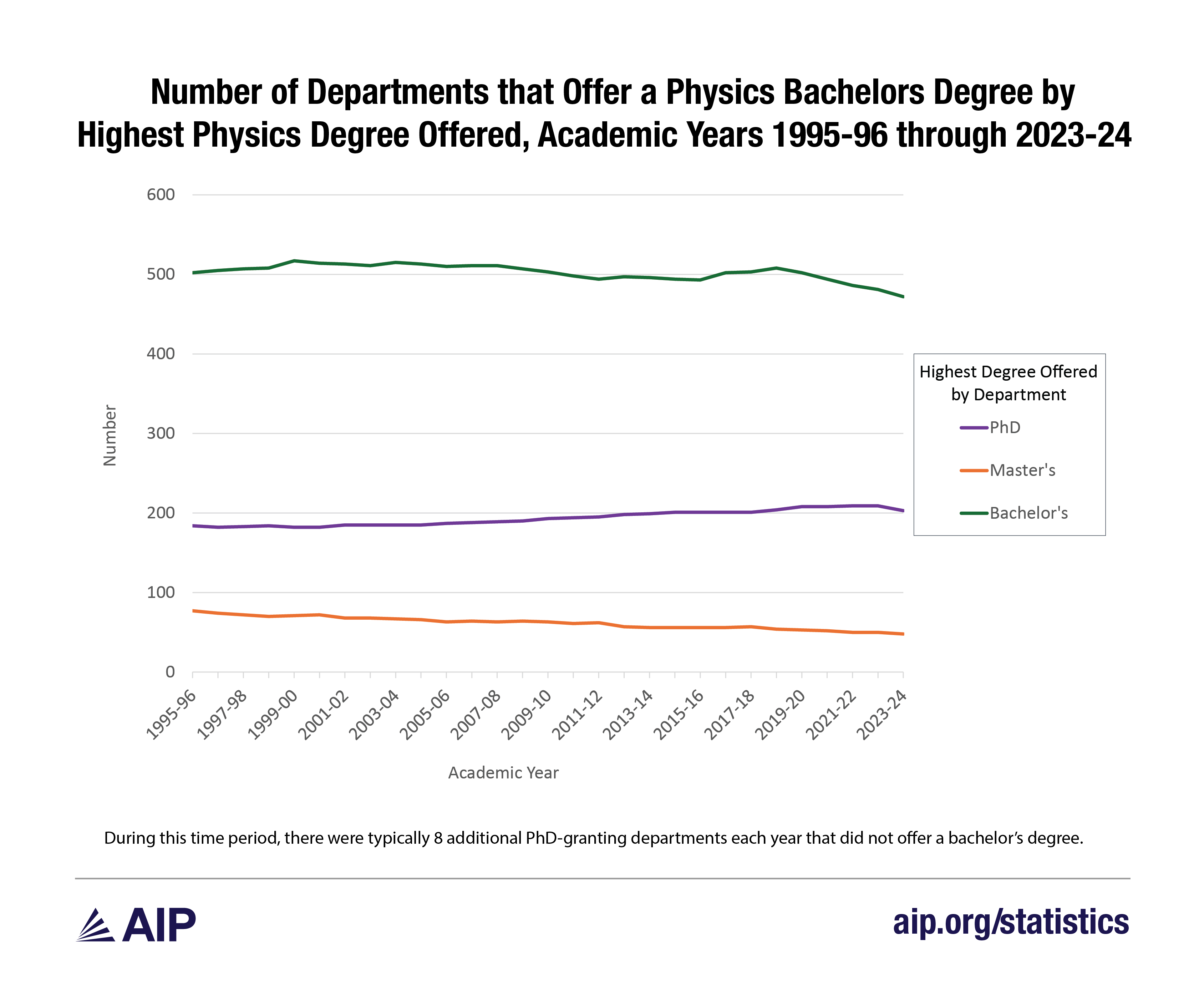
This report presents findings from the annual AIP Survey of Enrollments and Degrees. It includes trend data on physics bachelor’s degrees awarded in the 2023–24 academic year. Figure 1 highlights a 16% decline in the number of bachelor’s degrees awarded in recent years, while Figure 3 shows a 4.5% net decline in the number of institutions offering undergraduate physics degrees. Although the loss of these relatively small degree-granting departments is significant for individual institutions, it has contributed little to the overall decline in physics bachelor’s degrees awarded.Undergraduate physics enrollment data at the junior and senior levels indicate an end to the decline—or at least a stabilization—in the number of physics bachelor’s degrees awarded in the next couple of academic years.
Figure 1

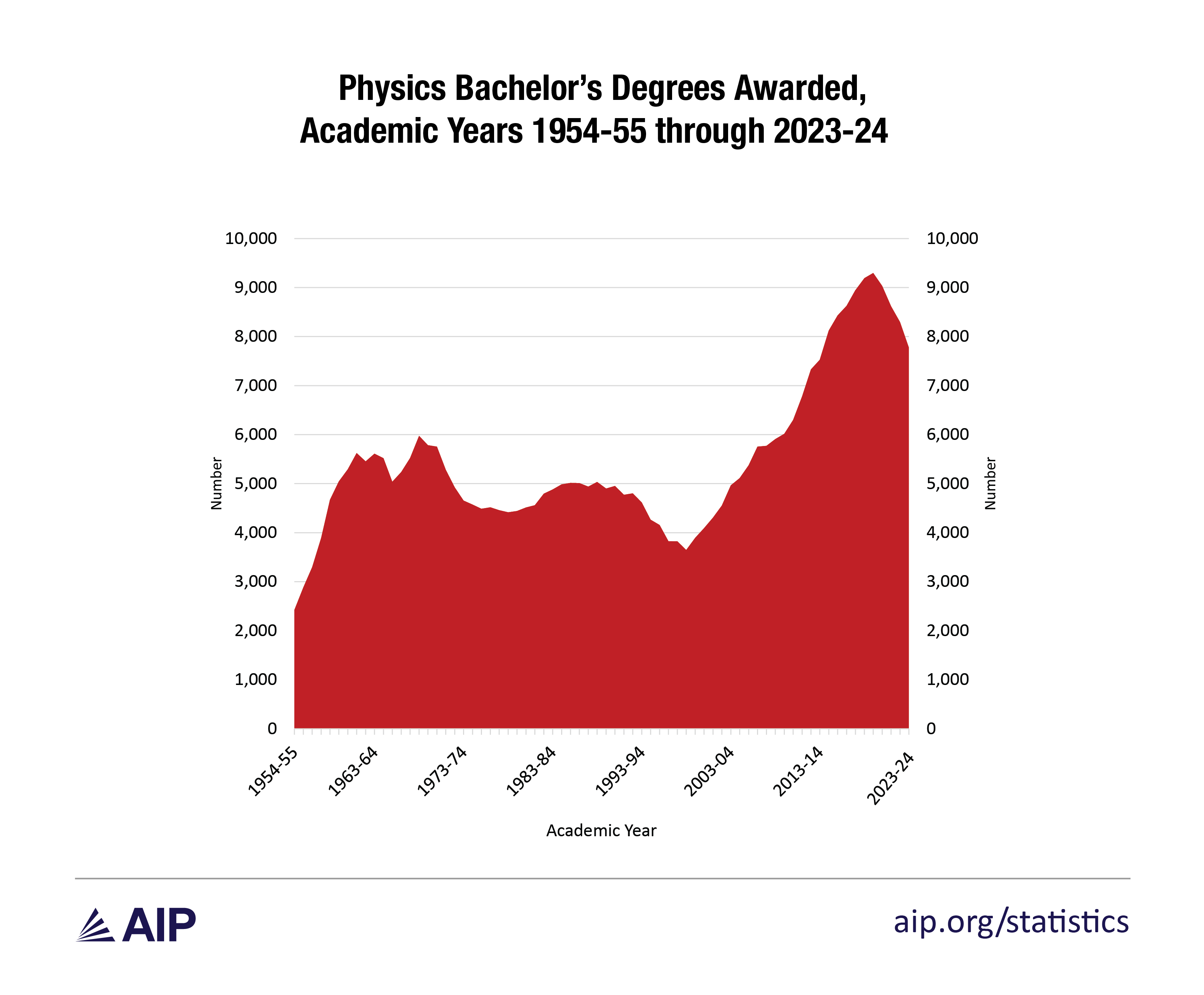
- There were 7,776 physics bachelor’s degrees awarded in the 2023-24 academic year.
- After two decades of increases, the overall number of physics bachelor’s degrees awarded has declined for the fourth consecutive year. The 7,776 degrees awarded in the 2023-24 academic year represents a 6% decline from the previous year and a 16% decline from the all-time high of 9,296 degrees awarded in the 2019-2020 academic year.
Undergraduate enrollment data presented later in this report and preliminary data for the 2024-25 academic year foretell an end to the decline or at least a stabilization in the number of physics bachelor’s degrees awarded.
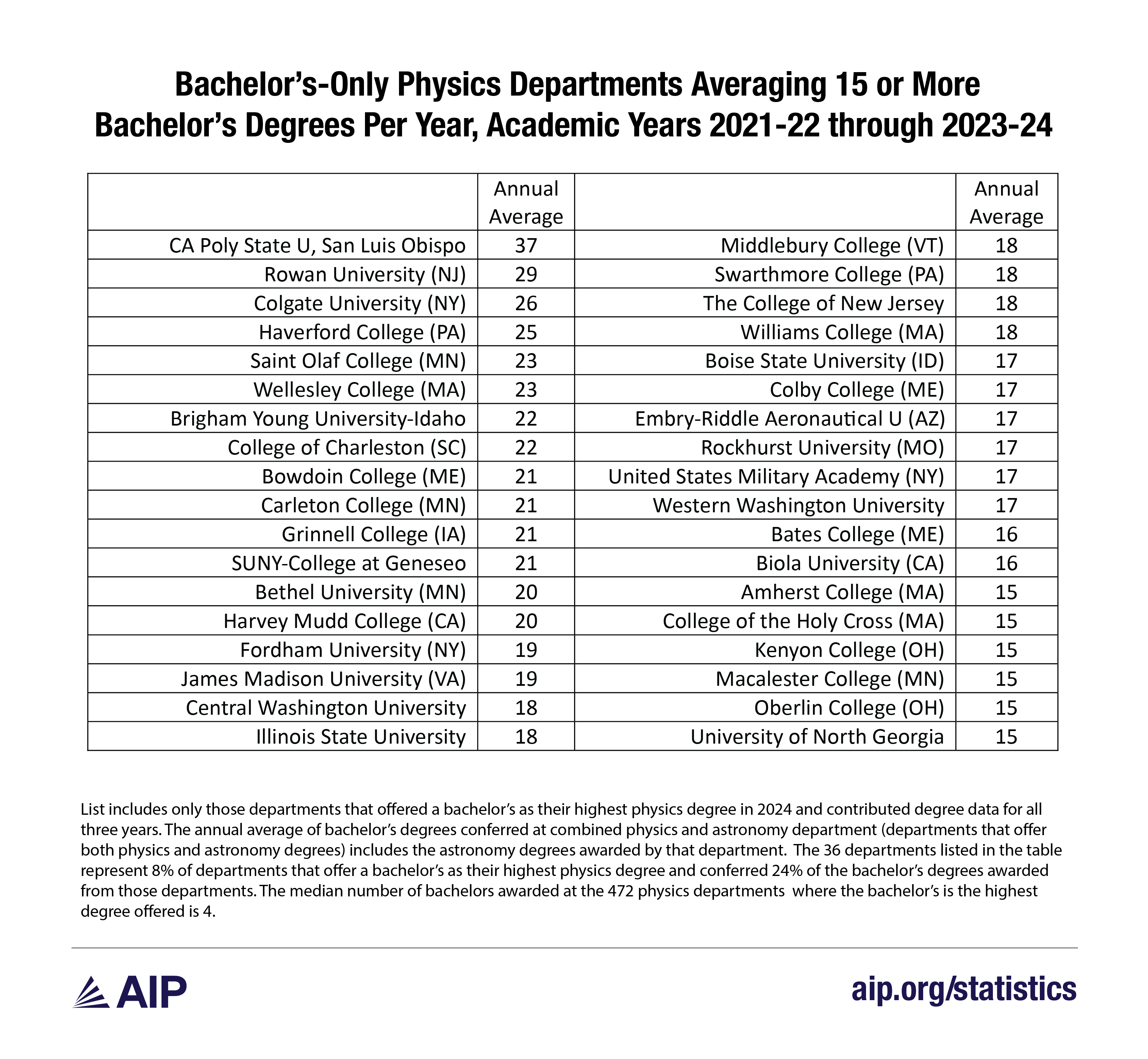
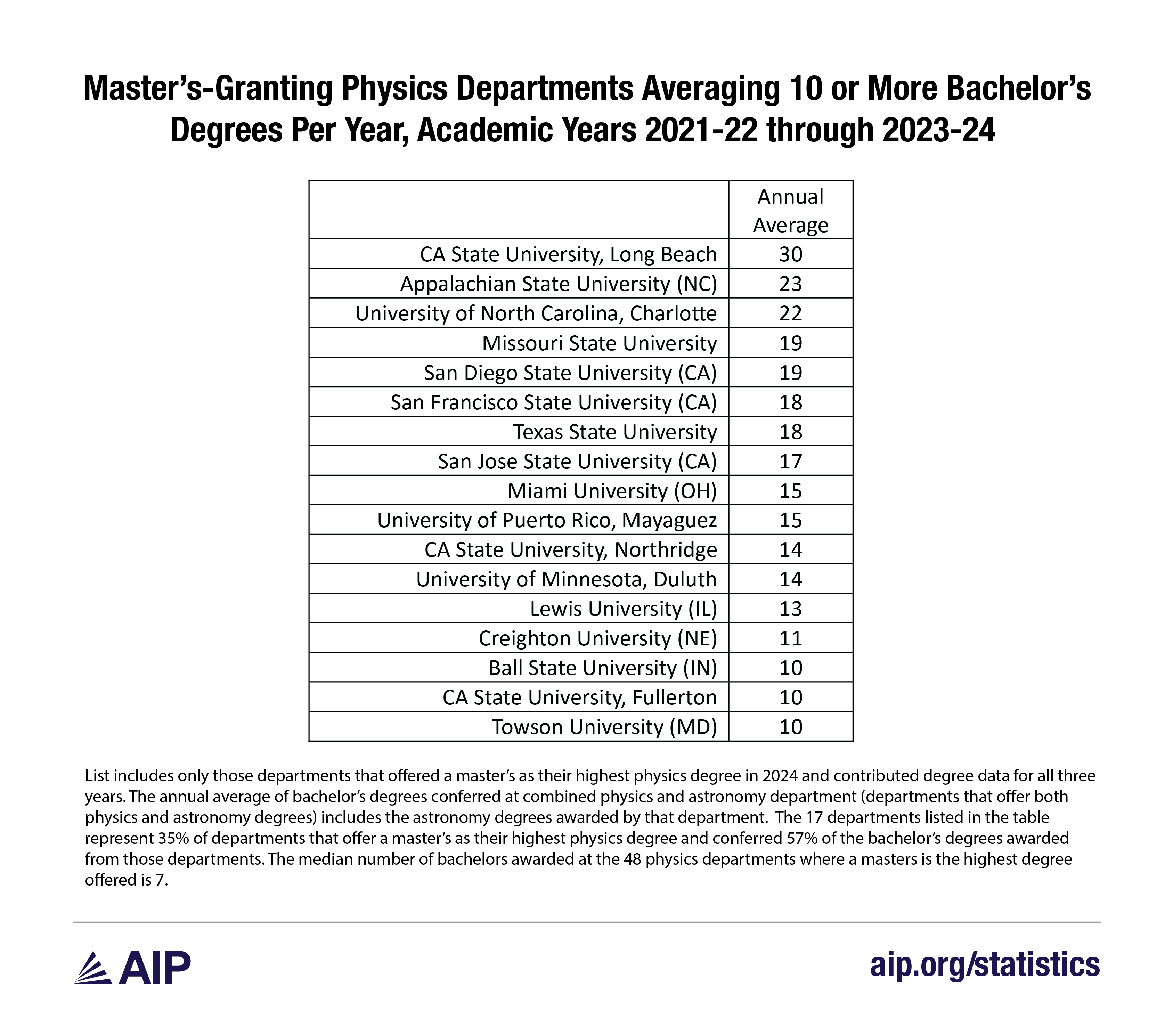
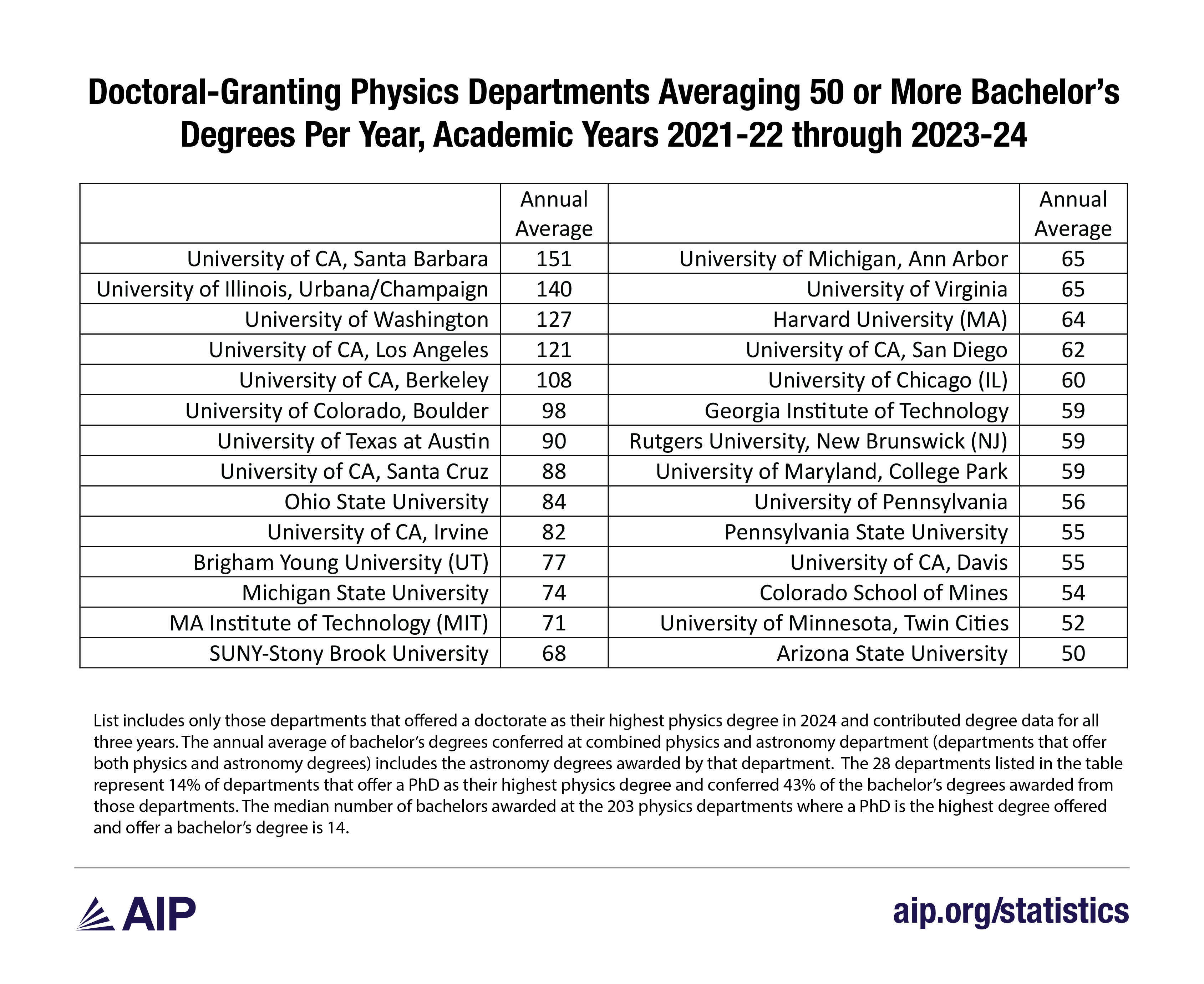
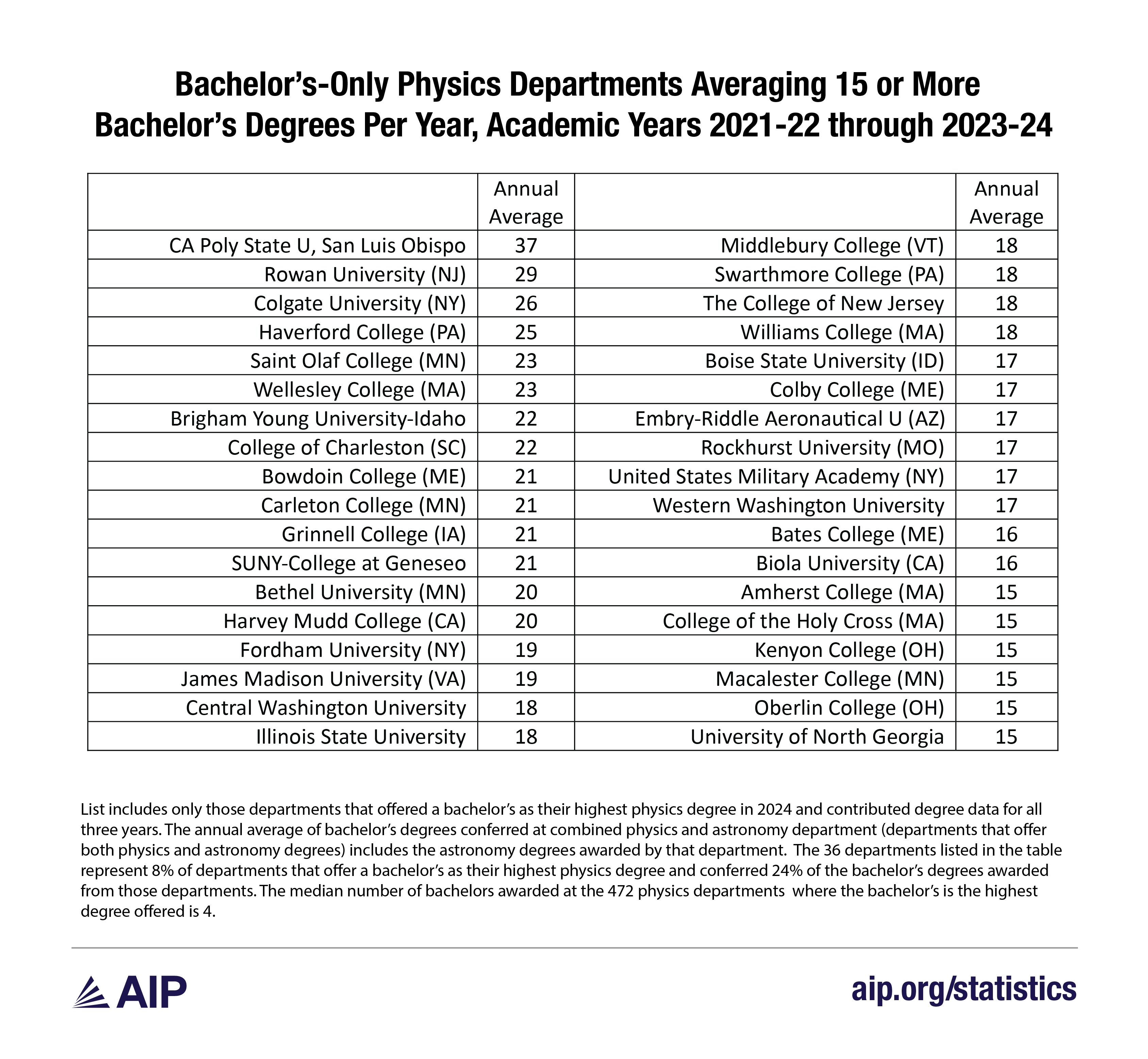
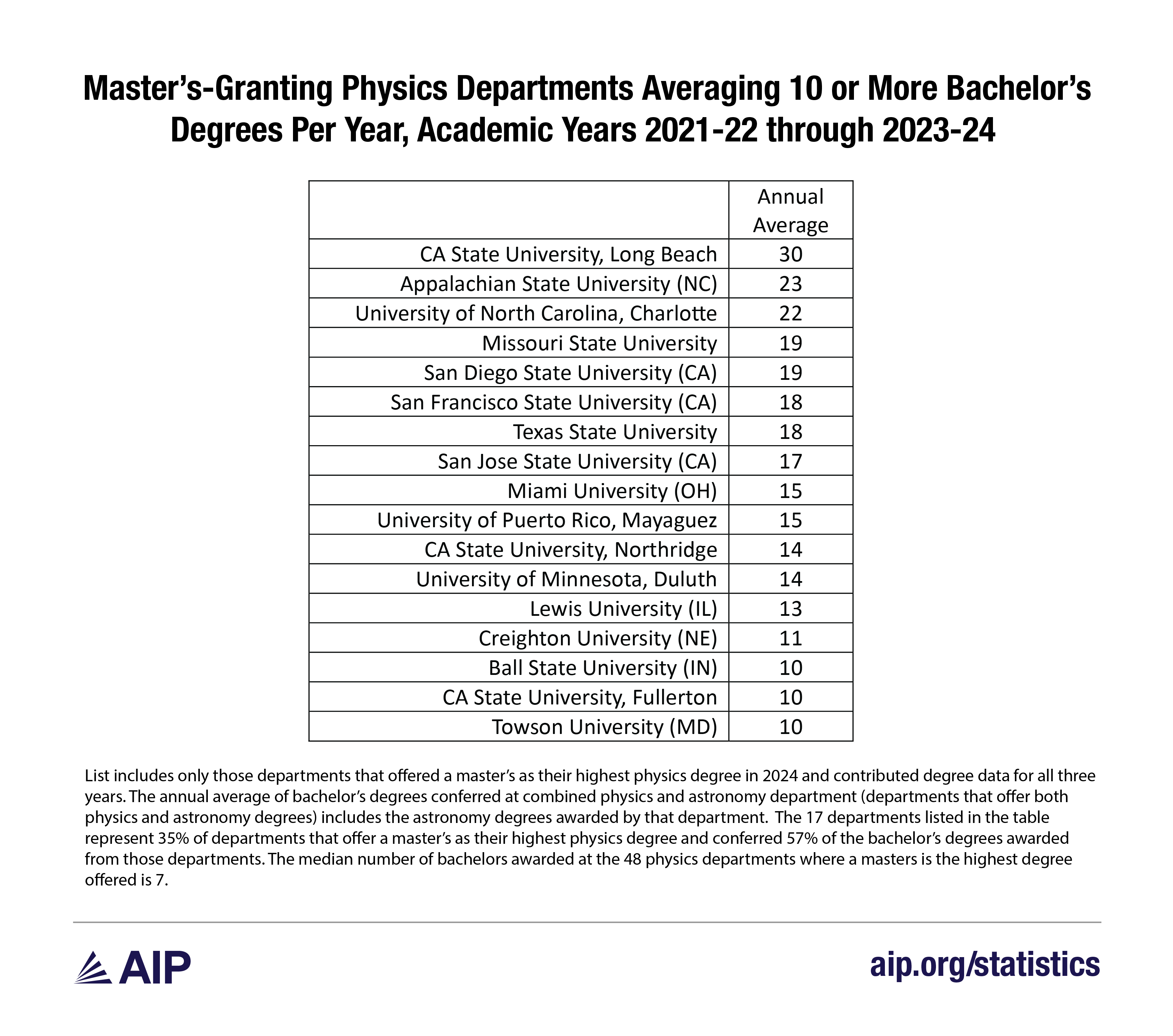
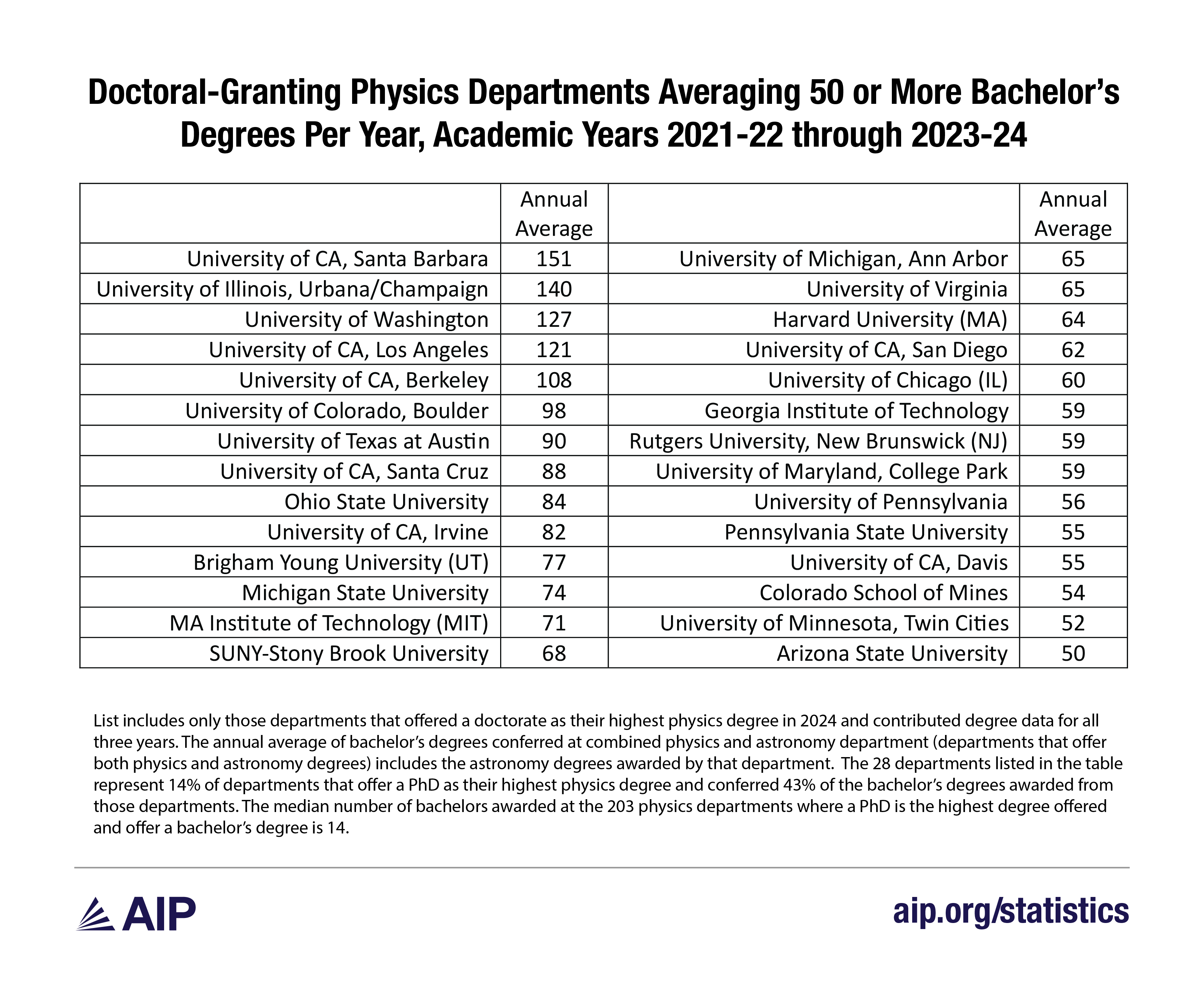
Note: The institutions conferring the most physics bachelor’s degrees are listed in the Appendix.
Figure 2

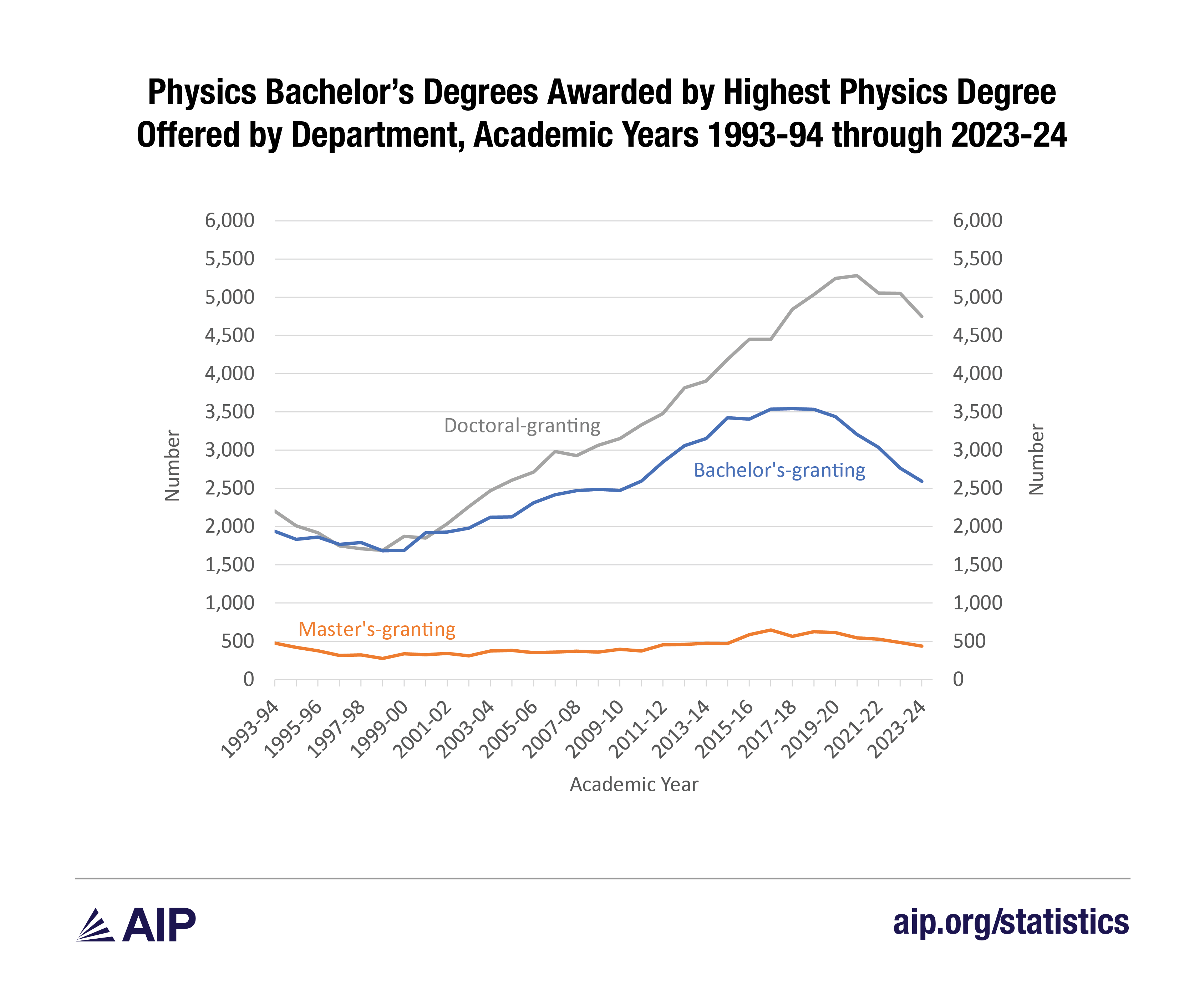
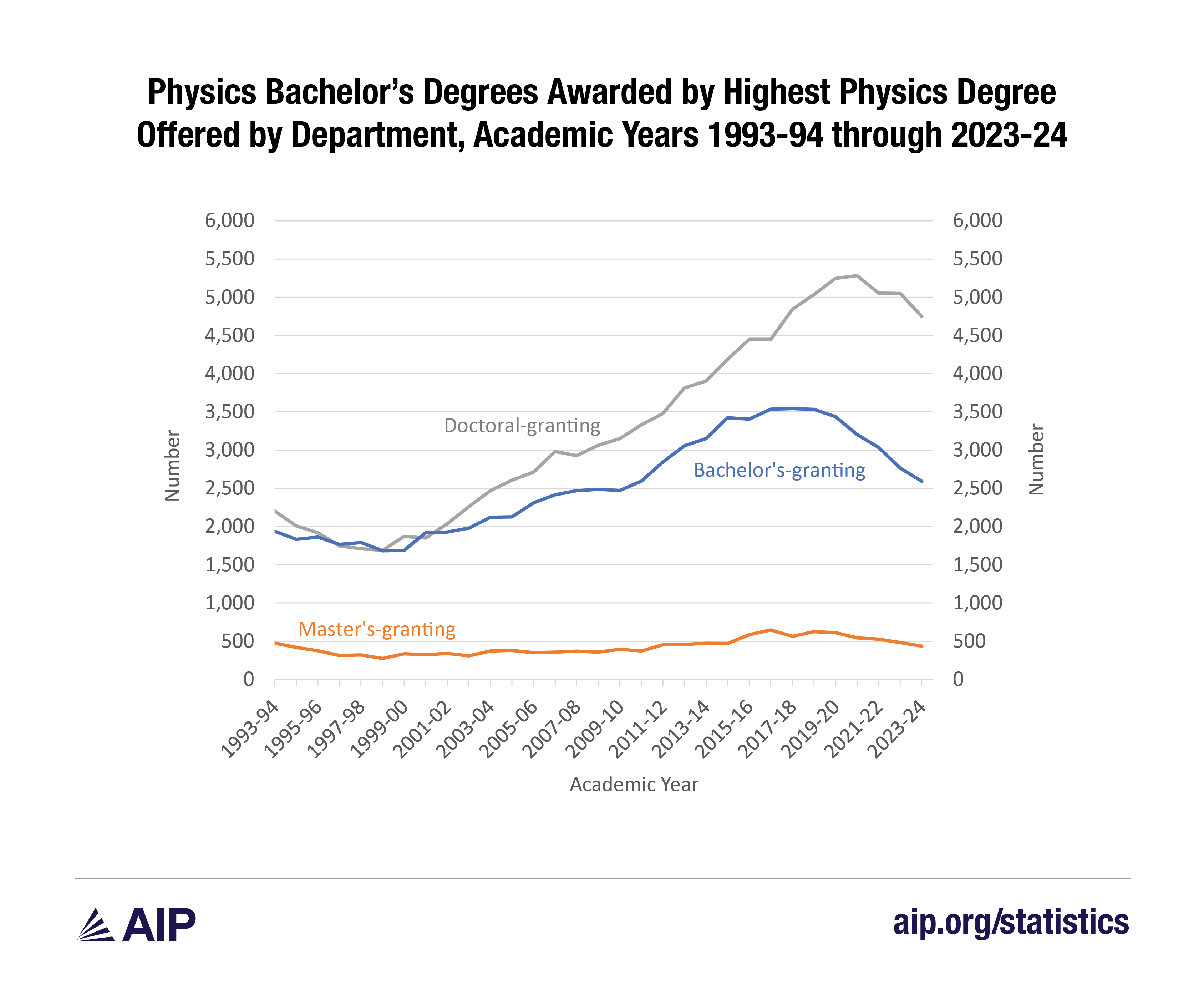
- Departments where a master’s or bachelor’s was the highest physics degree offered have experienced the greatest percentage decline in the number of bachelor’s degrees they award.
- For detailed data on the size of undergraduate physics programs in the US, see the AIP report “Size of Undergraduate Physics and Astronomy Programs, 2024” .
Table 1

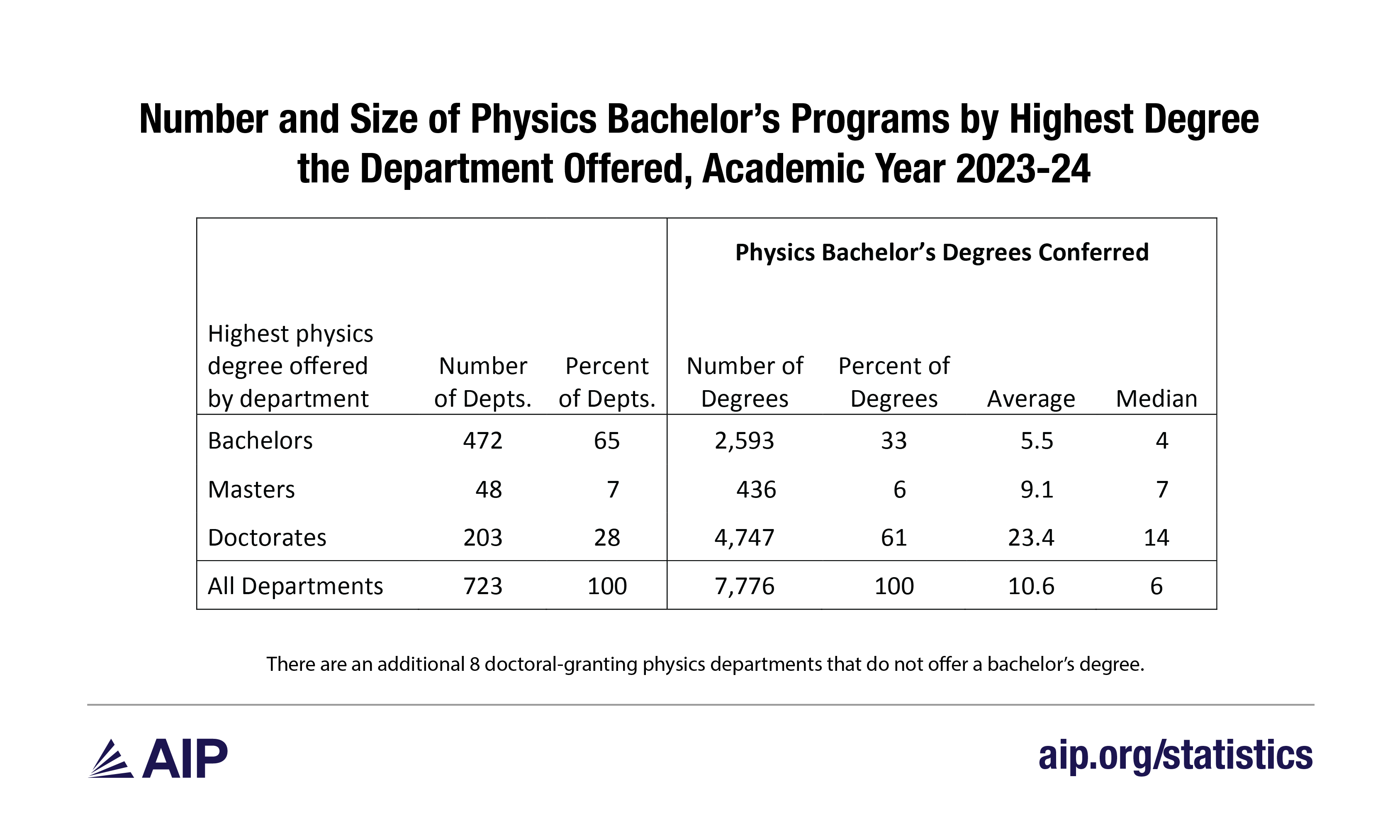
- In the 2023-24 academic year about two-thirds of the degree granting physics departments in the US awarded a bachelor’s as their highest physics degree, awarding an average of 5.5 degrees per department.
- The 203 doctoral-granting physics departments with undergraduate programs comprised 28% of all the degree-granting physics departments in the 2023-24 academic year and conferred 61% of the total number physics bachelor’s degrees awarded.
Figure 3

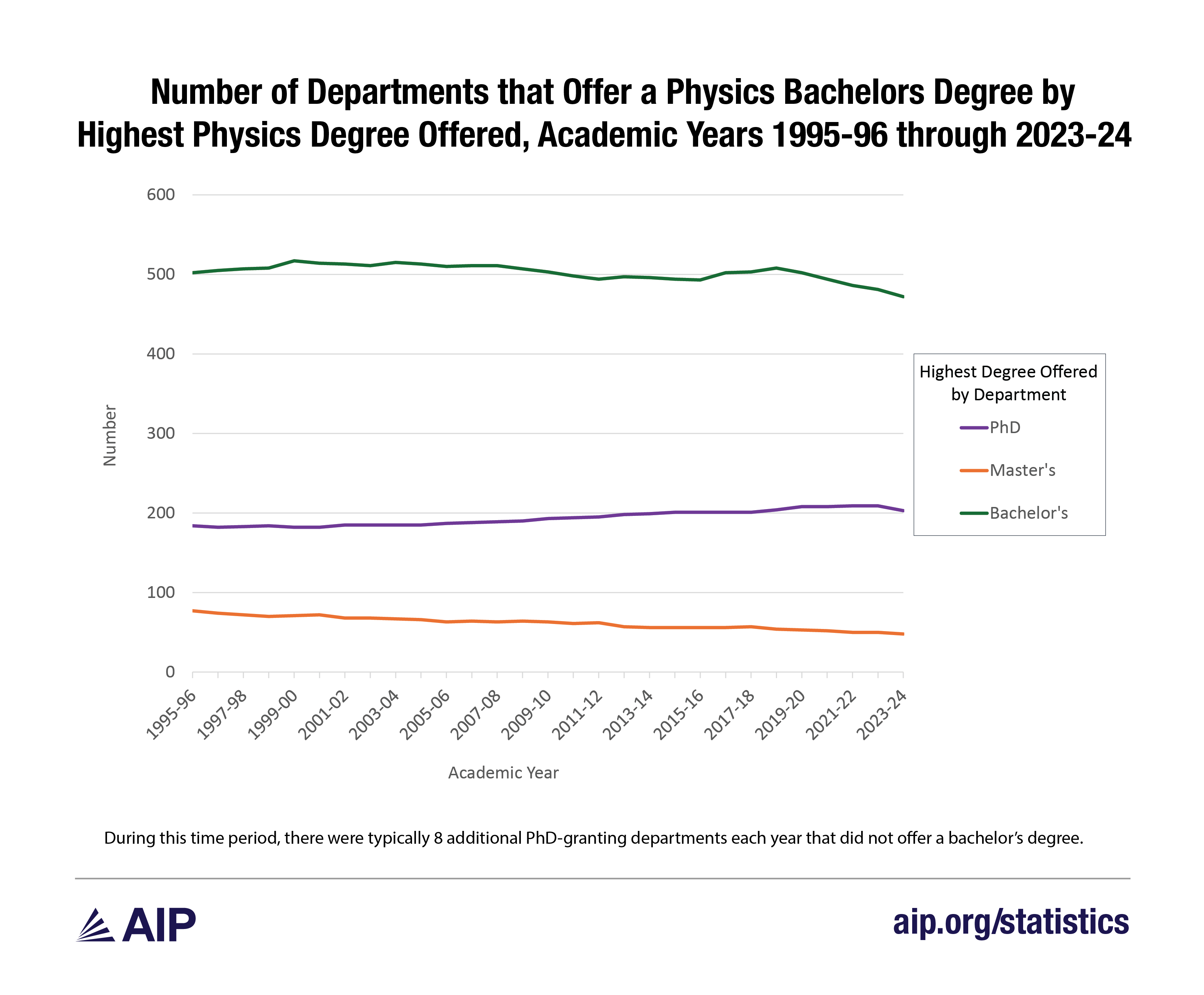
- Changes in the number of departments, categorized by highest degree offered, can occur in four ways: (1) a department may change the highest-level physics degree it offers; (2) a department may discontinue its physics degree-granting program; (3) an institution may introduce a new physics degree–granting program where one did not previously exist; and (4) an institution may merge with another institution or close altogether.
- In the academic year 2023-24 there were 723 departments in the US that offered a bachelor’s degree in physics. This represents a net decline of 34 departments (4.5%) from five years earlier. During this time period 39 programs or institutions stopped awarding a physics bachelor’s degree and five institutions started a degree program where one did not previously exist.
- The loss of these degree-granting departments contributed very little to the overall decline in the number of physics bachelors awarded seen in Figure 1. The departments at persisting institutions that no longer offered a physics bachelor’s degree averaged 2.5 degrees a year with some departments averaging 0 or 1 degree a year.
- Much of the decline in the number of programs that offered a master’s as their highest physics degree, and the increase in the number of departments that offer a PhD, is a result of master’s programs expanding their degree offerings to include a PhD.
Figure 4

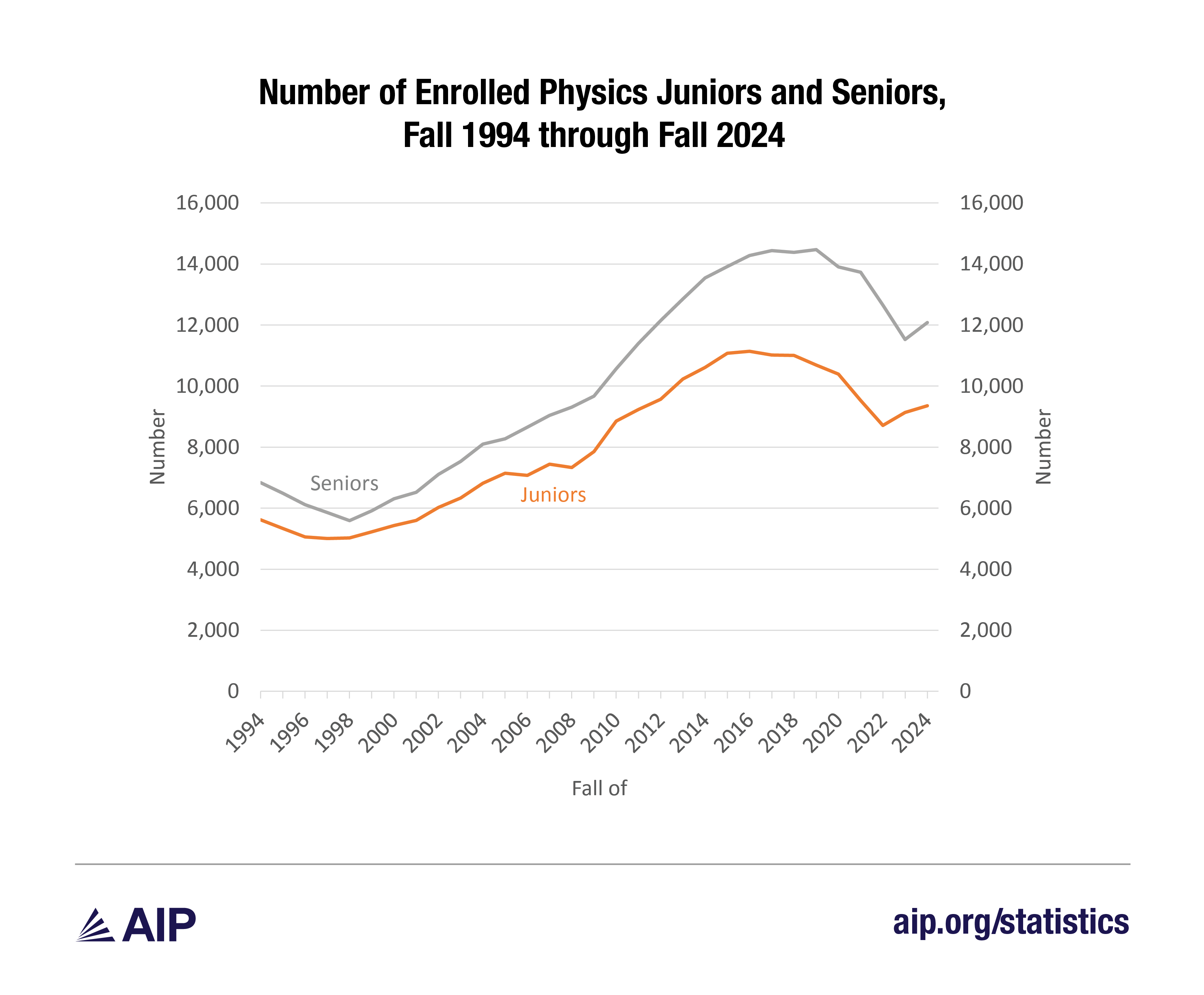
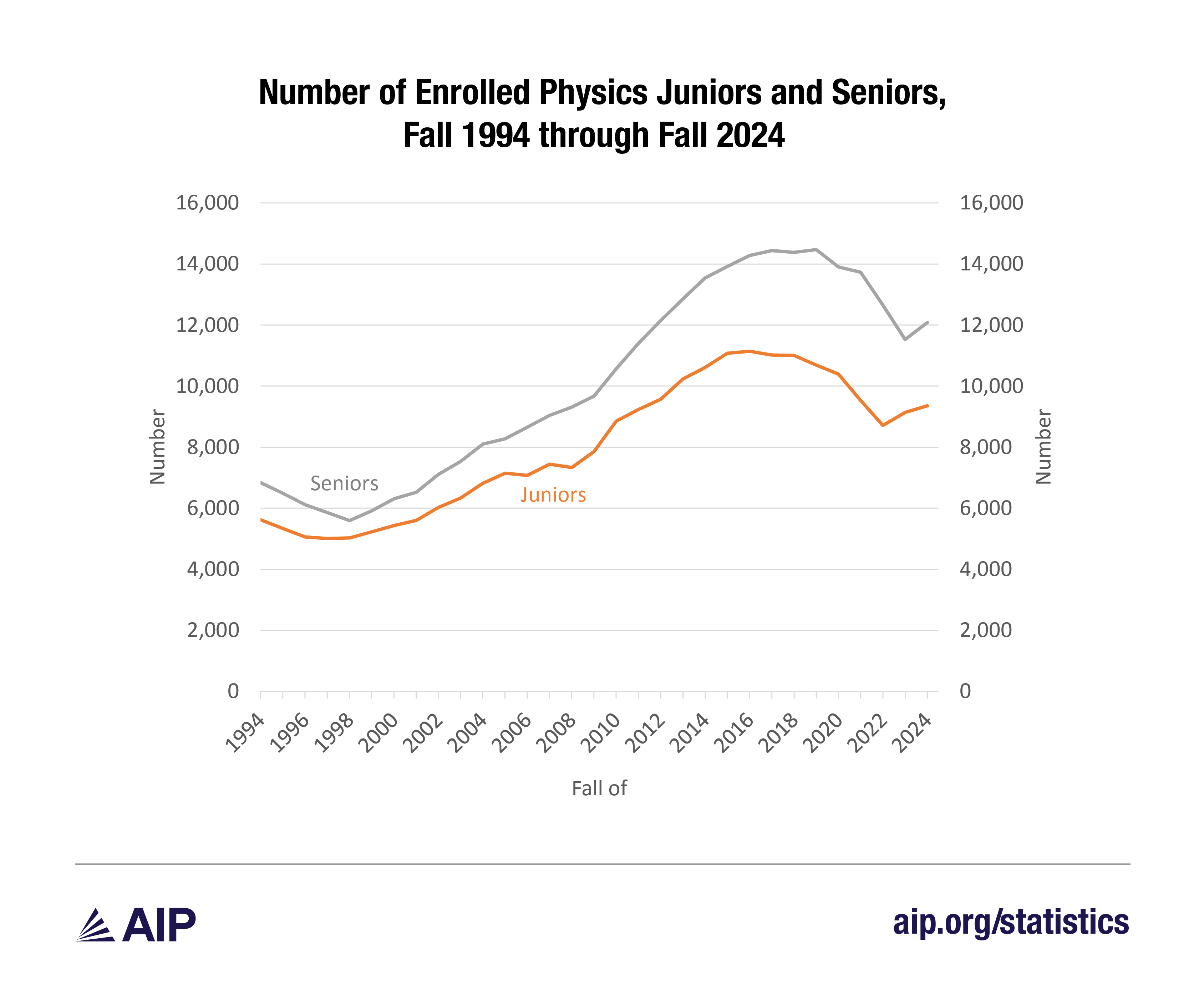
- The recent steady and sharp declines in the number of physics bachelors awarded follow the declines in the number of students at the junior and senior level in prior years.
- The decline seen in Figure 1 can be expected to end, at least temporarily, as the number of physics students at the junior and senior levels have shown recent increases.
Figure 5

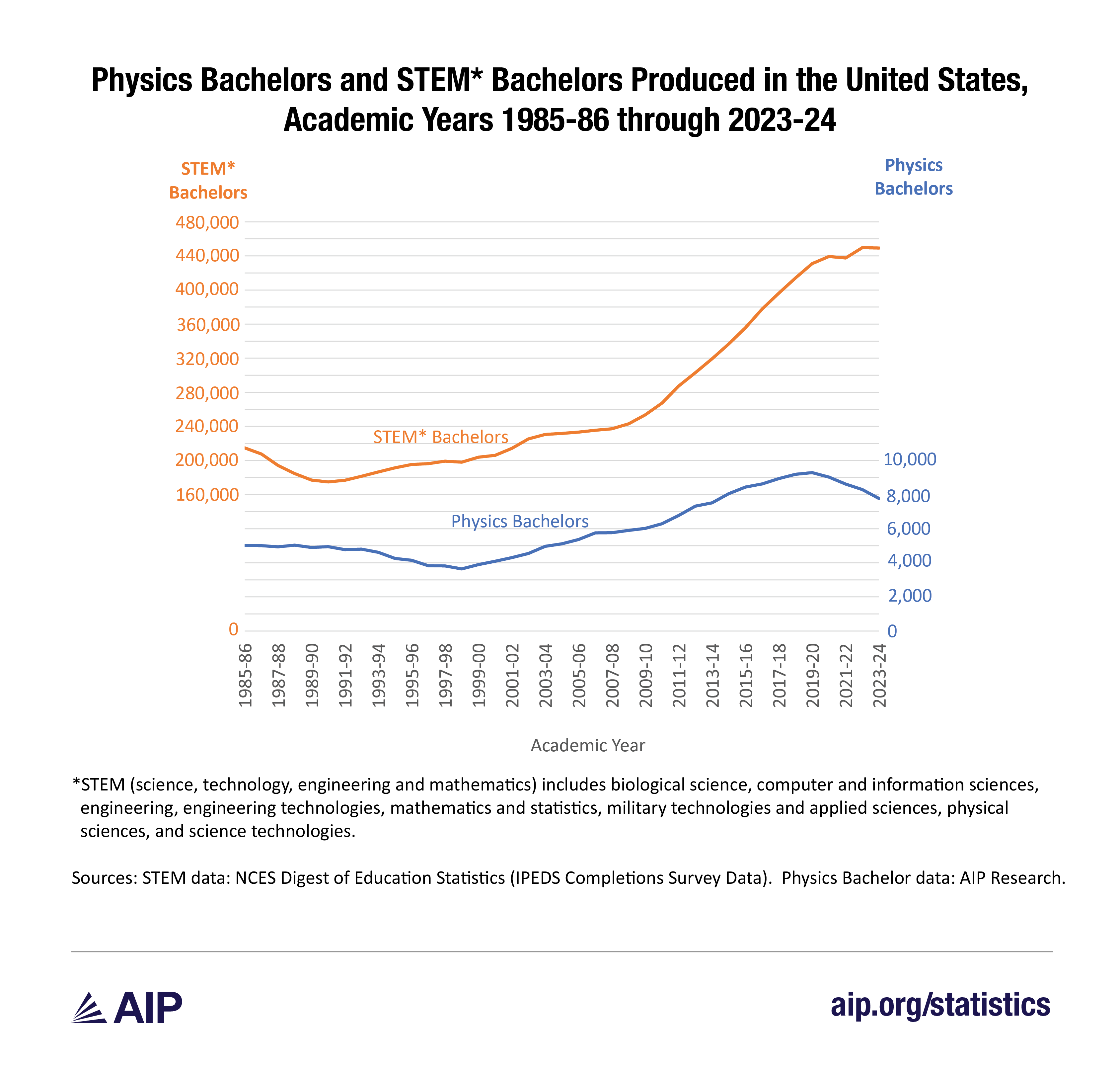
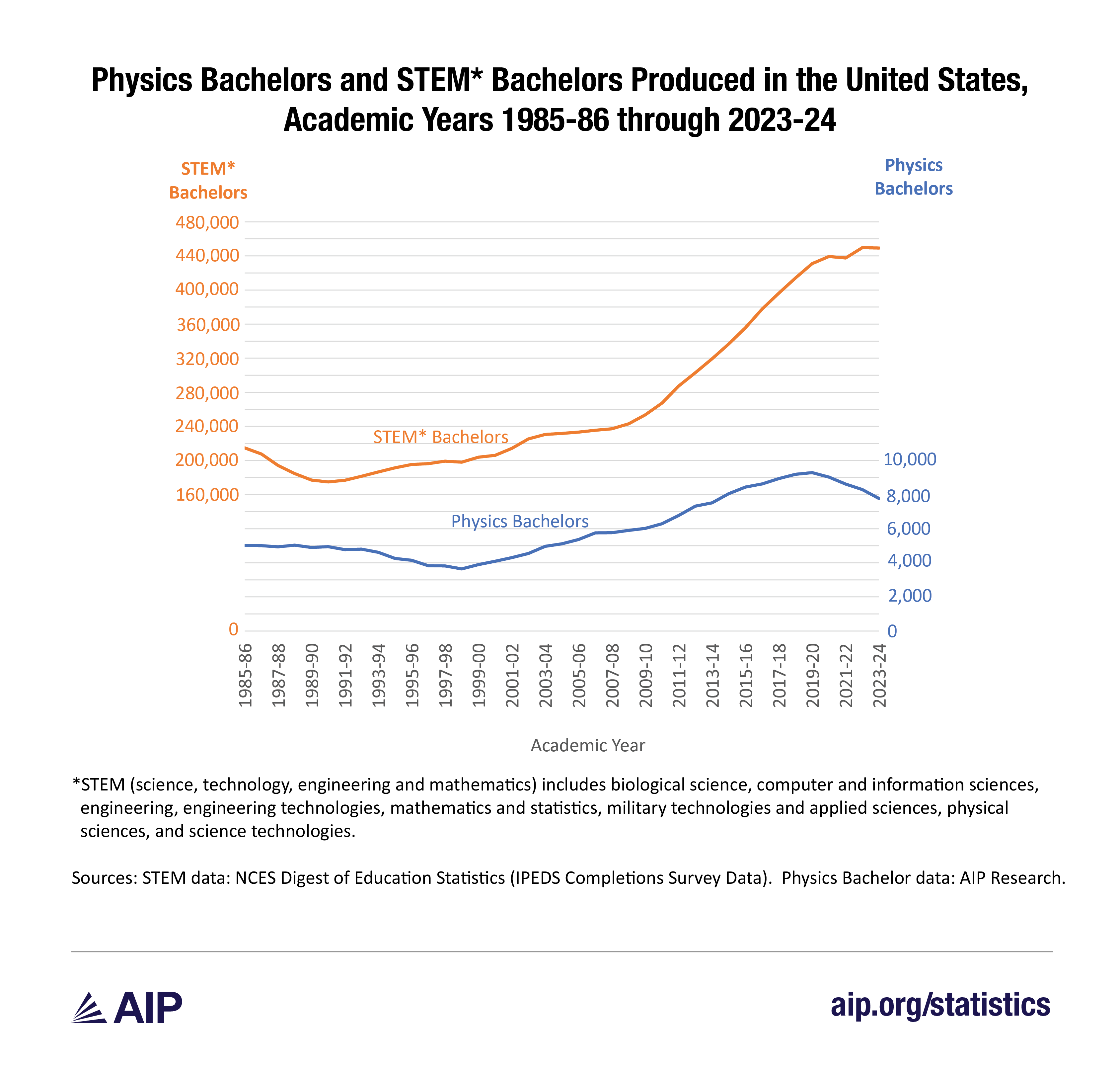
- Physics bachelor’s degrees awarded in the 2023-24 academic year comprised just under 2% of all STEM degrees awarded in the US.
- The overall number of STEM degrees awarded has not experienced the same decline as recently seen for physics bachelors.
Figure 6

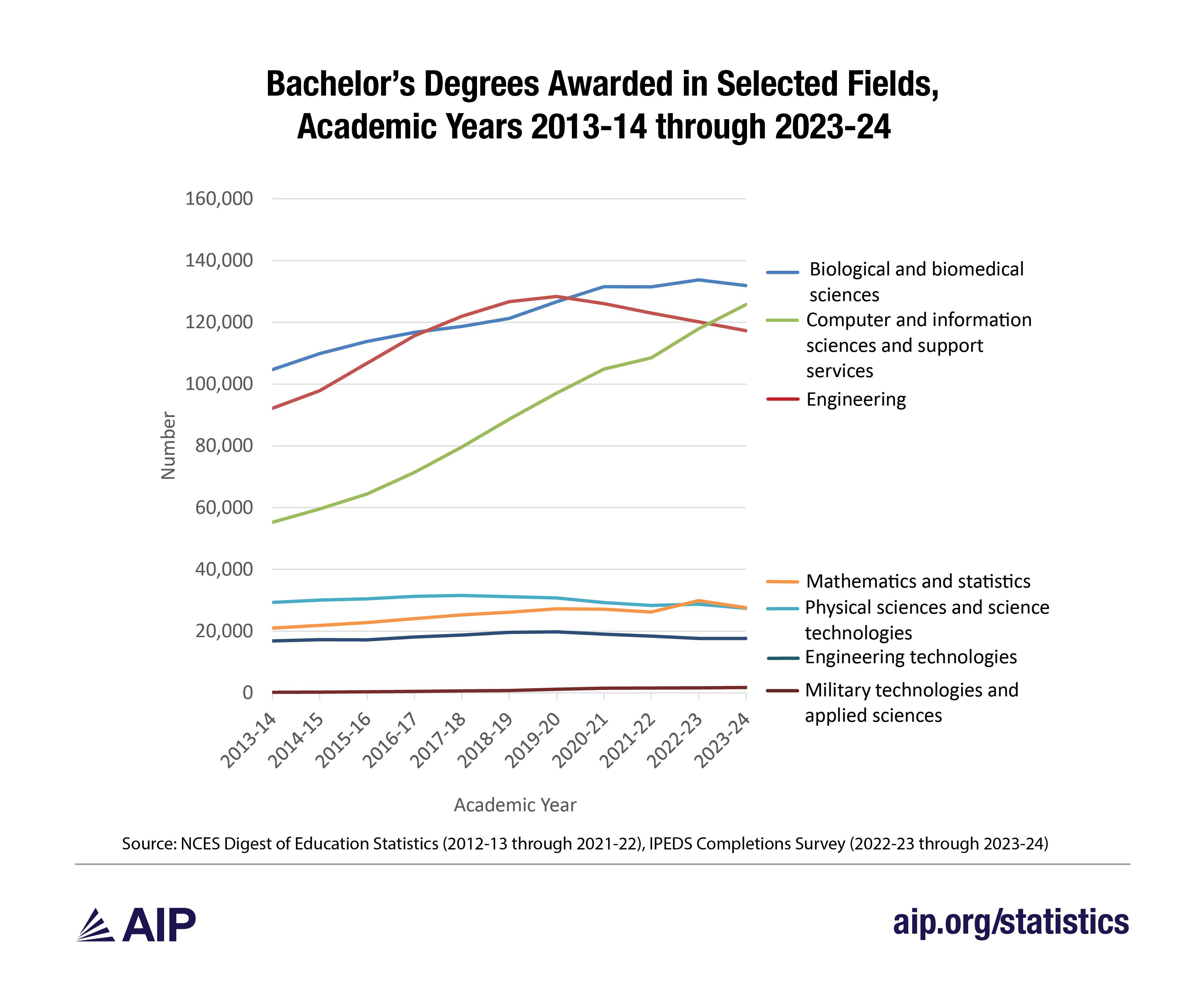
- The steady increase in overall STEM bachelor’s degrees is primarily a result of a rapid increase in the number of computer and information sciences bachelors awarded, and to a lesser extent, increases in biological and biomedical bachelor’s degrees awarded.
- Similar to physics, the number of engineering bachelor’s degrees awarded has also been declining recently.
Appendix
A1

A2

A3

Survey Methodology
Each fall, AIP Research conducts its Survey of Enrollments and Degrees. The survey is sent to all degree-granting physics and astronomy departments in the United States, Puerto Rico, and the Virgin Islands. Departments are asked to provide information concerning the number of students they currently have enrolled and the number of degrees they conferred in the previous academic year as well as contact information for their recent degree recipients. We define the academic year as being from September to August.
In the 2023-24 academic year, 723 departments offered bachelor’s degrees in physics. We received responses from 88% of these departments. For non-responding departments, we estimated their enrollment and degree data and included them in the totals reported.
Data from this survey are also used to produce the “Roster of Physics Departments,” which provides a department-level enrollment and degree snapshot. A copy of the roster can be found at: https://www.aip.org/statistics/roster-of-physics-departments-with-enrollment-and-degree-data-2024 .
We thank the many physics department chairpersons, faculty, and staff who made this publication possible by contributing their departmental data.
Trends in Physics Bachelor’s Degrees: Decline and Signs of Stabilization
By Patrick J. Mulvey and Starr Nicholson
Published: April 2026
A product of AIP Research of the American Institute of Physics
1 Physics Ellipse, College Park, MD 20740
555 12th Street NW, Suite 250, Washington, DC 20004
stats@aip.org |301.209.3070|aip.org/statistics