Federal Funding and Visa Uncertainty Shape Fall 2026 Graduate Admissions in Physics and Astronomy


Recent changes in federal research funding and student visa policies continue to create uncertainty for physics and astronomy graduate programs across the United States. Although these developments affect many aspects of departmental operations—including faculty hiring, staffing, research funding, and graduate student support—the recruitment and enrollment of first-year graduate students may provide one of the earliest indicators of their impact. Departments are also reporting increased uncertainty in admissions planning and their ability to support graduate students because of changes in federal research funding and the student visa process.
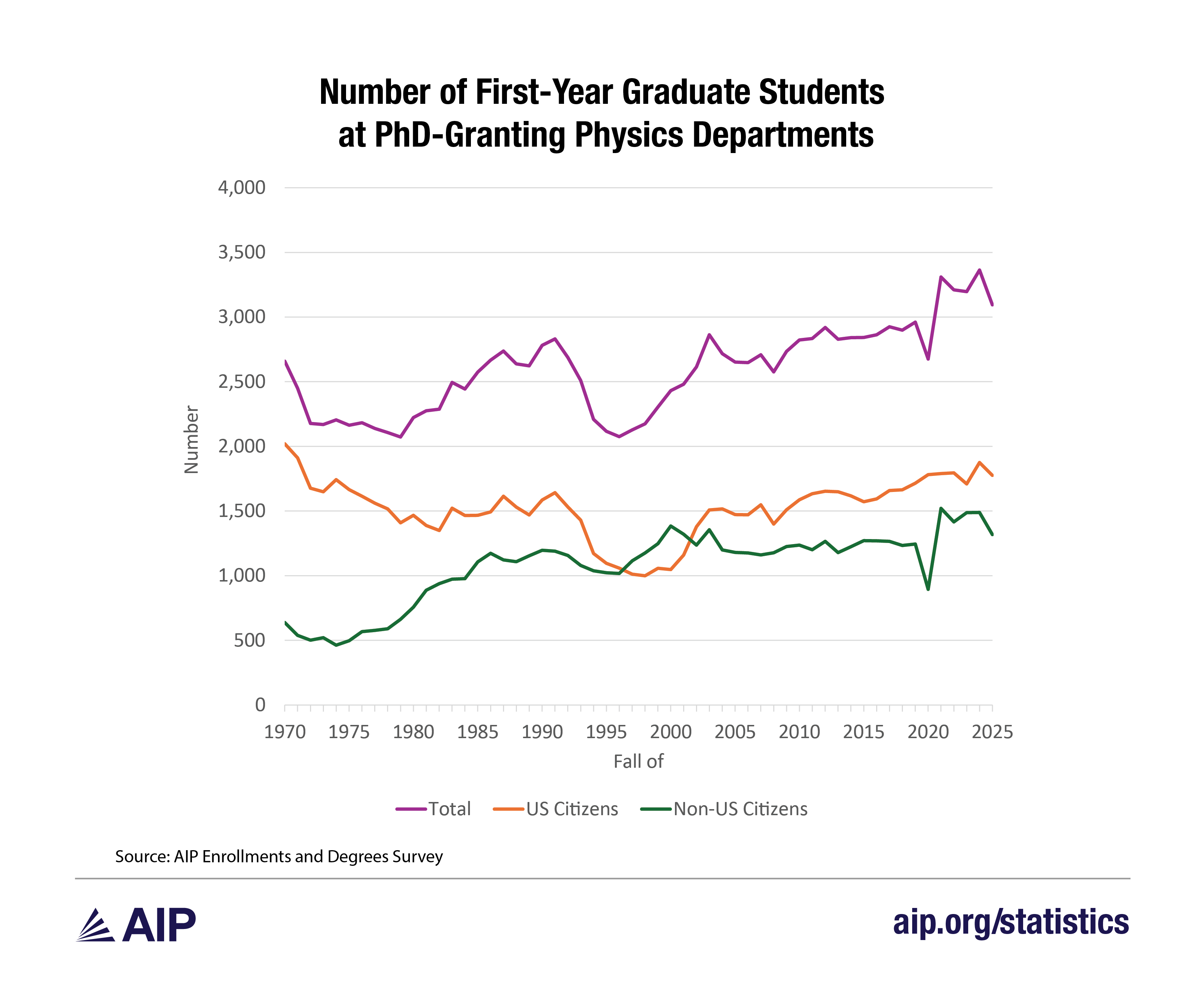
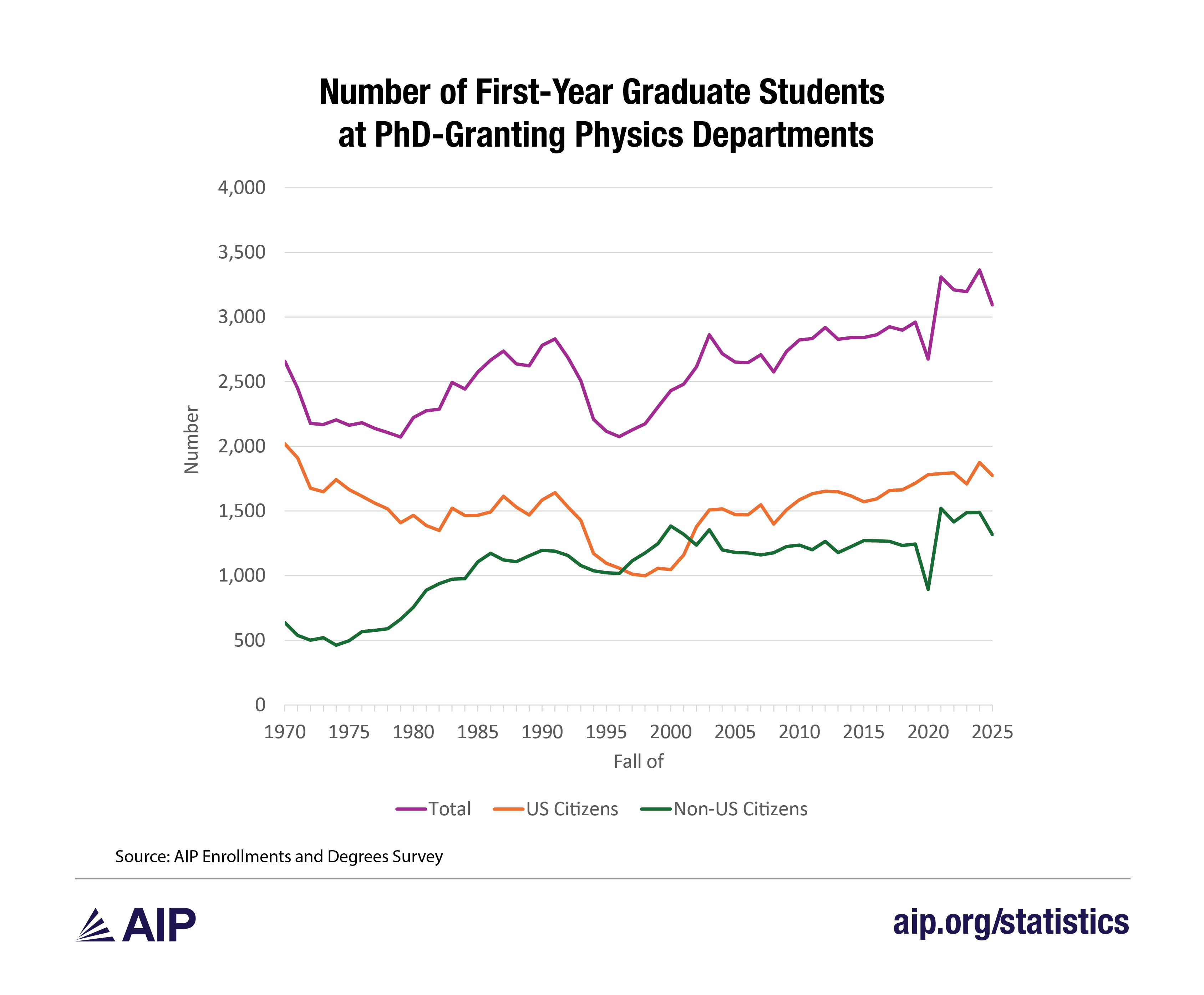
Data from AIP’s Enrollments and Degrees Survey (Figure 1) show that total first-year graduate student enrollments at PhD-granting departments declined by 8% (270 students) in fall 2025, with domestic student enrollments decreasing by 5% (99 students) and international student enrollments declining by 11% (171 students). These declines are in line with what we projected based on preliminary data collected in the fall. Excluding the temporary enrollment disruptions associated with the COVID-19 pandemic in the fall of 2020, these declines are historically significant: the decline of 270 total first-year graduate students is the largest year-over-year decline since the fall of 1994, while the decline of 171 international students is the largest since the fall of 2004.
Figure 1

When department chairs were surveyed in spring 2025, many indicated that it was too early to fully assess the impact of these developments on fall 2025 enrollments. At that time, admissions decisions for the incoming class had largely been made before uncertainty surrounding federal research funding and changes to student visa policies had intensified.
Graduate Admissions and Enrollment Experiences for Fall 2026
Results from the spring AIP 2026 Pulse Survey indicate that challenges facing physics and astronomy graduate programs have intensified since the previous admissions cycle, with international student recruitment emerging as a particular area of concern. Departments reported substantial declines in international applications and admissions offers, while domestic recruitment patterns remained comparatively stable. The combination of fewer international applicants, fewer admission offers, and lower-than-expected yield among international students suggests that many programs are likely to enroll even smaller international graduate cohorts in fall 2026 than they enrolled in 2025.
Looking ahead, departments generally are not anticipating restoring previous levels of international recruitment in the 2027 cycle, and a notable share remain uncertain about future admissions plans altogether. Collectively, these findings suggest that current funding and immigration-related uncertainties are likely reshaping graduate admissions strategies and the future talent pipeline for physics and astronomy, and likely all physical science disciplines, in the U.S.
The data in figures 2 through 5 came from 81 departments; there may be some variance in these trends by departmental or institutional characteristics but the subgroups are not large enough to be able to report meaningful differences.
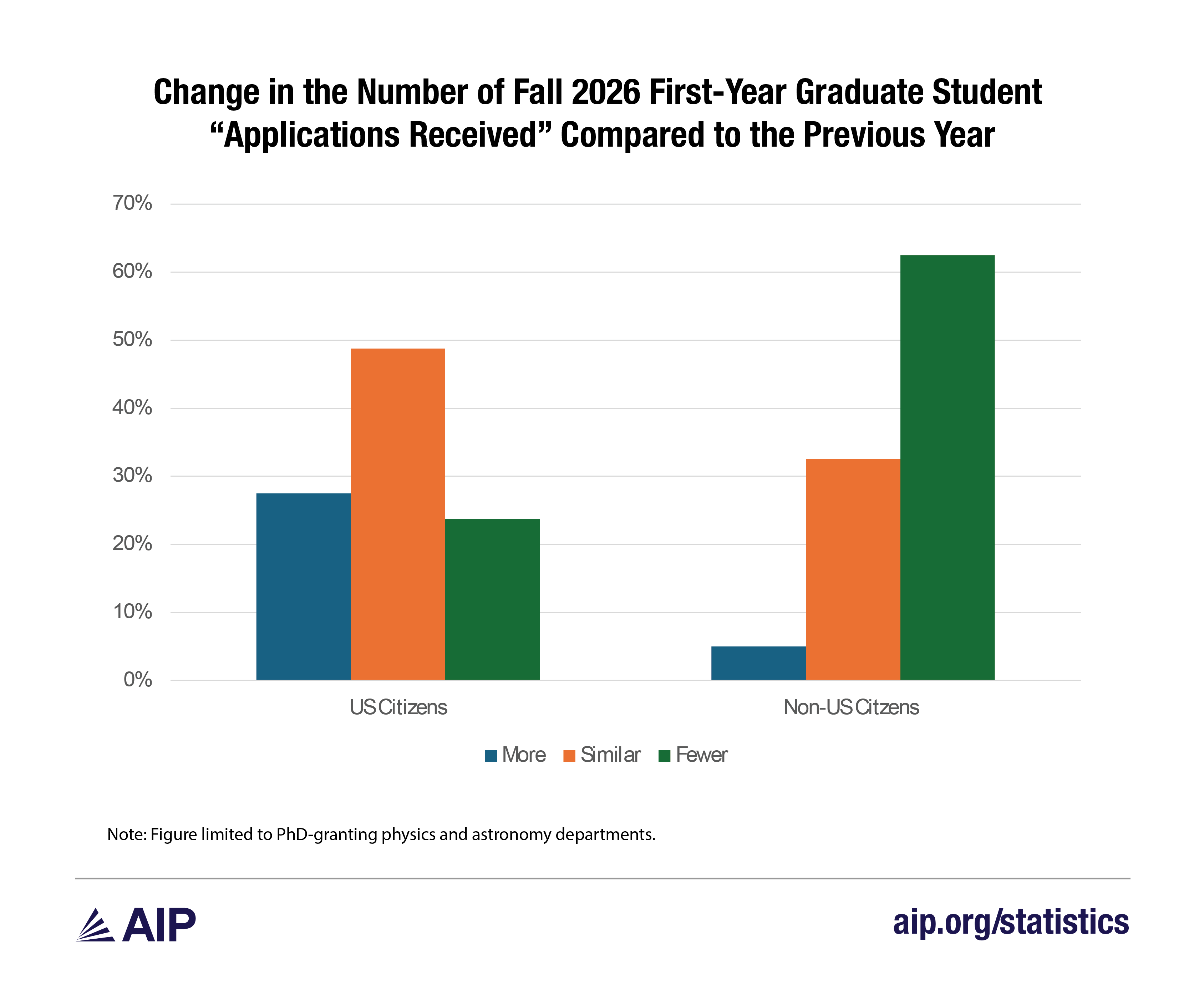
Figure 2

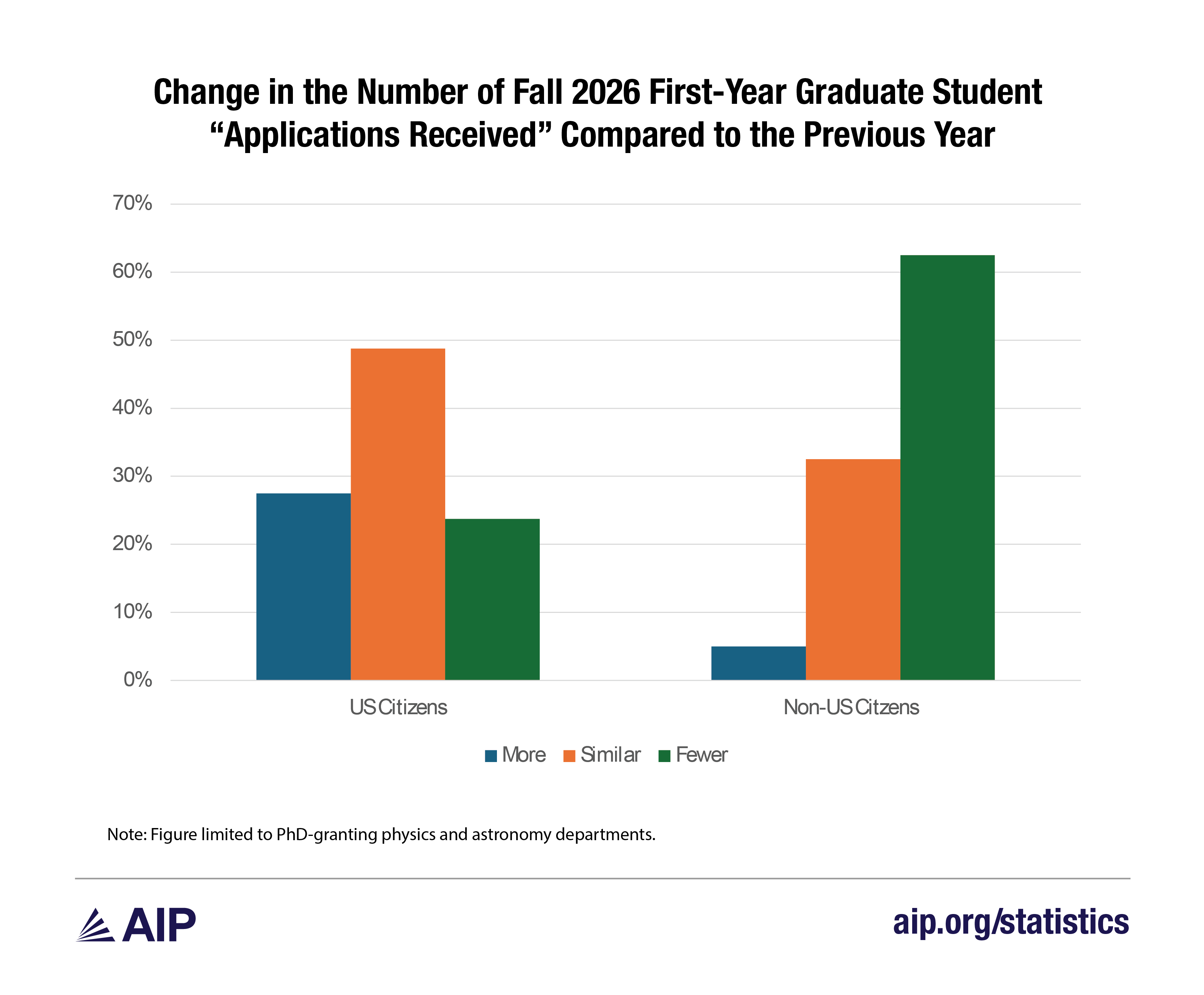
• More than 60% of PhD-granting physics and astronomy programs reported receiving fewer applications from international students for fall 2026 than for fall 2025.
• Changes in applications from U.S. students were more balanced. About half of departments reported little change in the number of applications received, while roughly equal proportions reported increases and decreases.
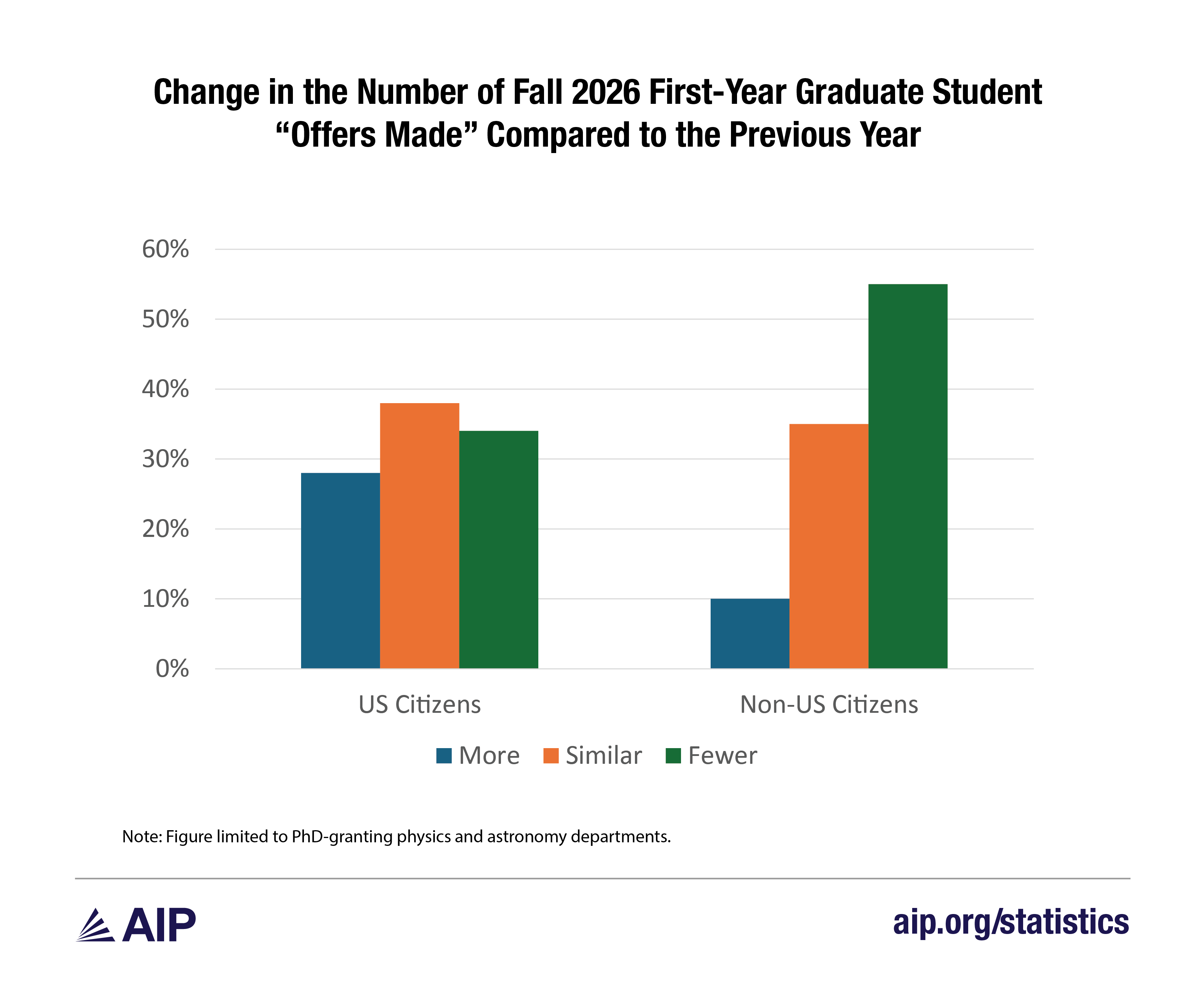
Figure 3

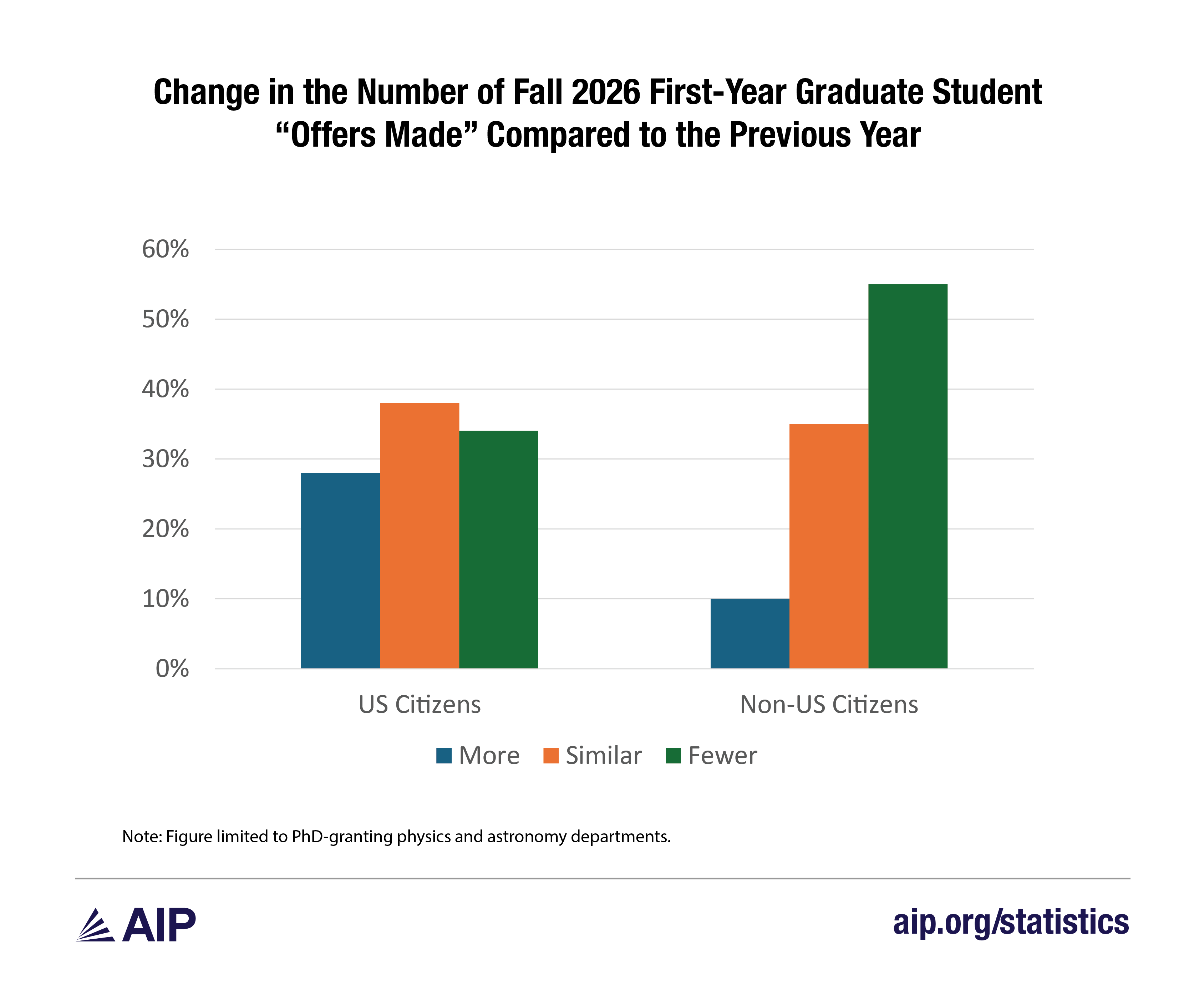
- More than half (55%) of PhD-granting physics and astronomy programs reported making fewer admission offers to international students for fall 2026 than they did for fall 2025.
- Forty-one percent of physics and astronomy graduate departments reported both receiving fewer applications from and making fewer admission offers to international students for fall 2026 than they did the previous year, suggesting that international student enrollments are likely to decline substantially in fall 2026.
- Changes in the number of admissions offers made to U.S. students for fall 2026 were fairly evenly distributed. Similar proportions of departments reported making more offers, about the same number of offers, and fewer offers than in the previous year.
Figure 4

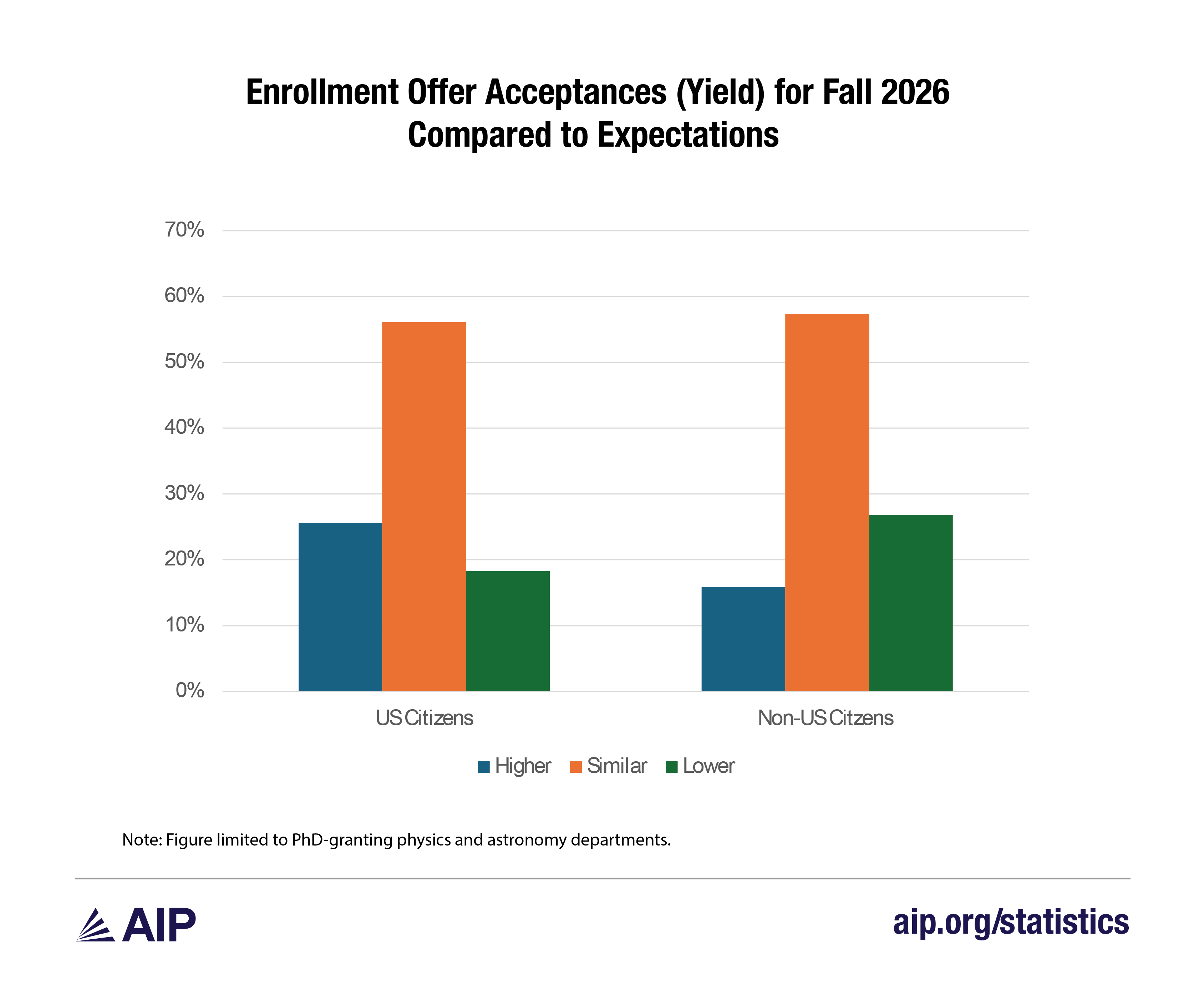
• More than half of departments reported that the number of accepted admissions offers (yield) for both U.S. and international students in fall 2025 was about what they had expected.
• About one-quarter of departments reported a higher-than-expected yield among U.S. students. In contrast, a similar proportion reported a lower-than-expected yield among international students.
Figure 5

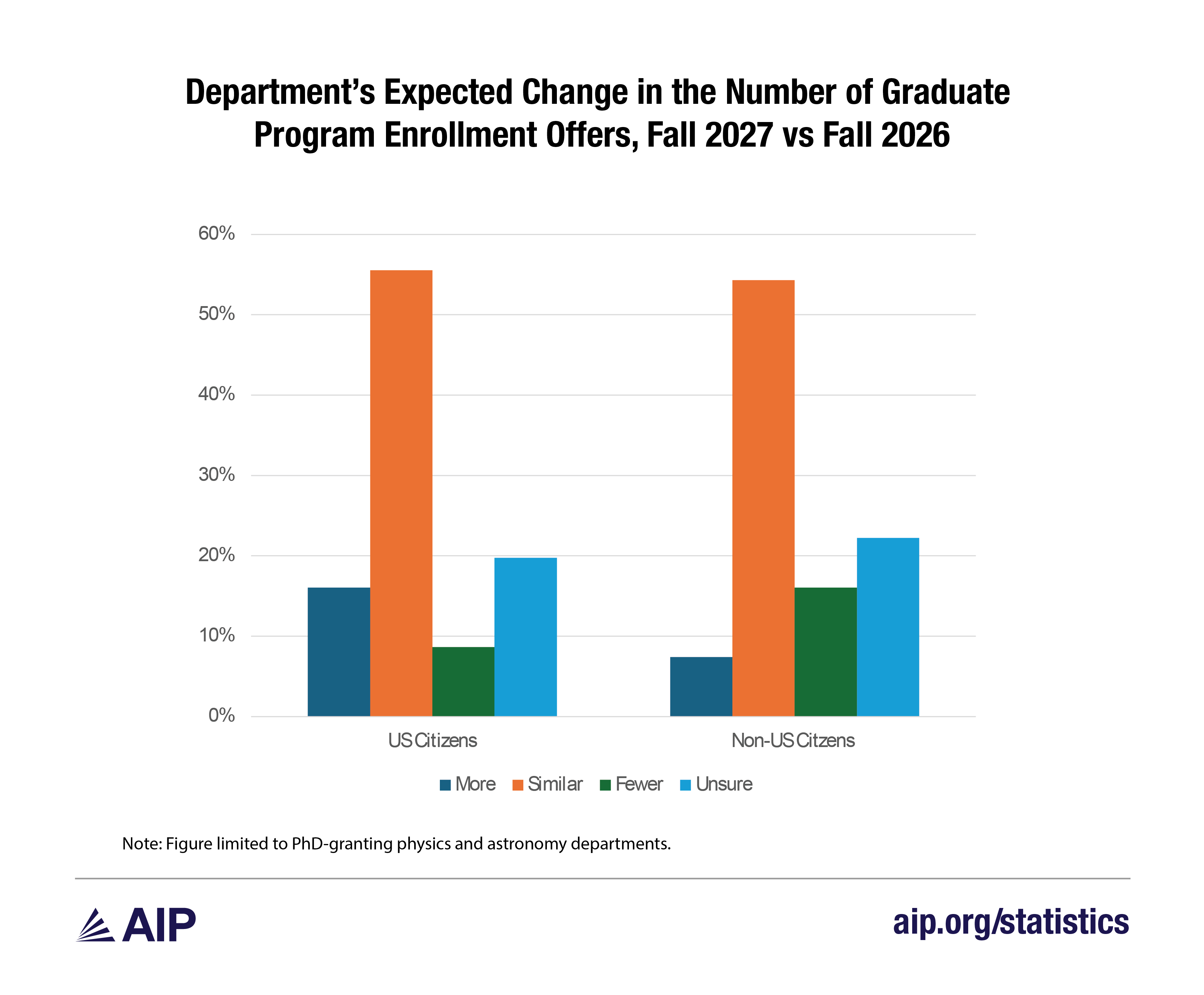
- About one-fifth of departments reported uncertainty about the number of admission offers they would make to both US and non-US applicants for their fall 2027 enrollment cycle.
- Most departments indicated that they planned to make about the same number of admissions offers to both U.S. and international students for fall 2027 as they did for fall 2026. For international students, this would continue the reduced level of offers reported for fall 2026. In addition, 16% of departments expected to make fewer admission offers to international students in 2027.
Department Chairs Speak
We also gave respondents the opportunity to provide additional comments on trends affecting Fall 2026 graduate enrollment, anticipated challenges for the Fall 2027 enrollment cycle, and the extent to which their institutions were providing adequate information about changes in visa and immigration policy.
Several themes from the 2025 survey recur in the 2026 responses, though respondents appear to describe less immediate shock and more sustained adaptation to ongoing structural uncertainty. Compared to last year, departments more frequently described concrete operational adjustments, including smaller cohorts, reduced offer numbers, tighter TA allocations, and re-calibrated expectations for international recruitment. At the same time, concerns about the long-term attractiveness of the United States as a destination for scientific training appear more pronounced, with multiple respondents describing international students becoming less inclined to study in the US.
Dominant themes included:
• Continued concern about visa and immigration restrictions.
• Concern about declining international applicant pools.
• Ongoing contraction in graduate program size because of funding constraints.
• Increasing institutionalization of enrollment limits and austerity measures.
• Concerns about the long-term attractiveness of the United States for global scientific talent.
• Persistent uncertainty around federal research funding.
• Wide variation in the adequacy and clarity of institutional communication.
Visa and Immigration Policy and Concerns about International Competitiveness
Many department chairs described visa uncertainty and immigration policy as among the most significant factors affecting graduate recruitment and enrollment. Respondents frequently connected these issues to declining international application numbers, growing hesitation among prospective students considering study in the United States, and broader concerns about the long-term attractiveness of the US scientific enterprise for global talent.
- “We are concerned that the international students seem less inclined to consider US institutions for their graduate studies.”
- “The number of international applicants has dropped by over 30%. Meanwhile, we are also decreasing the number of offers because of research budget constraints.”
Enrollment Limits and Hiring Constraints Are Becoming Institutionalized
Compared to the previous survey cycle, several respondents described normalization of structural enrollment limits and constrained hiring practices.
- “The physics department teaching budget faces a 10% cut next year. This effectively means reducing the size of the graduate program by 10%, therefore the number new first-year students needs to be below the anticipated number of departures, so fewer admission offers.”
- “Our university has declared a financial crisis and will be making substantial budget cuts. It may impact TAs well as faculty and staff.”
Institutions Challenged to Communicate Clearly About Immigration and Visa Uncertainty
Responses about institutional communication revealed variation in how universities are supporting faculty and students navigating immigration and visa policy uncertainty. With that noted, 73% of PhD departments said their university was providing students and faculty with adequate information and several respondents praised proactive communication from universities international offices, while others described significant uncertainty and difficulty obtaining actionable guidance.
- “I can’t advise my own graduate students about what to do. I have students who need to travel back to their home countries to renew their visas, with no guarantee of even getting an appointment.It’s not the University’s fault. The rules and policies and changing.”
- “Our international services department is very knowledgeable, easy to work with, and proactive about communicating changes.”
- “Our International Students and Scholars Office maintains a detailed website and sends out regular communications about these topics.”
- “There is a sense that we are not really supposed to tell international applicants about these problems ahead of time. I’m sure the info is somewhere on our university’s website, so it’s not being hidden, per se, but we don’t advertise it widely. The applicants tend to hear about this after they’ve applied or after we’ve tried to admit them to our program.”
Methodology
We sent a brief questionnaire to department chairs of the 290 departments that offer a graduate degree in physics or astronomy in the US. The first request was sent April 29, with a follow-up request on May 7. We received responses from 102 department chairs. The data in the bar charts are based on the responses of 81 PhD-granting physics and astronomy departments. The survey instrument was developed with input from the AAPT Graduate Education Committee.
Federal Funding and Visa Uncertainty Shape Fall 2026 Graduate
Admissions in Physics and Astronomy
By Patrick J. Mulvey, Trevor Owens and Starr Nicholson
Published: June 2026
A product of AIP Research of the American Institute of Physics 1 Physics Ellipse, College Park, MD 20740
555 12th Street NW, Suite 250, Washington, DC 20004
stats@aip.org |301.209.3070|aip.org/statistics